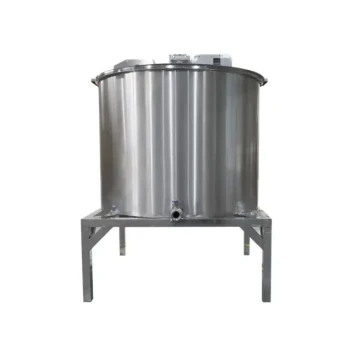
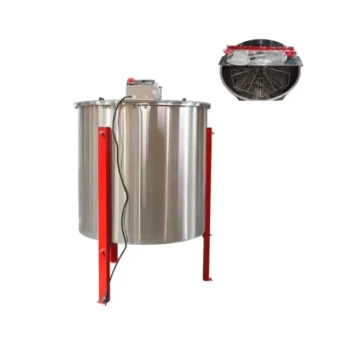
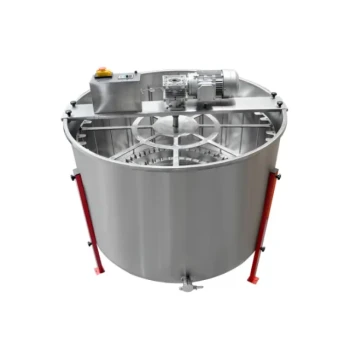
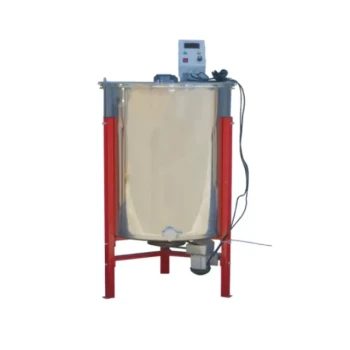
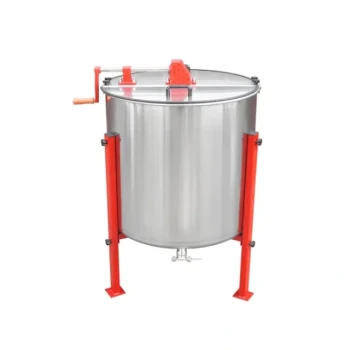
Industrial honey extractors serve as the critical mechanical bridge between the raw harvest and the final commercial product. Their primary function is to utilize centrifugal force to evacuate liquid honey from the honeycomb cells without destroying the wax structure, enabling high-speed production and ensuring the integrity of the hive's resources.
The core value of an industrial extractor lies in preservation, not just separation. By extracting honey without crushing the comb, the machinery allows beekeepers to return intact frames to the hive, sparing bees the energy-intensive task of rebuilding wax and directly increasing future honey yields.
The Mechanics of Non-Destructive Separation
Centrifugal Extraction
At the heart of the workflow, these machines spin frames at high speeds. This generates centrifugal force that pulls the honey out of the cells and throws it against the extractor's inner walls.
This process separates the liquid from the solid structure purely through physics. It eliminates the need for heat or crushing, which are methods used in traditional or smaller-scale processing that often degrade quality.
Structural Preservation
The most significant technical advantage is the protection of the honeycomb structure. Unlike pressing methods that destroy the comb to release the honey, centrifugal extractors leave the wax matrix intact.
This preservation is essential for industrial scalability. It allows for a continuous cycle where frames are harvested, spun, and immediately prepared for return to the apiary.
Impact on Colony Efficiency and Yield
The Biological Energy Economy
The function of the extractor extends beyond the factory floor and back into the hive. Bees consume a significant amount of honey and energy to secrete wax and build combs.
By returning reusable combs to the hive, the extractor removes the biological burden of reconstruction. This allows the colony to redirect its energy from construction to foraging, markedly improving the annual honey yield per hive.
Continuous Productivity
In a commercial setting, speed is currency. Industrial extractors facilitate a rapid turnover during the harvest season.
Because the bees do not need to rebuild the nest, they can immediately begin refilling the empty cells. This ensures continuous productivity during the peak nectar flow.
Quality Control and Hygiene
Enhancing Purity
Industrial extraction significantly improves the purity of the final product. Because the comb is not crushed, there is substantially less wax debris and foreign matter mixed into the raw honey.
This results in a cleaner initial output. It reduces the load on downstream filtration systems and ensures the honey meets the visual and physical standards required for premium markets.
Sanitary Processing Standards
Modern industrial extractors are constructed with food-grade materials. This prevents physical and chemical contamination during the violent spinning process.
By maintaining a closed and clean environment, these systems ensure the honey remains free from external impurities, meeting stringent food safety regulations such as AGMARK.
Understanding the Operational Trade-offs
The Prerequisite of Uncapping
While extractors are efficient, they are not standalone solutions for the entire harvest. They can only extract honey from beneath the wax cappings.
Therefore, an effective workflow requires a preceding "uncapping" stage. If the wax seals are not properly removed before the frames enter the extractor, the centrifugal force will be ineffective, leading to yield loss.
Maintenance and Cross-Contamination
The complexity of industrial machinery introduces a strict requirement for hygiene maintenance. The interior surfaces must be meticulously cleaned to prevent yeast fermentation or crystallization residue.
Failure to maintain the equipment can lead to cross-contamination between batches. This compromises the shelf stability that the machine is designed to protect.
Making the Right Choice for Your Goal
When integrating an industrial extractor into your workflow, consider your specific production targets:
- If your primary focus is Maximizing Yield: Prioritize extractors with variable speed controls to ensure total evacuation of the comb, allowing bees to focus entirely on nectar collection rather than wax secretion.
- If your primary focus is Product Quality: Select equipment featuring food-grade stainless steel components and integrated filtration to minimize wax debris and ensure export-grade purity.
- If your primary focus is Operational Speed: Ensure your workflow includes a synchronized uncapping station, as the extractor relies entirely on open cells to function efficiently.
The industrial honey extractor is not merely a harvesting tool; it is a resource management system that balances mechanical efficiency with biological conservation.
Summary Table:
| Key Function | Technical Impact | Commercial Benefit |
|---|---|---|
| Centrifugal Separation | Evacuates honey without crushing cells | Preserves wax frames for immediate reuse |
| Structural Preservation | Keeps the wax matrix intact | Reduces bee energy expenditure on rebuilding |
| Purity Control | Minimizes wax debris and sediment | Decreases downstream filtration time and costs |
| High-Speed Throughput | Facilitates rapid frame turnover | Maximizes production during peak nectar flows |
| Sanitary Processing | Uses food-grade stainless steel | Ensures compliance with global food safety standards |
Scale Your Honey Production with HONESTBEE
Maximize your apiary's efficiency and product purity with HONESTBEE. As a premier partner for commercial apiaries and distributors, we provide a full spectrum of professional beekeeping tools, specialized honey-filling machinery, and essential consumables designed for industrial-scale success.
Whether you are looking to upgrade your extraction workflow or source high-quality hive-making hardware, our comprehensive wholesale offerings ensure you stay ahead in the competitive honey market. Let us help you turn biological conservation into mechanical efficiency.
Contact Our Experts Today to Optimize Your Workflow
References
- Abdulahi Mahamed, Aden Omer. Traditional Management Practices and Production Potential of Beekeeping in Erer Zone of Somali Regional State, Ethiopia. DOI: 10.51227/ojafr.2022.22
This article is also based on technical information from HonestBee Knowledge Base .
Related Products
- HONESTBEE 72 Frame Industrial Electric Honey Extractor for Beekeeping
- Commercial Electric 12 Frame Honey Extractor Spinner Motorized Honey Extractor
- 32 Frame Commercial Electric Honey Extractor for Beekeeping and Honey Production
- Commercial 48-Frame Stainless Steel Honey Extractor
- 8-Frame Electric Self-Reversing Honey Extractor Spinner for Commercial Honey Extraction Equipment
People Also Ask
- What is the importance of balancing honeycomb frames within a honey extractor? Ensure Stability and Protect Machinery
- How is honey separated from the frames after they are uncapped? Efficient Extraction Methods for High Yields
- What are the main benefits of using a honey extractor? Maximize Yields and Protect Your Honeycomb
- What are the recommended methods for removing honey from the honeycomb? Top Extraction Techniques for Maximum Efficiency
- How do manual honey extractors compare to electric honey extractors? Choosing the Right Tool for Your Apiary Growth