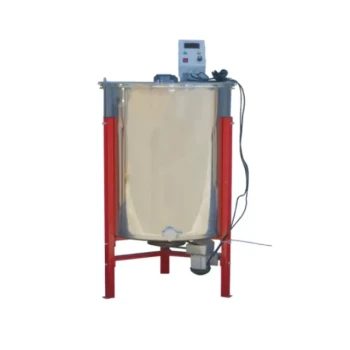
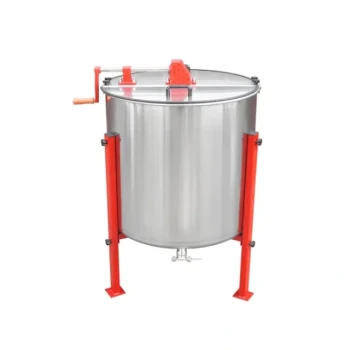
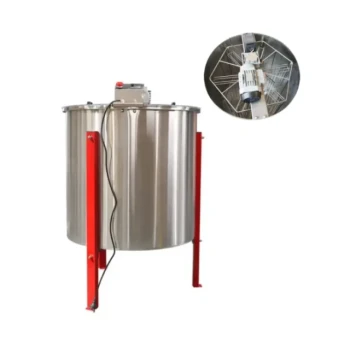
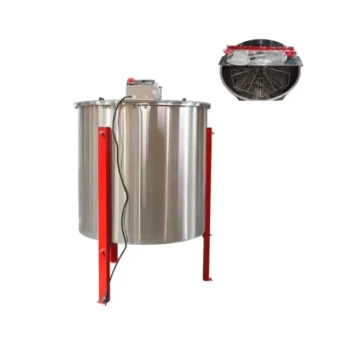
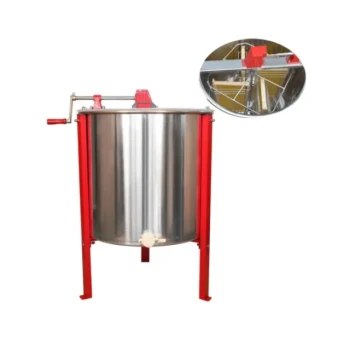
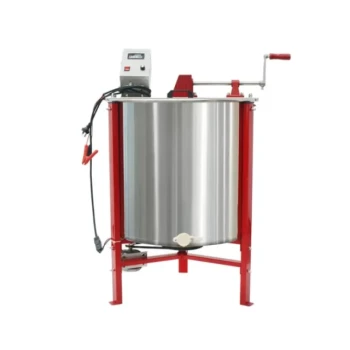
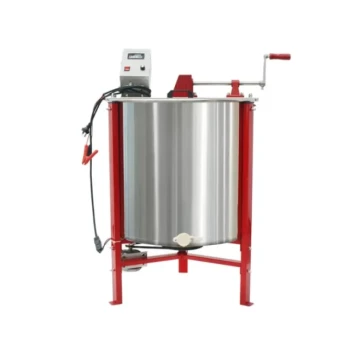
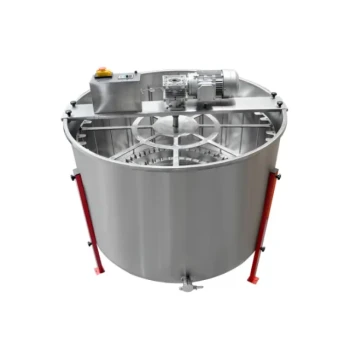
The primary function of a centrifugal honey extractor is to mechanically separate liquid honey from the honeycomb cells using high-speed rotational force. Its fundamental benefit in commercial production is the preservation of the wax comb's structural integrity, allowing the frames to be immediately returned to the hive for reuse.
By extracting honey without destroying the wax foundation, this equipment eliminates the need for bees to rebuild combs, thereby shifting the colony's energy expenditure from wax secretion to nectar foraging and significantly increasing overall honey yield.
The Mechanics of Non-Destructive Extraction
Utilizing Centrifugal Force
The extractor operates by spinning honeycomb frames at high speeds. This generates centrifugal force that pulls the liquid honey out of the cells and throws it against the inner wall of the tank.
Preserving Structural Integrity
Unlike "crush and strain" methods, this process leaves the delicate wax walls of the honeycomb intact. The empty frames emerge from the machine structurally sound and ready for immediate redeployment in the apiary.
Optimizing Colony Energy Resources
Reducing the Biological Burden
Producing beeswax is biologically expensive for a bee colony; it requires a massive consumption of honey and energy to secrete new wax. By reusing intact combs, you significantly reduce this resource burden on the worker bees.
Accelerating the Production Cycle
When bees are given empty, drawn-out combs, they can bypass the construction phase entirely. They immediately begin filling the cells with fresh nectar, which improves the turnover rate of the production cycle.
Commercial Efficiency and Throughput
Maximizing Peak Harvest Windows
Nectar flows are often short and intense. Large-capacity centrifugal extractors allow producers to harvest honey quickly and return empty combs to the hive while the nectar flow is still active.
High-Volume Recovery
Modern industrial extractors are designed to achieve high recovery rates. They remove the vast majority of the honey from the frame, ensuring that yield is maximized without sacrificing the comb needed for the next cycle.
Understanding the Trade-offs
Operational Precision Required
While the goal is to preserve the comb, improper operation can lead to "blowouts." If the rotational speed is too high for the temperature or weight of the honey, the centrifugal force can rip the wax foundation apart.
Equipment Maintenance and Cost
Centrifugal extractors are complex mechanical devices compared to gravity-based systems. They require significant capital investment, regular maintenance, and rigorous cleaning protocols to ensure the machinery functions correctly and remains sanitary.
Making the Right Choice for Your Production Goals
- If your primary focus is maximizing annual yield: Prioritize extraction methods that guarantee comb preservation, as reused combs directly correlate to higher honey production per hive.
- If your primary focus is operational speed: Invest in large-capacity radial extractors that can process high volumes during peak nectar flows to minimize the downtime of your supers.
The true value of a centrifugal extractor lies not just in harvesting the current crop, but in investing in the efficiency of the next one.
Summary Table:
| Feature | Centrifugal Extraction Benefit | Impact on Commercial Production |
|---|---|---|
| Comb Integrity | Preserves wax structure without damage | Allows immediate frame reuse & reduces bee labor |
| Energy Efficiency | Bees save energy on wax secretion | Colony focuses entirely on nectar foraging |
| Harvest Speed | High-speed rotational processing | Maximizes throughput during peak nectar flows |
| Yield Recovery | Deep extraction from cell walls | Ensures maximum honey volume per harvest cycle |
| Sustainability | Multi-cycle use of wax foundations | Reduces biological costs and speeds up production |
Elevate Your Apiary Efficiency with HONESTBEE
At HONESTBEE, we specialize in empowering commercial apiaries and distributors with the industry's most reliable honey-harvesting solutions. Whether you are scaling up your production or looking to optimize your yield, our comprehensive range of beekeeping machinery, including high-capacity centrifugal honey extractors, honey-filling machines, and specialized hive-making equipment, is designed to maximize your ROI.
Don't let your bees waste energy on rebuilding combs—let our technology preserve your assets and boost your harvest. From essential consumables to industrial-grade hardware, we provide the tools you need to succeed in the global honey market.
Ready to upgrade your commercial operations? Contact our expert team today for wholesale inquiries and custom equipment solutions!
References
- Ahmet Emir Şahin, Süleyman Alparslan. An Online Survey to Determine Breeding Activities and Main Issues in Turkey s Beekeeping Enterprises. DOI: 10.51458/bstd.2021.20
This article is also based on technical information from HonestBee Knowledge Base .
Related Products
- electric honey extractor honey centrifuge 3 frame honey extractor stainless steel honey frame extractor
- Manual Hand Crank 4 Frame Honey Extractor Centrifuge for Beekeeping
- Professional 4 Frame Self Reversing Electric Honey Extractor for Beekeeping
- Electric 4 Frame Tangential Honey Extractor
- 24 Frame Honey Extractor Commercial Radial Honey Frame Extraction Machine
People Also Ask
- What are the characteristics of electric honey extractors? Boost Your Apiary Efficiency with Automated Technology
- What are the disadvantages of using an electric honey extractor? Weighing Cost, Power, and Comb Safety
- What are the advantages of an electric honey extractor? Boost Efficiency and Scale Your Honey Production
- What are the technical advantages of electric honey extractors? Maximize Yield and Protect Your Bee Colony
- How does an electric honey extractor affect the quality of honey? Preserve Flavor & Purity with Precision Extraction