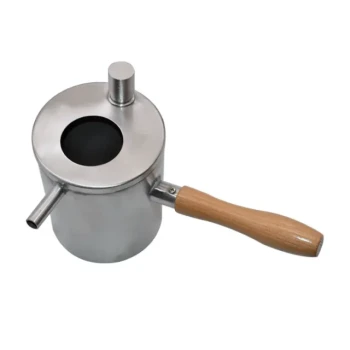
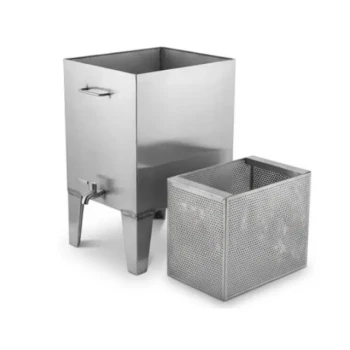
The primary function of double-walled water-heated stainless steel containers is to provide a controlled, indirect heat source that preserves beeswax quality during the melting and settling stages. This equipment facilitates deep primary purification by maintaining a stable temperature for up to 48 hours, allowing impurities and heavy metals to separate from the wax through physical density differences without the risk of burning or chemical contamination.
Core Takeaway: High-quality beeswax casting requires managing two specific variables: heat stability and chemical inertness. Double-walled stainless steel systems isolate the wax from direct flame to prevent scorching while maintaining the long-term thermal consistency necessary for gravity-based purification.
The Mechanism of Indirect Heating
Preventing Thermal Deterioration
The most critical advantage of this system is indirect heating. Direct contact with open flames or high-temperature points causes beeswax to deteriorate rapidly.
Ensuring Uniform Temperature
By utilizing a water jacket (double-wall construction), the container ensures heat is applied evenly across the surface area. This eliminates "hot spots" that damage the wax structure and compromise the final product.
Deep Purification Through Sedimentation
Utilizing Density Differences
The equipment is designed not just for melting, but for settling. It maintains the wax in a liquid state, allowing impurities containing heavy metals to sink to the bottom due to their higher physical density compared to the wax.
The Necessity of Time
This purification process is not instantaneous. The container is capable of maintaining a constant temperature for a sedimentation period of up to 48 hours, which is essential for achieving deep primary purification.
The Critical Role of Material Selection
Chemical Stability
Stainless steel is the industry standard because of its excellent chemical stability. It does not react chemically with beeswax during the liquefaction process, ensuring the material's integrity remains intact.
Preventing Contamination
Using stainless steel prevents metal ion contamination, which can alter the wax. This interaction-free environment preserves the natural color and purity of the beeswax, meeting the durability requirements for industrial production.
Understanding the Operational Trade-offs
Production Speed vs. Purity
The primary trade-off in this method is time. While faster melting methods exist, the requirement for a 48-hour sedimentation period significantly slows down throughput in exchange for higher purity.
Thermal Inertia
Indirect water heating is inherently slower than direct flame application. Operators must account for longer ramp-up times to reach the melting point compared to direct-heat vessels.
Optimizing Your Beeswax Processing Setup
To achieve the best results in beeswax casting, align your equipment choice with your specific quality metrics.
- If your primary focus is Purity and Safety: Prioritize the 48-hour sedimentation cycle to ensure heavy metals and dense impurities are fully removed before casting.
- If your primary focus is Visual Quality: Rely on stainless steel construction to prevent chemical reactions that dull the wax's natural color.
By controlling temperature stability and material interaction, you transform a simple melting task into a sophisticated purification process.
Summary Table:
| Feature | Function in Beeswax Casting | Benefit to Final Product |
|---|---|---|
| Double-Wall Jacket | Provides indirect water heating | Prevents scorching and preserves wax quality |
| Stainless Steel | Ensures chemical inertness | Eliminates metal ion contamination and discoloration |
| 48-Hour Settling | Enables gravity-based sedimentation | Removes heavy metals and dense impurities |
| Uniform Heat | Eliminates thermal "hot spots" | Maintains structural integrity of the wax |
Elevate Your Beeswax Production with HONESTBEE
At HONESTBEE, we specialize in empowering commercial apiaries and distributors with professional-grade beekeeping machinery. Whether you are scaling up with specialized hive-making tools or looking for advanced honey-filling and wax-processing equipment, our comprehensive wholesale portfolio is designed for industrial durability and precision.
Why partner with HONESTBEE?
- Full Spectrum Supply: From heavy machinery to essential industry consumables.
- Quality Assurance: Equipment engineered to preserve the purity of your honey and wax.
- Expert Support: Solutions tailored to the needs of large-scale honey-themed enterprises.
Ready to optimize your processing facility? Contact our expert team today to discover how our wholesale solutions can drive your business growth.
References
- Ivana Tlak Gajger, Bruno Čalopek. Variations in lead, cadmium, arsenic, and mercury concentrations during honeybee wax processing using casting technology. DOI: 10.1515/aiht-2016-67-2780
This article is also based on technical information from HonestBee Knowledge Base .
Related Products
- Professional Stainless Steel Honey Filtering Machine with Water Bath Heating for Beekeeping
- Professional Stainless Steel Wax Melter for Beekeeping and Crafts
- Stainless Steel Heated Honey Tank Warming Heating Tank
- Stainless Steel Perforated Inner Canister for Bee Smoker
- 10L Stainless Steel Honey Wax Press Extractor for Wax Cappings
People Also Ask
- Why is filtering honey an important step in honey processing? Ensure Purity, Clarity & Marketability
- Is it necessary to filter honey after extraction? A Guide to Straining vs. Raw Honey
- What is the best way to filter honey? A Guide to Quality, Clarity, and Raw Preservation
- Why do people filter honey? For Clarity, Stability, and Consumer Appeal
- What are the benefits of using honey filters? Achieve Purity, Efficiency, and Market Appeal