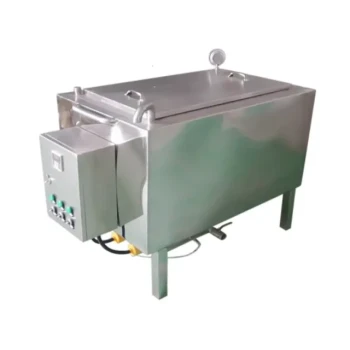
The primary function of industrial laboratory ovens in the pre-treatment of raw honey is to perform the controlled liquefaction of crystallized materials, such as rapeseed honey. These ovens provide a stable thermal environment to transition the honey from a solid or semi-solid state into a fully liquid form without compromising its chemical integrity.
Industrial laboratory ovens bridge the gap between raw material handling and product quality by ensuring complete de-crystallization at low temperatures. This specific thermal processing method is designed to maximize workability while minimizing the degradation of heat-sensitive bioactive components.
The Mechanics of Controlled Liquefaction
Achieving the Liquid State
Raw materials for honey enrichment, particularly varieties like rapeseed honey, often arrive in a crystallized state.
Before any enrichment or blending can occur, this crystalline structure must be broken down. The industrial oven serves as the mechanism to return the honey to a consistent liquid phase.
The Importance of Stability
Unlike rapid heating methods, laboratory ovens offer precise temperature regulation.
This stability prevents "hot spots" that could unevenly heat the batch. It ensures that the entire mass of honey reaches the target temperature uniformly.
Operational Parameters for Quality Preservation
The Temperature Threshold
According to established protocols, the optimal processing temperature within the oven is 45 degrees Celsius.
This specific temperature is high enough to melt glucose crystals effectively but remains low enough to prevent thermal damage. It represents the "sweet spot" between efficiency and preservation.
Duration of Treatment
To ensure the liquefaction is thorough, the process requires a sustained duration of 48 hours.
This extended timeframe allows heat to penetrate the core of the raw material containers gently. It ensures that no crystals remain, which could re-seed crystallization in the final enriched product.
Understanding Critical Process Constraints
The Risk of Thermal Degradation
The most critical constraint in this process is the heat sensitivity of honey's natural components.
Honey contains bioactive compounds and enzymes that are easily destroyed by high temperatures. Using an oven allows operators to strictly limit the heat exposure to the safe 45-degree ceiling.
Balancing Time and Temperature
Attempting to speed up this process by increasing temperature is a common error that compromises quality.
Higher temperatures may liquefy the honey faster, but they risk denaturing the enzymes that give the honey its nutritional value. The 48-hour cycle at a lower temperature is a deliberate trade-off, prioritizing biological integrity over processing speed.
Making the Right Choice for Your Goal
When configuring your pre-treatment protocols for honey enrichment, your equipment settings must align with your quality standards.
- If your primary focus is preserving bioactivity: strictly maintain the temperature cap at 45 degrees Celsius to protect heat-sensitive enzymes.
- If your primary focus is process consistency: ensure the full 48-hour duration is utilized to achieve complete, uniform de-crystallization across the entire batch.
By adhering to these precise thermal parameters, you ensure the raw material is physically prepared for enrichment without sacrificing its biological value.
Summary Table:
| Parameter | Specification | Purpose |
|---|---|---|
| Optimal Temperature | 45°C (113°F) | Melts glucose crystals without heat damage |
| Processing Duration | 48 Hours | Ensures uniform liquefaction throughout the batch |
| Primary Function | Controlled Liquefaction | Converts crystallized honey to a workable liquid state |
| Critical Constraint | Thermal Sensitivity | Prevents denaturation of bioactive enzymes |
| Target Material | Crystallized Raw Honey | Ideal for rapeseed and other high-glucose varieties |
Elevate Your Honey Processing with HONESTBEE
At HONESTBEE, we specialize in empowering commercial apiaries and distributors with high-performance beekeeping tools and industrial machinery. Whether you are looking for precise honey-filling machines, specialized hive-making equipment, or essential industry consumables, our comprehensive wholesale portfolio is designed to maximize your production efficiency.
Ready to scale your honey enrichment process while maintaining superior biological quality? Contact us today to discover how our tailored equipment solutions can streamline your operations and deliver the value your customers expect.
References
- Dorota Grabek-Lejko, Małgorzata Dżugan. Antiviral and Antibacterial Effect of Honey Enriched with Rubus spp. as a Functional Food with Enhanced Antioxidant Properties. DOI: 10.3390/molecules27154859
This article is also based on technical information from HonestBee Knowledge Base .
Related Products
People Also Ask
- Why might a commercial beekeeper prefer an electric beeswax melter? Maximize Profit with Speed & Scale
- What safety precautions should be taken when melting beeswax? A Guide to Flammable Wax Handling
- What types of beeswax melters are available for different scales of beekeeping? Solar vs. Electric Melters Compared
- What are the three popular methods for melting beeswax? Safely Process Your Wax with Ease
- How do you melt beeswax without making a mess? Master Safe & Clean Techniques