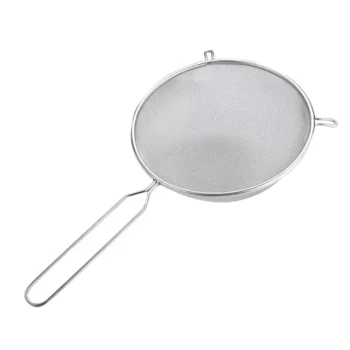
The primary purpose of a double sieve stainless-steel strainer is to ensure the purity of harvested honey. By mechanically filtering the raw liquid, this tool effectively removes wax particles, physical debris, and other impurities accumulated during extraction. This process is the critical final step that transforms raw harvest into a clean product suitable for bottling and consumption.
Raw honey naturally contains unwanted solids like wax and hive debris. A double sieve strainer serves as the essential purification stage, separating these impurities to produce a professional-grade liquid ready for the bottle.
The Mechanics of Purification
To understand the value of this tool, one must look at how it bridges the gap between extraction and the final consumer product.
Eliminating Physical Contaminants
Harvested honey is rarely clean immediately after extraction. It typically contains bits of wax capping, propolis, and other hive debris.
The strainer acts as a physical barrier. It captures these solids, preventing them from entering the final storage container.
Ensuring Consistency for Bottling
Unfiltered honey can be difficult to bottle and unappealing to consumers due to floating particulate matter.
By running the honey through the sieve, you create a uniform liquid. This ensures that the honey is suitable for bottling, resulting in a clear, consistent product.
Why Design and Material Matter
The specific construction of a "double sieve stainless-steel" unit offers distinct advantages over makeshift filtration methods.
The Double Filtration Advantage
While a single screen might miss smaller particles or clog quickly with large debris, a double sieve system provides two layers of defense.
This ensures a more thorough removal of impurities, trapping larger chunks in the top layer and finer particulates in the second.
The Value of Stainless Steel
Honey production requires equipment that meets food safety standards.
Stainless steel is the material of choice because it is durable, easy to clean, and non-reactive. It maintains the hygienic integrity of the honey during the filtration process.
Understanding the Trade-offs
While essential for producing clear honey, using a gravity-fed double sieve introduces specific operational constraints.
Processing Speed
Filtration is a bottleneck in the workflow. Because the honey must pass through two layers of mesh, the flow rate can be slow, especially with thicker honey.
Maintenance and Clogging
The very purpose of the strainer—catching debris—leads to its primary drawback. Wax particles will accumulate quickly on the screens.
To maintain flow, the operator must monitor the sieve and clear the debris regularly, or the process will grind to a halt.
Making the Right Choice for Your Goal
The decision to use this specific tool depends on your desired end product.
- If your primary focus is Professional Presentation: This tool is mandatory to ensure your honey is free of visible wax and debris, making it visually appealing for sale.
- If your primary focus is Processing Efficiency: Be aware that this method relies on gravity and may require time; ensure your honey is warm enough to flow through the mesh without compromising quality.
The double sieve stainless-steel strainer is the industry standard for converting raw hive extraction into pure, bottling-ready honey.
Summary Table:
| Feature | Single Sieve | Double Sieve (Stainless Steel) |
|---|---|---|
| Filtration Efficiency | Basic removal of large debris | Two-stage thorough purification |
| Hygienic Standard | Varies by material | High-grade, non-reactive food safety |
| Particle Removal | May miss finer particulates | Captures both large wax and fine debris |
| Durability | Lower | High (corrosion and rust resistant) |
| Product Clarity | Moderate | Superior professional presentation |
Elevate Your Honey Quality with HONESTBEE
At HONESTBEE, we specialize in supporting commercial apiaries and distributors with the high-performance tools required for professional honey production. Our comprehensive wholesale catalog includes premium stainless-steel double sieve strainers, honey-filling machines, and specialized hive-making equipment designed to optimize your workflow.
Whether you are scaling up your extraction line or sourcing essential industry consumables, our portfolio offers the durability and precision your business demands. Contact us today to discuss how our wholesale equipment and global logistics can enhance your apiary’s efficiency and product value.
Related Products
- Stainless Steel Double Layer Honey Strainer Sieve Filters
- Stainless Steel Honey Storage and Settling Tank with Double Strainer
- Stainless Steel Triangle Support Honey Strainer and Filters
- Professional Stainless Steel Honey Filter with Support Handle
- Precision Stainless Steel Frame Cleaner for Hive Grooves and Corners
People Also Ask
- What are some typical mesh size combinations found in double sieve honey strainers? Expert Guide to Honey Filtration
- How is a double-layer honey filter used for monitoring Varroa mite infestation? Achieve Precise Pest Control Data
- How do double-layer honey filters and white blotting paper function together in Varroa mite detection? Expert Guide
- What is the function of honey sieves, strainers, and filters in processing? Master the 3 Stages of Honey Purity
- What mesh sizes are commonly used in double sieve honey strainers? Achieve Clean, Raw Honey Efficiently