A stereomicroscope equipped with a digital camera functions as the foundational hardware for acquiring high-fidelity data in honey bee wing analysis. Its primary role is to deliver the necessary magnification and pixel density to capture wing vein junctions with absolute clarity, creating the input standard required for advanced computational analysis.
The system acts as a bridge between biological samples and computational precision. By delivering high-resolution images—specifically around 1000 pixels per centimeter—it enables deep learning models to perform detection at a sub-pixel level.
The Mechanics of High-Fidelity Capture
Achieving Necessary Magnification
The primary function of the stereomicroscope is to provide the optical power needed to visualize microscopic biological structures.
It focuses specifically on rendering wing vein junctions distinct from the surrounding membrane. Without this optical clarity, feature points become ambiguous and difficult to measure.
Establishing Pixel Density
The digital camera integration allows for the precise quantification of image resolution, transforming an analog view into digital data.
To ensure the data is usable for rigorous analysis, the system typically targets a specific density, such as 1000 pixels per centimeter. This density ensures that the digital representation retains the fidelity of the physical sample.
Bridging Optics and Artificial Intelligence
The Input for Deep Learning
Modern analysis increasingly relies on automated deep learning models to process biological data.
These models are dependent on high-quality input to function correctly. The stereomicroscope provides the raw material that allows these algorithms to "see" the wing structure effectively.
Enabling Sub-Pixel Detection
Standard resolution is often insufficient for the precise measurements required in scientific research.
High-quality acquisition allows algorithms to perform sub-pixel level feature point detection. This capability significantly increases the accuracy of morphometric analysis beyond what is visible to the naked eye.
Critical Considerations and Trade-offs
The "Garbage In, Garbage Out" Principle
The potential of any downstream deep learning model is strictly limited by the quality of the optical input.
If the stereomicroscope fails to achieve the required pixel density or focus, the algorithm will fail to detect feature points. Software cannot fully compensate for poor hardware acquisition.
Balancing Resolution and Storage
While higher resolution is generally better for analysis, it requires appropriate hardware handling.
Acquiring images at 1000 pixels per centimeter creates large files that require sufficient storage and processing power. However, this is a necessary trade-off to enable sub-pixel accuracy.
Maximizing Data Quality for Analysis
To ensure your imaging setup supports your analytical goals, consider the following:
- If your primary focus is Visual Inspection: Ensure the stereomicroscope provides sufficient optical magnification to clearly distinguish vein junctions.
- If your primary focus is Deep Learning Automation: Prioritize the digital camera's ability to output at least 1000 pixels per centimeter to enable sub-pixel feature detection.
Ultimately, the stereomicroscope is not just a viewing tool, but the critical first step in a data pipeline that converts physical biology into precise digital metrics.
Summary Table:
| Feature | Role in Honey Bee Wing Analysis | Impact on Data Quality |
|---|---|---|
| Optical Magnification | Visualizes microscopic wing vein junctions | Eliminates ambiguity in feature points |
| Digital Integration | Converts analog views into digital data | Enables quantifiable 1000 px/cm resolution |
| High Pixel Density | Provides high-fidelity input for AI models | Supports accurate sub-pixel detection |
| Hardware Precision | Acts as the foundation for the data pipeline | Prevents "Garbage In, Garbage Out" results |
Elevate Your Beekeeping Operations with HONESTBEE
Precision matters in every aspect of bee management, from laboratory analysis to large-scale commercial hive production. HONESTBEE is dedicated to supporting commercial apiaries and distributors with high-performance hardware designed for durability and accuracy.
Our extensive wholesale portfolio includes:
- Advanced Machinery: Hive-making and honey-filling machines for high-volume efficiency.
- Professional Equipment: A full spectrum of beekeeping tools and industrial consumables.
- Unique Cultural Merchandise: Honey-themed products to expand your market reach.
Whether you are scaling a commercial apiary or supplying the next generation of beekeepers, HONESTBEE provides the specialized tools you need to succeed.
Contact us today to explore our wholesale solutions!
References
- Pedro Rodrigues, M. Alice Pinto. DeepWings©: Automatic Wing Geometric Morphometrics Classification of Honey Bee (Apis mellifera) Subspecies Using Deep Learning for Detecting Landmarks. DOI: 10.3390/bdcc6030070
This article is also based on technical information from HonestBee Knowledge Base .
Related Products
- HONESTBEE Adjustable Voltage Wire Embedder with Digital Display
- Plastic Beekeeping Honey Bee Larvae Grafting Tools for Queen Rearing and Chinese Grafting
- Queen Bee Artificial Insemination Instrument Equipment for Instrumental Insemination
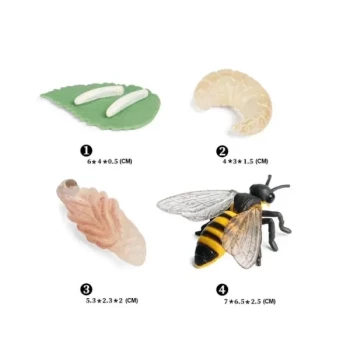
- Honey Bee Life Cycle Model 4 Stage Educational Set for Kids Learning
- HONESTBEE Anatomy Bee Model Detailed Anatomical Display for Education and Study
People Also Ask
- How can combs be further strengthened? Embed Wires for Durable, High-Yield Hives
- What is an embedder in beekeeping? Essential Tool for Strengthening Wax Foundation & Hive Frames
- Why replace honeybee populations during invasive predation? Maintain Apiary Stability & Maximize Honey Yields
- Why must honeybee colonies be selected based on specific breed standards for nutritional studies? Key to Data Integrity
- What are the consequences of disrupting the propolis envelope? Protect Your Beehive's Social Immunity