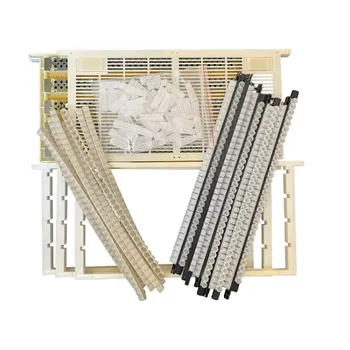
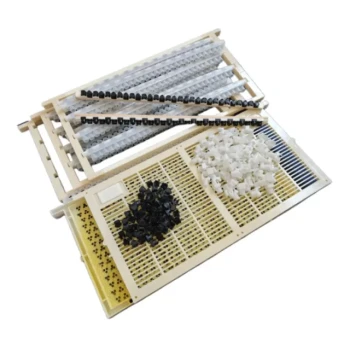
For commercial royal jelly harvesting, the standard cycle is a three-day production loop. A typical setup uses two plastic cell-cup strips carrying approximately 128 cups per colony, grafting tools for transferring one-day-old larvae, a strong nurse-bee colony, a suction or spatula extraction tool, precision scales, and immediate refrigerated or frozen storage. Larvae are grafted on Day 0, nurse bees feed them for approximately 72 hours, and the royal jelly is harvested on Day 3 before the larvae consume more of it or the cells are capped.
The efficient commercial model is standardized hardware plus a strict 72-hour schedule: graft one-day-old larvae into prepared cups, place the cell strips with well-conditioned nurse bees, harvest after three days, weigh the output, and cold-store it immediately.
The Standard Commercial Equipment Setup
Cell-cup strips and queen-rearing frames
Commercial operations use pre-molded plastic queen cell cups mounted on frame bars or plastic strips. The primary production configuration is two strips with a combined capacity of approximately 128 cups per colony.
This standardized format improves grafting speed, cup uniformity, colony-to-colony comparison, and replacement-part planning. Some operations use smaller frames carrying approximately 30 to 90 cups, depending on colony strength and production targets.
Grafting tools
A grafting needle, grafting tool, or fine forceps is required to transfer one-day-old larvae into the artificial cups. The larva must be moved carefully, without injury and with its orientation maintained.
For commercial throughput, the tool should be ergonomic, consistent, and easy to clean. A small variation in grafting quality can reduce acceptance and create uneven yields across a production batch.
Nurse-bee colony and hive configuration
The grafted cell strips are placed in a strong colony with abundant nurse bees. Positioning them near open brood helps expose the grafts to workers already conditioned to produce brood food.
Operations may use a queen-rearing or queenless finishing section, and some systems use queen excluders to separate the queen chamber from the cell-rearing area. The exact hive arrangement can vary, but the essential requirement is a well-populated, well-fed nurse-bee population.
Feeding and colony conditioning
A properly conditioned colony is central to efficient production. Commercial operators commonly use supplemental 1:1 sugar syrup feeding to support cell acceptance and royal jelly secretion when natural forage is insufficient.
Feeding does not replace colony management. The finisher colony must have enough nurse bees and resources for the number of cups installed; too many cups for the available bees can reduce acceptance and per-cell yield.
Extraction and measuring equipment
Harvesting equipment typically includes a small spatula, suction device, or targeted vacuum extractor for removing royal jelly from the cups after the larvae are removed. Fine straining may be used to remove wax fragments or larval skins.
A precision digital scale is important for weighing each batch. Standardized cup counts and accurate weighing allow operators to assess colony performance, compare production cycles, and identify underperforming colonies.
Cold-storage and handling equipment
Royal jelly should be transferred immediately into clean, sealed containers and placed under refrigeration or freezing. Its proteins and other biological components can deteriorate rapidly at room temperature.
For commercial distribution, the setup should include hygienic collection containers, dark or opaque storage vials where appropriate, cold-chain capacity, and packaging materials that prevent unnecessary heat and light exposure.
The Efficient Three-Day Harvesting Timeline
Day 0: Prepare and graft
On the first day, prepare the cell strips, verify the cups are clean and secure, and select healthy one-day-old larvae. Graft one larva into each cup using a fine grafting tool.
The strips are then installed in the prepared nurse-bee colony, normally near open brood and within the intended queen-rearing section. Record the colony, strip, cup count, and grafting time.
Days 1–2: Nurse-bee feeding and monitoring
During the next 48 hours, nurse bees accept the grafts and deposit royal jelly into the cups. The colony should be monitored without excessive disturbance.
Operators should confirm that the colony remains strong, adequately supplied, and capable of supporting the installed cup count. Any signs of poor acceptance, insufficient feeding, or abnormal colony condition should be recorded for later yield assessment.
Day 3: Harvest at approximately 72 hours
The standard commercial harvest point is approximately 72 hours after grafting. At this stage, the cups contain substantial royal jelly, while the larvae have not yet consumed excessive quantities or caused the cells to be capped.
Remove the larvae carefully, then extract the royal jelly using a suction device or spatula. The material can be fine-strained if necessary before weighing and storage.
Immediately after extraction: Weigh and chill
Weigh the collected royal jelly promptly with a precision digital scale. Recording both total batch weight and the number of accepted cups provides a useful measure of colony efficiency.
Place the product into cold storage immediately after collection. Delays at this stage can reduce quality and compromise the consistency required for commercial packaging or formulation.
How to Assess Commercial Yield
Measure output per cup and per colony
Yield should be assessed at multiple levels: per accepted cup, per strip, per colony, and per production cycle. This prevents a large total harvest from masking poor acceptance rates or inefficient use of cell cups.
Some supplementary industry guidance cites approximately 200 mg or more per individual queen cell under favorable conditions, but actual output varies with colony strength, larval handling, cup loading, nutrition, and harvest timing. These figures should be treated as management benchmarks rather than guaranteed results.
Compare accepted cups with installed cups
A colony may receive 128 cups but produce useful royal jelly from only a portion of them. Therefore, record the number of grafted cups, accepted cups, harvested cups, and total grams collected.
This data helps determine whether the limiting factor is grafting quality, colony conditioning, cup density, feeding, or harvest timing.
Use standardized cycles for supply planning
A fixed three-day cycle makes production easier to schedule across multiple colonies. Distributors and commercial apiaries can plan cup-strip inventory, grafting-tool requirements, labor, extraction capacity, packaging, and cold storage around predictable harvest windows.
For suppliers, maintaining a complete stock of compatible strips, cups, grafting tools, extraction devices, scales, and storage supplies is more valuable than supplying isolated components with uncertain compatibility.
Understanding the Trade-offs
Higher cup counts increase capacity but can reduce acceptance
Installing approximately 128 cups per colony creates high potential output, but the colony must have sufficient nurse bees and nutrition. Overloading a finisher colony can reduce acceptance and lower royal jelly quantity per accepted cell.
The best cup count is therefore determined by colony condition, not hardware capacity alone.
Longer intervals do not necessarily improve yield
Allowing the cells to remain in the colony beyond the intended harvest window may reduce recoverable royal jelly because larvae consume it. Worker bees may also begin capping the cells, making extraction more difficult and lowering efficiency.
A strict 72-hour harvest schedule is generally more reliable than attempting to maximize fill time without regard to larval consumption.
Manual extraction is flexible but labor-intensive
Spatulas and forceps are inexpensive and useful for small or mixed operations. However, manual extraction becomes slower and less uniform as cup counts increase.
Vacuum or suction extraction can improve throughput, but it adds equipment cost, cleaning requirements, and the need for careful adjustment to avoid contamination or product loss.
Plastic cups improve standardization but require consumable control
Pre-molded plastic cups support repeatable production and faster preparation than individually formed wax cups. They also create an ongoing requirement for reliable cup and strip supply.
A commercial operation should verify cup dimensions, strip compatibility, material quality, and delivery continuity before standardizing on a particular system.
Cold storage adds infrastructure requirements
Immediate refrigeration or freezing protects product quality but requires dependable cold-chain capacity at the apiary and during transport. A harvesting system is not commercially complete if extraction is efficient but the product cannot be cooled and stored promptly.
How to Apply This to Your Operation
The following recommendations connect equipment selection with the most common commercial goals:
- If your primary focus is maximum harvesting efficiency: Use standardized two-strip, approximately 128-cup configurations, dedicated grafting tools, suction extraction, and a tightly controlled 72-hour harvest schedule.
- If your primary focus is accurate colony yield assessment: Record grafted cups, accepted cups, harvest time, and batch weight with a precision digital scale for every colony.
- If your primary focus is product quality: Arrange immediate refrigeration or freezing, hygienic extraction, clean sealed containers, and uninterrupted cold-chain handling.
- If your primary focus is scalable procurement: Source compatible cell strips, cups, grafting tools, extraction equipment, scales, and cold-storage supplies as one coordinated system rather than as unrelated items.
- If your primary focus is labor reduction: Prioritize pre-molded plastic cups and suitable suction equipment, while retaining spatulas and forceps for inspection and recovery work.
A well-designed royal jelly program combines compatible equipment, properly conditioned colonies, disciplined three-day timing, and immediate cold storage into one repeatable production system.
Summary Table:
| Equipment/Step | Specification/Details |
|---|---|
| Cell-cup strips | Two strips, ~128 cups per colony |
| Grafting tools | Needle, grafting tool, or fine forceps |
| Nurse-bee colony | Strong, with abundant nurse bees, near open brood |
| Feeding | 1:1 sugar syrup feeding if needed |
| Extraction tools | Spatula, suction device, or vacuum extractor |
| Measuring | Precision digital scale |
| Storage | Immediate refrigeration or freezing |
| Timeline | Day 0: Graft; Days 1-2: Nurse bees feed; Day 3: Harvest at ~72 hours |
| Yield assessment | Per cup, strip, colony, and cycle; compare accepted vs. installed cups |
Ready to optimize your royal jelly harvesting? HONESTBEE offers a comprehensive range of beekeeping tools, machinery, and consumables to streamline your 72-hour cycle—from cell-cup strips and grafting tools to extraction and cold-storage solutions. As a trusted supplier for commercial apiaries and distributors, we ensure rapid delivery, OEM/ODM support, and expert guidance. Contact us today to build a complete setup that maximizes efficiency and profitability.
Related Products
- HONESTBEE Improved No Grafting Queen Rearing Kit For Queen Rearing and Royal Jelly Production
- No Grafting Queen Rearing Kit: System for Royal Jelly Production and Queen Rearing
- Plastic Chinese Queen Grafting Tool for Bee Queen Rearing
- Professional Honey Uncapping Roller for Efficient Harvesting
- All-Stainless Steel Pivoting Honey Uncapping Fork for Beekeeping
People Also Ask
- How can commercial queen rearers and royal jelly producers align their harvesting schedules and equipment with the biological timing of larval development? Master the 48-Hour Grafting Window and 72-Hour Harvest Cycle
- How do honeybee reproductive traits affect queen rearing and hive equipment?
- What equipment and systems are utilized in queen rearing operations to scale queen bee production? Essential Tools for Commercial-Scale Queen Rearing
- How can commercial queen breeders and apiaries utilize low-density SNP screening alongside queen rearing equipment to maintain genetic purity in native honey bee populations? Achieve Genetic Purity with Efficient Screening
- What biological principles govern honeybee queen rearing, and why should commercial beekeepers use controlled queen-rearing equipment rather than relying on natural queen cells?