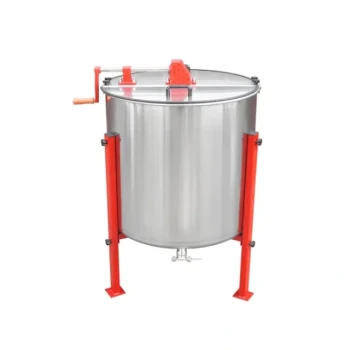
The crush-and-strain method is a manual extraction technique that relies on gravity rather than centrifugal force to harvest honey. This process involves physically breaking down the entire honeycomb structure using a mashing tool, then placing the mixture into a filtration medium—such as a cheesecloth bag—to allow the honey to drain into a collection vessel while capturing wax and debris.
While this method eliminates the need for expensive machinery, it fundamentally alters the hive management cycle by requiring the destruction of the honeycomb, forcing bees to rebuild their wax infrastructure for the next season.
The Mechanics of the Process
Removing the Honeycomb
Unlike centrifugal extraction, this method does not require an uncapping knife to slice off wax caps.
Instead, the entire honeycomb is removed from the wooden frames or top bars. This makes the technique particularly well-suited for top-bar hives or frames that do not utilize wire or plastic foundations.
Breaking the Structure
Once removed, the comb is placed into a large tub or container.
Using a sturdy spatula, wooden spoon, or specialized mashing tool, you must physically crush the comb. The goal is to rupture every cell to release the honey, resulting in a mash of liquid honey and broken beeswax.
Gravity Filtration
The honey-wax mixture is poured into a filtration system, typically a bag made of cheesecloth or a fine metal sieve.
Gravity pulls the heavy honey through the mesh, leaving the wax particles and other debris behind in the filter. This process is passive and slow, often requiring the setup to sit undisturbed for approximately one day to achieve maximum yield.
Technical Equipment Setup
The Two-Tiered Bucket System
For efficiency, this method often utilizes a specific two-bucket configuration.
The top bucket acts as a sieve holder, featuring several 1/2 inch holes drilled into the bottom. A cheesecloth bag with an elastic top is secured inside this bucket to hold the crushed comb.
The Collection Vessel
The top bucket rests securely on a secondary, solid collection bucket (food-grade).
As the honey drains through the cheesecloth and the drilled holes, it collects in the lower bucket, protected from external contaminants.
Environmental Control
Because the honey is exposed to the air for an extended period during draining, sanitation is critical.
Floors and work surfaces should be covered with cardboard or plastic sheeting to manage stickiness, and the environment must be sealed to prevent pests or robber bees from entering.
Understanding the Trade-offs
Destruction of Drawn Comb
The most significant technical implication of this method is the total destruction of the wax comb.
In centrifugal extraction, the comb remains intact, allowing bees to immediately refill it. With crush-and-strain, the bees must consume significant energy and resources to rebuild the comb from scratch, potentially delaying the next honey crop.
Time vs. Investment
This method represents a trade-off between capital investment and time.
It is a low-cost option requiring minimal upfront investment in machinery (like a centrifuge). However, the draining process is significantly slower than mechanical spinning, and the manual labor involved in crushing is higher.
Making the Right Choice for Your Apiary
The decision to use the crush-and-strain method depends largely on your hive style and production goals.
- If your primary focus is low initial cost: This method is the ideal entry point for hobbyists, as it requires only basic kitchen tools and buckets.
- If your primary focus is top-bar beekeeping: This is the technically correct method, as natural combs without foundation cannot withstand the force of a centrifugal extractor.
- If your primary focus is maximum honey production: You should avoid this method, as preserving drawn comb via centrifugal extraction yields a faster harvest and higher volume over time.
By understanding the mechanical requirements and the biological cost to the hive, you can deploy this method effectively for small-scale harvesting.
Summary Table:
| Feature | Crush-and-Strain Method | Centrifugal Extraction |
|---|---|---|
| Equipment Need | Low (Buckets, Mashers, Cloth) | High (Extractor, Uncapping Knife) |
| Comb Preservation | Destroyed (Must be rebuilt) | Preserved (Ready for refill) |
| Time Efficiency | Slow (Passive 24-hour drainage) | Fast (Mechanical spinning) |
| Ideal Hive Type | Top-bar or Foundationless | Langstroth with Foundation |
| Yield Speed | Lower (Bees use energy for wax) | Higher (Immediate storage) |
Scaling Your Honey Production? Partner with HONESTBEE Today!
Whether you are refining manual techniques or transitioning to industrial efficiency, HONESTBEE is here to support your growth. We specialize in providing commercial apiaries and distributors with high-performance beekeeping tools, honey-filling machinery, and essential consumables.
From specialized hardware to help you manufacture your own hives to advanced extraction equipment that maximizes your yield, our comprehensive wholesale offering is designed to streamline your operations. Let us help you bring high-quality honey to market with less effort and more precision.
Ready to upgrade your apiary’s capabilities? Contact us today to explore our full product range!
Related Products
- Stainless Steel 3 Frame Manual Honey Extractor Spinner for Bee Honey Extraction
- electric honey extractor honey centrifuge 3 frame honey extractor stainless steel honey frame extractor
- Stainless Steel Manual 8 Frame Radial Honey Extractor Machine for Beehives
- HONESTBEE 3-Frame Manual Acrylic Honey Extractor
- Manual Hand Crank 4 Frame Honey Extractor Centrifuge for Beekeeping
People Also Ask
- Which type of honey extractor is generally more durable? Focus on Material & Build Quality for Longevity
- What are the disadvantages of a manual honey extractor? Overcome Efficiency Bottlenecks in Your Apiary
- What is a manual honey extractor? The Essential Guide to Cost-Effective Beekeeping for Beginners
- Why are manual extractors popular among beginner beekeepers? A Guide to Starting Simple & Saving Money
- What are the primary advantages of utilizing a manual honey extractor? Cost-Effective & Gentle Harvesting