The primary challenge with split-cell frames in colder climates is the physical state of the honey itself. Low ambient temperatures can cause honey to thicken significantly or crystallize completely within the comb, rendering the unique gravity-based extraction mechanism ineffective.
The success of split-cell technology relies entirely on the honey’s ability to flow. When cold weather increases viscosity or triggers crystallization, operating the frame's mechanism may break the wax capping, but the solid honey will fail to drain, effectively trapping the harvest inside the frame.
The Mechanics of the Problem
Reliance on Gravity and Viscosity
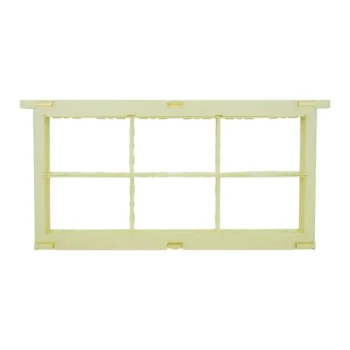
Split-cell frames operate on a mechanical principle where the cells shift vertically to create a zig-zag channel.
For this system to work, the honey must be fluid enough to move immediately through these channels and down to the collection trough solely via gravity.
The Barrier of Crystallization
As noted in your primary reference, cold climates accelerate the natural tendency of honey to crystallize (turn solid).
When the frame mechanism is activated (the "split" occurs), crystallized honey retains its shape rather than flowing. It sits in the now-broken cell structure, unable to move down the extraction tube.
Increased Viscosity Even Without Solids
Even if the honey does not fully crystallize, cold temperatures dramatically increase its viscosity (thickness).
Thickened honey moves much slower, which can lead to incomplete extraction or require the mechanism to remain open for impractical lengths of time.
Understanding the Trade-offs
The Window of Harvest
This issue introduces a distinct operational limitation: the harvesting window becomes tighter in cool regions.
Beekeepers using standard frames can pull solid frames and warm them indoors before spinning; split-cell users often rely on harvesting directly at the hive, where they are at the mercy of ambient temperature.
Risk of Frame Damage
Forcing the mechanism on a frame filled with solid, cold honey can potentially stress the plastic components.
While the primary reference highlights the lack of flow, it is mechanically prudent to understand that operating moving parts against a solid mass (crystallized honey) creates resistance that fluid honey does not.
Making the Right Choice for Your Climate
To mitigate these risks, you must adapt your harvesting strategy to your local weather patterns.
- If your primary focus is reliability: Harvest honey earlier in the season, well before the first frost or significant temperature drops, to ensure maximum fluidity.
- If your primary focus is managing late-season flows: Monitor your hive closely; if the honey has already crystallized due to cold, you may need to remove the frames and warm them in a temperature-controlled room before attempting to drain them.
Success with split-cell frames in the cold requires preemptive timing rather than reactive force.
Summary Table:
| Challenge | Impact on Split-Cell Frames | Recommended Solution |
|---|---|---|
| High Viscosity | Honey flows too slowly to drain via gravity. | Harvest during peak warmth or pre-warm frames. |
| Crystallization | Honey turns solid and won't enter drainage channels. | Monitor hives closely; harvest before first frost. |
| Mechanical Stress | Operating frames against solid honey can damage plastic. | Avoid forcing the mechanism if resistance is felt. |
| Harvest Window | Shorter timeframe compared to traditional extraction. | Plan early-season harvests for late-season flows. |
Maximize Your Apiary’s Productivity with HONESTBEE
Are you a commercial apiary or a distributor looking for reliable solutions to handle regional climate challenges? HONESTBEE is your dedicated partner, providing the professional-grade tools you need to ensure a seamless harvest, regardless of the weather.
From high-performance honey-filling machines and hive-making equipment to a full spectrum of durable beekeeping tools and essential consumables, we empower your business with efficiency and quality.
Ready to scale your operations? Contact us today to explore our wholesale offerings and discover how our industry expertise can drive your success.
Related Products
- Commercial 48-Frame Stainless Steel Honey Extractor
- 24 Frame Honey Extractor Commercial Radial Honey Frame Extraction Machine
- Electric 4 Frame Tangential Honey Extractor
- electric honey extractor honey centrifuge 3 frame honey extractor stainless steel honey frame extractor
- Stainless Steel 3 Frame Manual Honey Extractor Spinner for Bee Honey Extraction
People Also Ask
- Who are commercial honey extractors designed for? Scaling Your Industrial Beekeeping Success
- What is a commercial honey extractor? The Essential High-Volume Solution for Large Apiaries
- What are commercial honey extractors used for? Boost Your Apiary's Efficiency & Profitability
- How is honey extracted commercially? Maximize Your Apiary's Efficiency and Honey Yield
- What is a stainless steel honey extractor? Boost Your Apiary's Efficiency with Professional Extraction