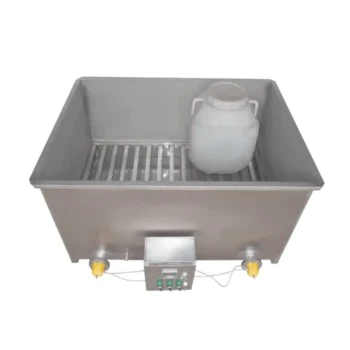
Honey dehydration and mixing equipment fundamentally address the problem of product instability and non-compliance caused by excess moisture and inconsistent composition. These technical systems allow processors to precisely regulate water content to prevent fermentation while standardizing ingredient proportions across large batches. By stabilizing the honey, these tools ensure the final product meets strict international regulatory frameworks, such as the European Union directives and Codex Alimentarius standards.
The core function of this equipment is to engineer a shelf-stable product by rigorously maintaining moisture levels between 17.5% and 21%, thereby eliminating the risk of spoilage and enabling access to global markets.
Solving the Moisture and Stability Challenge
Prevention of Fermentation
The most critical technical problem addressed is the biological instability of raw honey. Excess moisture creates an environment conducive to yeast growth, leading to rapid fermentation and spoilage. Dehydration units mechanically reduce moisture content to safe levels, effectively arresting this biological process.
Compliance with International Standards
To sell honey commercially, particularly for export, producers must meet precise technical specifications. Dehydration equipment ensures the final product falls within the strict moisture range of 17.5% to 21%, satisfying legal requirements for shelf life and quality.
Handling High-Moisture Varieties
Certain honey varieties, such as that from stingless bees, naturally contain moisture levels up to 35%, making them extremely volatile. Specialized dehydration systems can reduce this to approximately 18% without thermal damage, stabilizing a product that would otherwise spoil quickly.
Ensuring Consistency and Texture
Standardization of Batches
Raw honey harvested from different hives or seasons often varies significantly in viscosity and composition. Mixing equipment solves this inconsistency by blending various batches into a single, homogenous product with uniform ingredient proportions.
Control of Crystallization and Fluidity
Through controlled thermal treatment and mixing, this equipment addresses the physical problem of premature crystallization. By maintaining proper fluidity and consistency, the machinery ensures the honey remains visually appealing and suitable for automated packaging systems.
Removal of Trapped Gases
High-speed processing can introduce air bubbles that affect the product's weight and visual clarity. Integrated mixing and processing units often include degassing features to remove these trapped air pockets, ensuring sensory consistency and accurate fill volumes.
Understanding the Trade-offs
Thermal Treatment vs. Nutritional Value
While heat is efficient for dehydration and preventing crystallization, excessive thermal treatment can degrade the honey’s natural enzymes and flavor profiles. Operators must balance the need for moisture reduction against the potential loss of "raw" product status.
Efficiency vs. Delicate Processing
Industrial dehydration is fast, but aggressive processing can impact the honey's organoleptic (sensory) qualities. For sensitive varieties like stingless bee honey, non-heating dehydration methods are technically superior for preserving nutrition but may require longer processing times or more specialized capital investment.
Making the Right Choice for Your Goal
Select your equipment configuration based on your specific market requirements and volume.
- If your primary focus is large-scale export: Prioritize high-capacity dehydration units capable of strictly guaranteeing moisture levels between 17.5% and 21% to meet EU and Codex standards.
- If your primary focus is premium or medicinal honey: Invest in low-temperature or vacuum-based dehydration systems that reduce moisture without heating, preserving the original nutritional value and active ingredients.
- If your primary focus is consistency for retail packaging: Ensure your system includes advanced mixing and degassing modules to guarantee the fluidity and visual clarity required for consumer shelves.
Technological precision in dehydration and mixing is the bridge between a volatile raw ingredient and a reliable commercial commodity.
Summary Table:
| Technical Problem | Equipment Solution | Key Benefit |
|---|---|---|
| High Moisture & Fermentation | Vacuum Dehydration Units | Arrests yeast growth; ensures shelf-stability. |
| Regulatory Non-compliance | Precision Moisture Control | Meets EU and Codex standards (17.5%-21% moisture). |
| Batch Inconsistency | Homogenized Mixing Systems | Uniform viscosity, color, and ingredient proportions. |
| Trapped Gases & Air Bubbles | Degassing Modules | Enhances visual clarity and ensures accurate fill volumes. |
| Premature Crystallization | Thermal & Mixing Control | Maintains fluidity for automated packaging lines. |
Elevate Your Honey Processing with HONESTBEE
Are you ready to scale your commercial apiary or distribution business? HONESTBEE provides the full spectrum of professional beekeeping machinery, from high-precision honey dehydration and mixing units to automated honey-filling and hive-making machines. Our comprehensive wholesale offering ensures your products meet international standards while maintaining peak nutritional value.
Why partner with us?
- Global Compliance: Achieve the 17.5%–21% moisture levels required for international export with ease.
- End-to-End Solutions: We supply everything from heavy hardware to essential industry consumables and honey-themed cultural merchandise.
- Targeted Engineering: Specialized configurations for both large-scale retail and premium medicinal honey varieties.
Contact HONESTBEE Today to Optimize Your Production
References
- Giovanni Federico, Yongmei Zhang Carol. The Competitiveness of Ethiopian Honey in the European Union and the United Kingdom. DOI: 10.6007/ijarbss/v13-i3/16509
This article is also based on technical information from HonestBee Knowledge Base .
Related Products
- 0.5T Capacity Honey Dehumidifier Dryer with Vacuum Heating and Thickening Filtering Machine
- Honey Concentrating and Filtering Dehumidifier Machine 2T Capacity for Honey
- High Quality Honey Dehumidifier Dryer Thickening Machine for Beekeeping
- Honey Concentrating Vacuum Heating Thickening Machine Dehumidifier for Honey
- Economy Honey Homogenizer Mixer and Melting Machine for Beekeeping
People Also Ask
- What is the primary function of professional dehumidification equipment in honey processing? Stability & Quality
- How to dry up honey? The Safe Guide to Stabilizing Honey and Preventing Fermentation
- What is the process for using a dehumidifier to lower honey's moisture content? Expert Drying Techniques
- How to decrease moisture in honey? Prevent Fermentation and Ensure Long-Term Quality
- How to remove humidity from honey? Protect Your Harvest from Fermentation