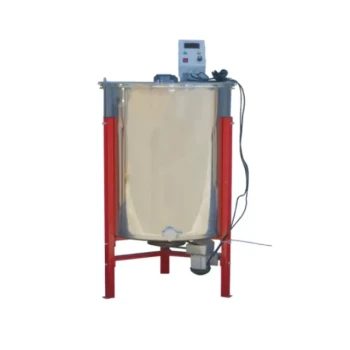
A laboratory centrifuge acts as a critical accelerator for the physical separation of pollen grains from honey. By spinning samples at high speeds, it generates centrifugal force that rapidly settles pollen from a diluted honey solution. This mechanical separation is the only practical way to isolate these microscopic particles from the liquid matrix efficiently.
The centrifuge transforms a low-concentration liquid sample into a high-concentration solid precipitate. This step is essential because it allows for the recovery of trace pollen amounts required for accurate microscopic analysis and frequency statistics.
The Physics of Separation
Generating Centrifugal Force
Honey is too viscous to analyze directly, so it must first be dissolved in distilled water. Once diluted, the pollen grains are suspended in a large volume of liquid.
The centrifuge utilizes high-speed rotation to generate significant centrifugal force. This force directs the sedimentation of these tiny particles, pushing them to the bottom of the container far faster than gravity could alone.
Creating High-Concentration Precipitates
The primary output of this process is the transformation of the sample's state.
The machine takes a low-concentration solution and forces the solids into a high-concentration precipitate (or pellet). This effectively separates the biological material you need to study from the sugar water, which can then be discarded.
From Trace Elements to Data
Solving the Dilution Problem
Pollen exists in honey in trace amounts. If you were to place a drop of non-centrifuged, diluted honey under a microscope, the pollen grains would be too sparse to analyze.
You would likely find vast empty spaces between grains, making it impossible to get a representative count.
Enabling Statistical Validity
To perform meaningful analysis, you need a "frequency distribution"—a statistical view of the different pollen types present.
The centrifuge enriches the sample volume. This ensures that when the sample is placed under a microscope, there are enough pollen grains present to count, classify, and calculate accurate statistics regarding the honey's floral origin.
Understanding the Trade-offs
The Necessity of Physical Concentration
It is important to understand that there is no chemical substitute for this mechanical process.
Attempting to filter honey often results in clogging due to viscosity or other particulates. Relying on natural gravity settling is inefficient and time-consuming for particles as light as pollen.
Sample Preparation Dependency
The centrifuge is not a standalone tool; its effectiveness is entirely dependent on the initial dilution.
If the honey is not adequately dissolved in distilled water, the viscosity will remain too high, and the centrifugal force may fail to separate the pollen effectively. The process relies on the distinct density difference between the solid pollen and the liquid solution.
Optimizing Your Analysis Workflow
The use of a centrifuge is about bridging the gap between a raw food product and a scientific sample.
- If your primary focus is Efficiency: Ensure your rotation speeds are high enough to rapidly settle the pollen but calibrated to avoid damaging delicate grain structures.
- If your primary focus is Accuracy: Prioritize the complete recovery of the precipitate to ensure your frequency distribution statistics represent the entire sample, not just the heaviest particles.
Mastering the concentration step ensures that your microscopic analysis is based on rich, representative data rather than empty liquid.
Summary Table:
| Process Phase | Action | Purpose of Centrifuge |
|---|---|---|
| Preparation | Dilute honey in distilled water | Reduce viscosity to allow particle movement |
| Separation | High-speed rotation | Generate force to push microscopic pollen to the bottom |
| Concentration | Precipitation (Pellet) | Transform sparse trace elements into a dense sample |
| Analysis | Microscopic counting | Ensure statistical validity for floral origin frequency |
Elevate Your Honey Quality Control with HONESTBEE
Precision in pollen analysis is vital for establishing the authenticity and value of your honey. HONESTBEE supports commercial apiaries and global distributors by providing a comprehensive range of professional beekeeping machinery, including high-efficiency honey-processing equipment and essential lab tools.
Whether you are scaling up your production or refining your scientific analysis, our wholesale solutions—from hive-making machines to honey-themed merchandise—are designed to give you a competitive edge.
Ready to optimize your apiary’s technical capabilities? Contact us today to explore our full equipment catalog!
References
- Sunday Dele Oyeyemi, Oluseyi Oriyomi Murele. Melissopalynological and Physicochemical Analysis of Honey Samples from Ekiti, Southwestern Nigeria. DOI: 10.3923/sjsr.2023.48.59
This article is also based on technical information from HonestBee Knowledge Base .
Related Products
- Honey Concentrating and Filtering Dehumidifier Machine 2T Capacity for Honey
- Honey Concentrating Vacuum Heating Thickening Machine Dehumidifier for Honey
- Manual Hand Crank 4 Frame Honey Extractor Centrifuge for Beekeeping
- electric honey extractor honey centrifuge 3 frame honey extractor stainless steel honey frame extractor
- Professional 4 Frame Self Reversing Electric Honey Extractor for Beekeeping
People Also Ask
- What heating methods can be used with the honey concentrating equipment? Electric vs. Boiler Options
- How does honey filtration and processing machinery transform raw honey? Scale Your Production for Global Markets
- What electrical safety precaution is necessary when operating the honey concentrating equipment? Essential Grounding Tips
- What are the main functions of the honey concentrating equipment? Essential Machinery for Commercial Quality
- What maintenance should be performed when the honey concentrating equipment is not in use? Key Safety & Care Tips