The Illusion of a Healthy Hive
A beehive in late summer can be a picture of profound success. Tens of thousands of bees move with a single purpose, the air thick with the hum of productivity. To the naked eye, the colony is thriving.
This visual strength is one of the most dangerous cognitive traps in beekeeping.
Beneath this bustling facade, a silent parasite, Varroa destructor, can be multiplying exponentially. A beekeeper's intuition, honed by observing bee behavior, is often powerless against a threat that grows unseen. Our senses can deceive us. We need data.
The Flaw in Raw Numbers
If you found 50 Varroa mites in a hive, is that a problem?
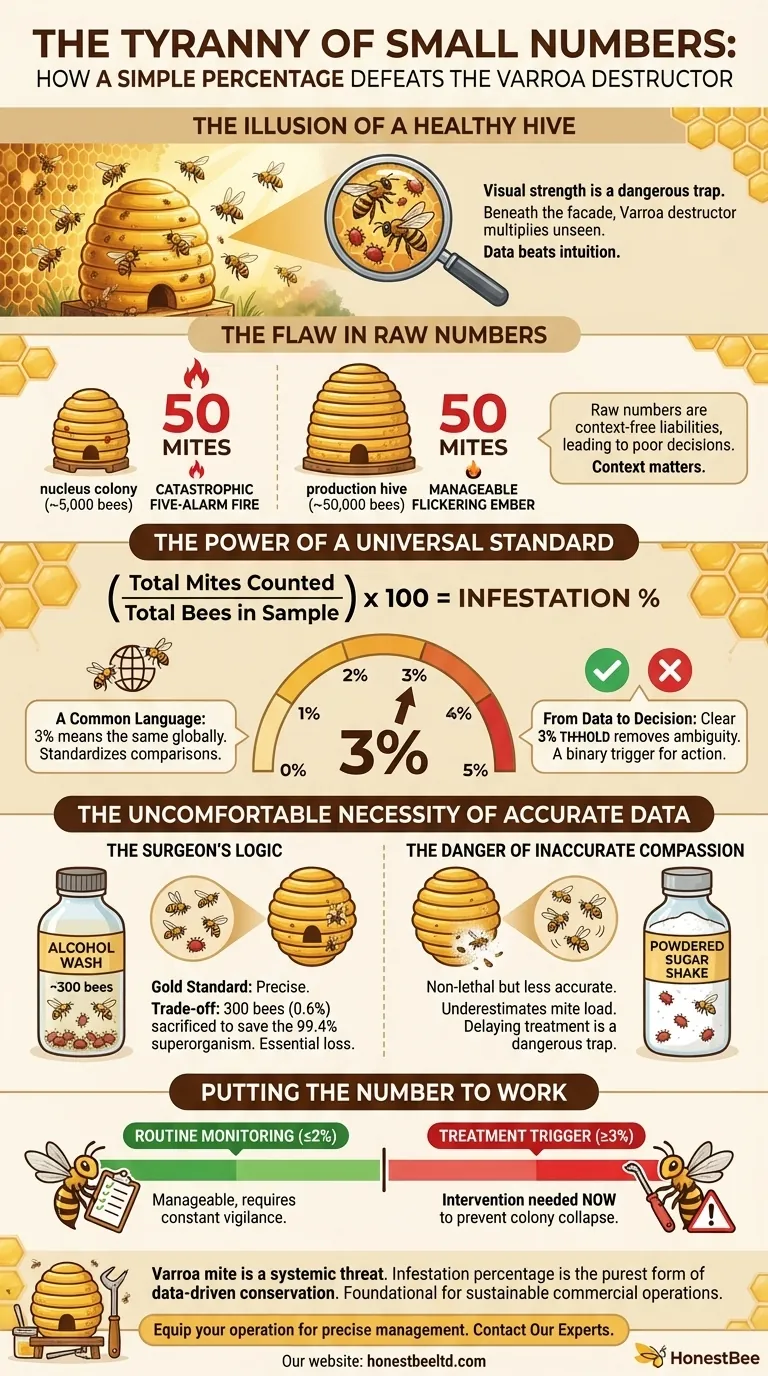
The only correct answer is: it depends. Fifty mites in a small nucleus colony of 5,000 bees is a catastrophic, five-alarm fire. Fifty mites in a booming production hive of 50,000 bees might be a flickering ember—dangerous, but manageable.
The raw number is context-free. And context-free data is a liability. It leads to poor decisions, either by creating panic where none is warranted or, more often, by fostering a false sense of security.
The Power of a Universal Standard
The entire global system of Varroa mite management hinges on converting that raw count into a single, standardized metric: the infestation percentage.
The formula is brutally simple: (Total Mites Counted / Total Bees in Sample) x 100 = Infestation %
This small piece of math transforms a vague observation into a powerful decision-making tool.
A Common Language for a Global Problem
The infestation percentage acts as a universal language. A 3% infestation rate means the same thing to a beekeeper in California as it does to one in France. It normalizes for colony size, allowing for true "apples-to-apples" comparisons between your own hives, against your neighbor's, and across entire commercial operations.
From Data to Decision
More importantly, this standard creates clear, data-driven thresholds for action. The industry has largely coalesced around a critical number: 3%.
Crossing this threshold removes ambiguity and emotion from the decision to treat a colony. It's a binary trigger. The debate is over; the time for action has arrived. This simple rule prevents the dangerous human tendency to procrastinate or hope the problem resolves itself.
The Uncomfortable Necessity of Accurate Data
To get this critical percentage, we must first get an accurate count. And this presents a psychological and ethical hurdle that every serious beekeeper must overcome.
The Surgeon's Logic
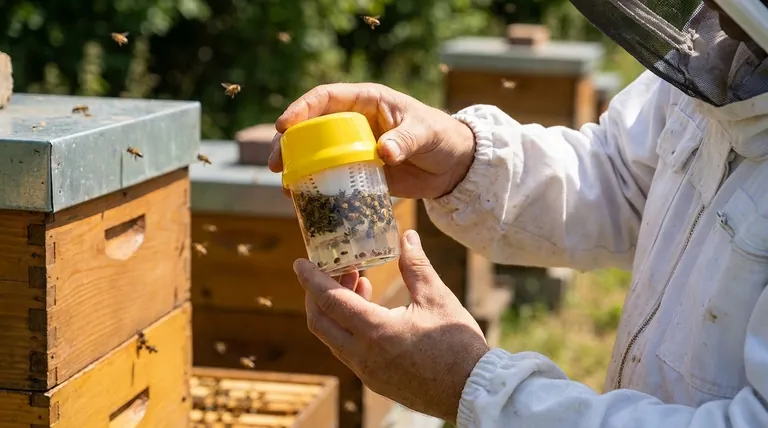
The gold standard for determining a mite count is the alcohol wash. A sample of roughly 300 bees is collected and washed in alcohol, dislodging the mites for a precise count.
The trade-off is unavoidable: the 300 bees in the sample will die.
This feels wrong. The goal is to save bees, not sacrifice them. But this is the surgeon's logic. To save the patient—the 50,000-bee superorganism—a small, calculated loss is not just acceptable, it is essential. The loss of 0.6% of the colony's population to gain the data needed to save the other 99.4% is the best trade-off in beekeeping.
The Danger of Inaccurate Compassion
Alternative methods like the powdered sugar shake are non-lethal, which feels emotionally better. However, they are consistently proven to be less accurate. They can underestimate the mite load, giving you a falsely low percentage.
This is a dangerous cognitive trap. Choosing the feel-good method over the effective one can lead a beekeeper to delay treatment past the point of no return. Professional apiaries cannot afford this risk. They rely on standardized, accurate equipment like Varroa EasyCheck tools to get reliable data every time.
Putting the Number to Work
Understanding your mite percentage transforms you from a reactive keeper to a proactive manager.
- Routine Monitoring: A count of 2% or lower is often considered manageable, but requires constant vigilance.
- Treatment Trigger: A count of 3% or higher is the widely accepted signal that intervention is needed now to prevent colony collapse in the coming months.
The Varroa mite is a relentless, systemic threat. It cannot be managed by guesswork or intuition alone. The infestation percentage is an elegant, simple tool designed to fight a complex, devastating problem. It is the purest form of data-driven conservation.
For commercial apiaries and equipment distributors, where the health of hundreds or thousands of colonies is on the line, this level of precision isn't optional. It's the foundation of a sustainable operation.
Equip your operation with the tools for precise, proactive management. Contact Our Experts
Visual Guide
Related Products
Related Articles
- How Beekeepers Can Control Late-Summer Varroa Mites Without Compromising Honey Quality
- The Deceptive Calm: Why a Strong Summer Hive Masks a Looming Winter Collapse
- The Tyranny of Small Numbers: Mastering Varroa Mite Math Before It Masters Your Hives
- The Varroa Paradox: Why Strong Summer Beehives Collapse in Winter
- The Signal and the Noise: Why Thriving Hives Collapse and How Data Prevents It
