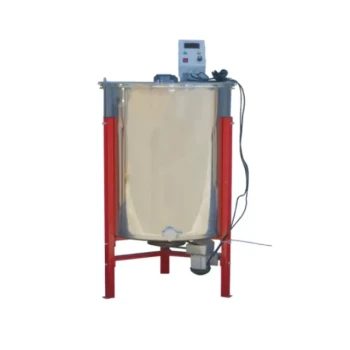
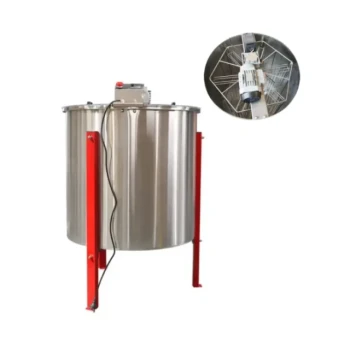
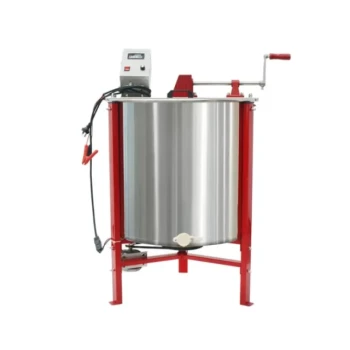
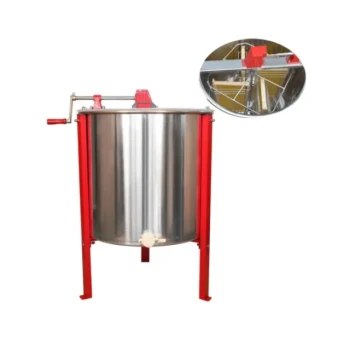
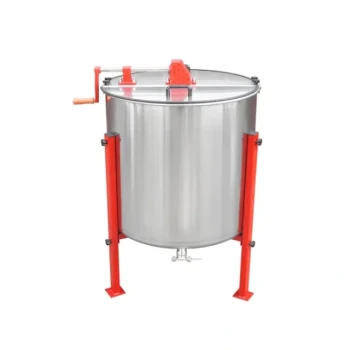
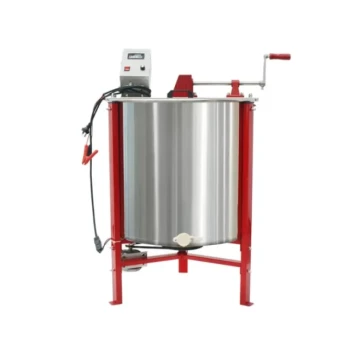
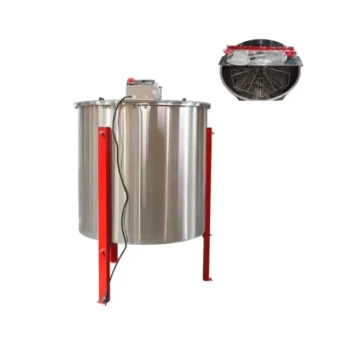
Centrifuge honey extractors operate by harnessing rotational physics to separate liquid honey from solid wax structures. Hive frames are placed into a central basket within a cylindrical drum. As the basket spins, the resulting centrifugal force flings the honey out of the cells and onto the inner walls of the drum, where it flows down to the bottom for collection.
The definitive advantage of this method is the preservation of the honeycomb. By extracting honey without crushing the wax, the intact frames can be returned to the hive, allowing the colony to refill them immediately rather than expending energy to rebuild.
The Mechanics of Extraction
Preparing the Frames
Before the extraction process can begin, the physical barrier keeping the honey inside the cells must be breached.
Beekeepers must first remove the wax cappings—the thin layer of wax bees use to seal ripe honey—from the frames. Only uncapped frames are placed into the extractor's basket, as the force cannot pull honey through a sealed wax lid.
Generating Centrifugal Force
Once loaded, the extractor spins the basket, powered either by a manual hand crank or an electric motor.
This rotation creates significant centrifugal force. This force acts on the liquid honey, overcoming the surface tension and gravity that hold it inside the hexagonal cells.
Separation and Collection
As the honey is expelled from the comb, it is projected outward until it hits the interior wall of the drum.
Gravity then causes the honey to run down the sides of the drum, pooling at the bottom. From there, it is drained through a tap or removed via a pump for filtration and bottling.
Critical Operational Considerations
The Necessity of Load Balancing
The physics of a centrifuge requires precise weight distribution to function safely.
It is crucial to balance the load of frames across the basket. An unbalanced extractor will wobble violently during operation, which can damage the equipment or destroy the frames inside.
Structural Requirements for Frames
Not all honeycombs are suitable for centrifugal extraction.
The force exerted during spinning is significant; therefore, frames usually require a wire or plastic foundation for support. Trying to spin natural comb without this reinforcement will often cause the wax to break apart or "blowout," ruining the harvest.
Power Source Trade-offs
The choice between manual and electric operation changes the workflow.
Manual extractors rely on a hand crank, making them cost-effective and excellent for hobbyists, but physically demanding for larger harvests. Electric extractors utilize a motor for rapid, consistent spinning, offering higher efficiency at a higher cost.
Optimizing Your Extraction Process
To ensure you select the right equipment and methods for your specific needs, consider the following guidelines:
- If your primary focus is small-scale or hobby beekeeping: A manual extractor is the most cost-effective choice, as the physical effort required for a few hives is manageable.
- If your primary focus is volume and efficiency: An electric extractor is essential, as the motor automates the labor-intensive spinning process, allowing you to process more frames in less time.
- If your primary focus is preserving equipment: rigorous attention to load balancing is required to prevent mechanical failure and ensure the longevity of your frames.
By utilizing centrifugal force, you transform a destructive harvest into a sustainable cycle that benefits both the beekeeper and the bees.
Summary Table:
| Feature | Manual Honey Extractor | Electric Honey Extractor |
|---|---|---|
| Power Source | Hand-cranked manual labor | High-torque electric motor |
| Ideal Scale | Hobbyists & small-scale apiaries | Commercial apiaries & distributors |
| Efficiency | Lower (physically demanding) | High (automated, rapid output) |
| Key Benefit | Cost-effective and portable | Consistent speed and high volume |
| Frame Safety | Requires careful manual control | Features smooth, adjustable speed |
Scale Your Honey Production with HONESTBEE
At HONESTBEE, we specialize in empowering commercial apiaries and distributors with professional-grade beekeeping solutions. Whether you are looking for high-capacity electric honey extractors, specialized honey-filling machines, or durable hive-making machinery, our comprehensive wholesale offering is designed to optimize your operations.
From essential hardware to a full spectrum of industry consumables, we provide the tools you need to maximize efficiency and preserve your valuable honeycomb. Contact us today to explore our wholesale equipment solutions and see how HONESTBEE can grow your beekeeping business.
Related Products
- electric honey extractor honey centrifuge 3 frame honey extractor stainless steel honey frame extractor
- Manual Hand Crank 4 Frame Honey Extractor Centrifuge for Beekeeping
- Professional 4 Frame Self Reversing Electric Honey Extractor for Beekeeping
- Electric 4 Frame Tangential Honey Extractor
- HONESTBEE 72 Frame Industrial Electric Honey Extractor for Beekeeping
People Also Ask
- What are the characteristics of electric honey extractors? Boost Your Apiary Efficiency with Automated Technology
- What are the disadvantages of using an electric honey extractor? Weighing Cost, Power, and Comb Safety
- What are the advantages of an electric honey extractor? Boost Efficiency and Scale Your Honey Production
- What are the technical advantages of electric honey extractors? Maximize Yield and Protect Your Bee Colony
- How does an electric honey extractor affect the quality of honey? Preserve Flavor & Purity with Precision Extraction