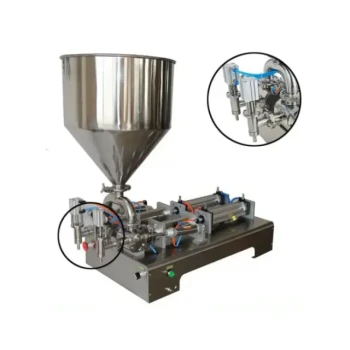
Industrial-grade honey-filling machines transform production efficiency by utilizing high-precision metering pumps and thermal pre-processing to manage the naturally high viscosity of honey. These systems ensure rapid, accurate bottling that significantly minimizes material waste while integrating filtration components to guarantee the final product meets strict commercial standards for hygiene and sensory quality.
By automating the complex task of managing honey's viscosity and flow, industrial filling machines shift production from labor-intensive manual methods to scalable operations that prioritize weight consistency, hygiene, and speed.
Overcoming the Physical Challenges of Honey
Honey is a unique fluid that presents specific processing difficulties due to its thickness and sensitivity to temperature. Industrial machines address these physical properties directly.
Managing High Viscosity
Honey resists flow, making manual pouring slow and inconsistent.
Industrial machines employ thermal pre-processing to gently warm the honey. This reduces viscosity enough to allow for rapid movement through the system without degrading the honey's quality or nutritional value.
Precision Metering
One of the greatest sources of loss in manual filling is overfilling containers to ensure "at least" the stated weight is met.
These machines utilize high-precision metering pumps to dispense exact quantities. This ensures every unit meets regulatory weight requirements without giving away excess product, directly impacting the bottom line.
Integrated Filtration
Raw honey often contains micro-impurities, such as wax particles, that can affect clarity and texture.
Many industrial systems integrate filtration components directly into the filling line. This ensures the honey is purified immediately before bottling, guaranteeing the sensory quality required for retail distribution.
Operational Efficiency and Scalability
Beyond the mechanics of moving fluid, these machines fundamentally change the economics of the operation.
Minimizing Material Waste
Spillage and drip are common issues in manual processing that result in sticky, unsafe work environments and lost product.
Automated filling technologies are designed to stop flow precisely, ensuring clean break-offs after every fill. This keeps the production line sanitary and ensures maximum yield from the harvested honey.
Reducing Labor Dependency
Manual filling is a bottleneck that restricts how much product can be brought to market.
By automating the dispensing and sealing stages, producers can significantly reduce labor costs. This allows staff to focus on apiary management or logistics rather than repetitive bottling tasks.
Ensuring Hygiene and Safety
Manual handling introduces the risk of secondary contamination through prolonged exposure to air or human contact.
Automated equipment creates a closed loop from tank to jar. Advanced hygienic sealing technologies further protect the product, ensuring it meets the stringent safety requirements of large-batch retail networks.
Understanding the Trade-offs
While the efficiency gains are substantial, adopting industrial-grade machinery requires careful consideration of the operational shift.
Maintenance and Sanitation
Complexity increases the need for rigorous maintenance.
Pumps and filtration systems must be cleaned regularly to prevent crystallization or bacterial buildup. Unlike manual tools, these machines require a disciplined schedule to maintain their high-precision performance.
Capital Investment vs. Volume
The technology represents a significant upfront cost.
For smaller operations, the efficiency gains may not immediately offset the capital expenditure. These machines are most effective when the goal is transitioning to a high-volume, commercial scale.
Making the Right Choice for Your Goal
Selecting the right equipment depends heavily on where your operation currently sits on the spectrum between boutique apiary and commercial distributor.
- If your primary focus is Scalability: Prioritize machines with high-throughput metering pumps and automated sealing to maximize volume per hour.
- If your primary focus is Product Quality: Look for systems with advanced thermal controls and fine filtration to ensure clarity without heat damage.
- If your primary focus is Cost Control: Focus on precision dosing capabilities to eliminate overfilling and reduce raw material waste.
True efficiency in honey processing comes not just from speed, but from the ability to deliver a consistent, hygienic product every single time.
Summary Table:
| Feature | Impact on Efficiency | Benefit for Operations |
|---|---|---|
| High-Precision Pumps | Eliminates overfilling and product giveaway | Maximizes profit margins per unit |
| Thermal Pre-processing | Reduces viscosity for faster flow rates | Increases throughput without quality loss |
| Integrated Filtration | Removes impurities during the filling stage | Guarantees commercial sensory standards |
| Automated Closed-Loop | Minimizes manual handling and spillage | Enhances hygiene and reduces labor costs |
| Clean Break-off Tech | Prevents sticky residue and downtime | Ensures a sanitary, high-speed production line |
Scaling Your Honey Production with HONESTBEE
Transitioning from manual bottling to a high-volume commercial operation requires the right technology. HONESTBEE specializes in serving commercial apiaries and distributors with professional-grade honey-filling machines and integrated hive-making hardware.
Our comprehensive wholesale offering ensures your facility is equipped with tools designed for precision, hygiene, and maximum yield. Whether you need specialized machinery or essential industry consumables, we provide the hardware to grow your brand.
Ready to automate your success? Contact us today to discover how HONESTBEE can streamline your honey processing and boost your market competitiveness.
References
- Abel Adebayo Ayansola, Banjo Adedoyin Davies. Honeybee Floral Resources in Southwestern Nigeria. DOI: 10.5296/jbls.v3i1.1720
This article is also based on technical information from HonestBee Knowledge Base .
Related Products
- Precision Durable Efficient HONESTBEE Rotary Honey Filling Machine
- Semi Automatic Small Honey Bottle Filling Machine Honey Filler
- Fully Automatic Honey Filling Packaging Machine for Processing Line
- Commercial Rotary Honey Filling Machine for Production
- Economy Small Honey Filling Machine Honey Bottle Filler Packaging Machine
People Also Ask
- How do high-precision honey filling machines ensure quality? Optimize Your Commercial Production with HONESTBEE
- What quality control role does professional honey filling equipment perform? Ensure Consistency and Product Stability
- What are the common types of bottling machines used for honey? Choosing the Right Solution for Your Apiary
- What is a key feature of the new generation of the honey filling machine? The Advanced Electronic Control Unit
- How do honey filling and processing machines aid native bee product conservation? Boost Value with HONESTBEE Technology