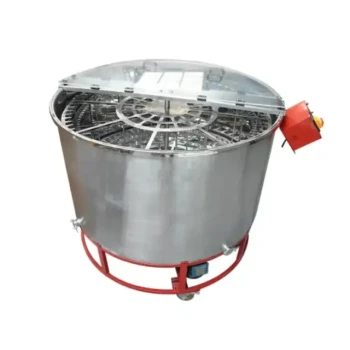
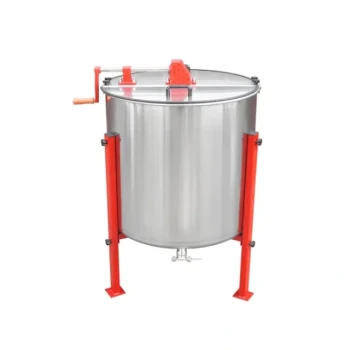
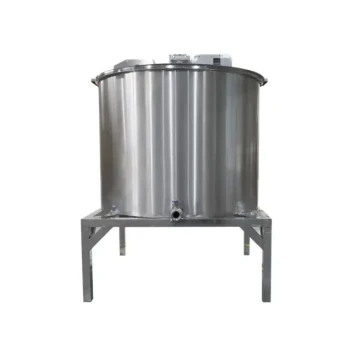
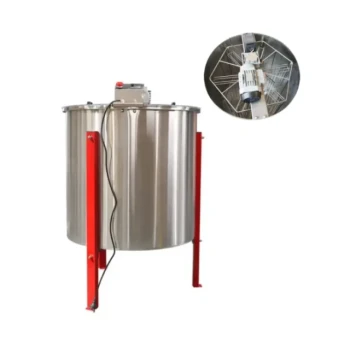
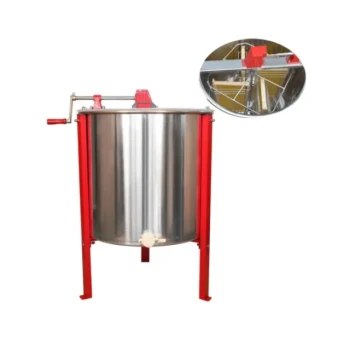
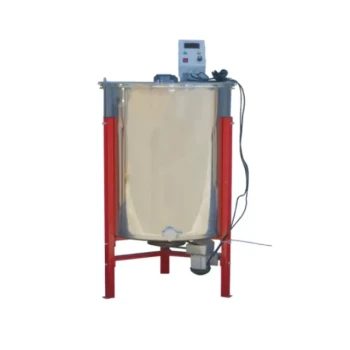
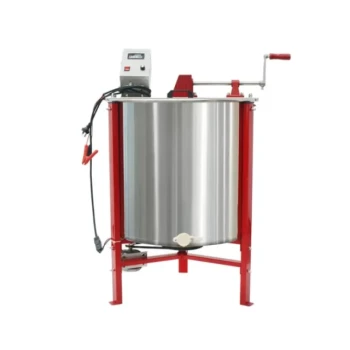
A tangential honey extractor operates by holding honeycomb frames vertically within a rotating cage, positioned so that one face of the comb sits flat against the outer mesh screen. When the cage spins, centrifugal force pulls the honey out of the cells on the outward-facing side only, requiring the operator to stop the machine and manually flip the frames to extract the second side.
The tangential design prioritizes comb preservation over speed. While it requires more manual interaction than radial extractors, the specific spinning procedure is essential for preventing structural damage to the wax foundation.
The Mechanical Principle
Frame Orientation
In this design, frames are placed tangentially to the center shaft—like chords on a circle—rather than radiating outward like spokes on a wheel.
Unidirectional Extraction
Because the frames sit flat against the cage perimeter, the spinning motion applies force perpendicular to the comb face.
This forces honey out of the cells on the side facing the drum wall, while the honey on the inward-facing side remains trapped against the midrib of the comb.
The Critical Extraction Workflow
To operate a tangential extractor correctly, you cannot simply spin one side dry and then the other. Doing so risks destroying the honeycomb. You must follow a specific three-step sequence.
Step 1: The Partial Spin
First, place the frames with the bottom bars leading the direction of rotation. Spin the cage slowly to extract only half the honey from the first side.
If you extract this side completely, the weight of the full, heavy honey on the inner side may push through the softened wax midrib, causing the comb to break against the wire mesh.
Step 2: The Reverse Flip
Stop the extractor and manually flip the frames to expose the second (full) side to the outer wall.
Spin the cage again, this time at a higher speed, to extract all the honey from this second side. Because the first side is lightened (but not empty), the comb is strong enough to withstand the pressure.
Step 3: The Final Clean-Up
Stop the machine and flip the frames one last time, returning to the first side.
Spin the cage to extract the remaining honey from the first side. Since the second side is now empty and light, there is no risk of the comb collapsing under weight.
Understanding the Trade-offs
The Labor Intensity
The defining characteristic of tangential extraction is the interruption of workflow.
Because you must stop, flip, and restart the machine twice per batch, the process is significantly more labor-intensive than using radial extractors, which spin both sides simultaneously.
The Benefit of Gentle Handling
Despite the extra labor, this method is highly effective for delicate combs.
The direct angle of force makes it easier to empty thick honey or fragile combs without the blowouts common in high-speed radial extraction.
Capacity Limitations
Tangential extractors are typically designed for lower volume, generally holding between 2 to 6 frames at a time.
They are available in both manual hand-crank and motorized electric versions, but the low frame count limits their utility for large-scale operations.
Making the Right Choice for Your Goal
Tangential extractors are specific tools that solve a specific problem: extracting honey without destroying the equipment.
- If your primary focus is keeping costs low and preserving wax: The tangential extractor is the ideal choice for hobbyists with a small number of hives (typically under 10).
- If your primary focus is speed and volume: The manual flipping requirement will become a bottleneck; a radial extractor is preferred for commercial efficiency.
Tangential extraction allows the small-scale beekeeper to maximize yield from every frame while ensuring the comb remains intact for the bees to reuse immediately.
Summary Table:
| Feature | Tangential Extractor Details |
|---|---|
| Frame Orientation | Tangential to the center shaft (flat against the wall) |
| Extraction Principle | Unidirectional centrifugal force per side |
| Workflow Steps | 3 Steps: Partial spin, full reverse spin, final clean-up |
| Best For | Hobbyists, fragile combs, and thick honey |
| Key Benefit | Maximum comb preservation and structural integrity |
| Capacity | Typically 2 to 6 frames per batch |
Scale Your Apiary Efficiency with HONESTBEE
Are you looking to upgrade your extraction process or supply your customers with professional-grade equipment? HONESTBEE provides commercial apiaries and distributors with a comprehensive range of beekeeping tools, from manual and motorized extractors to advanced honey-filling machines.
Our portfolio covers everything from heavy-duty hardware to essential industry consumables, ensuring you have the reliability needed for a successful harvest. Contact us today to explore our wholesale solutions and bulk pricing!
Related Products
- Electric 4 Frame Tangential Honey Extractor
- 24 Frame Honey Extractor Commercial Radial Honey Frame Extraction Machine
- HONESTBEE 72 Frame Industrial Electric Honey Extractor for Beekeeping
- Stainless Steel Manual 8 Frame Radial Honey Extractor Machine for Beehives
- Commercial Electric 12 Frame Honey Extractor Spinner Motorized Honey Extractor
People Also Ask
- What are the characteristics of electric honey extractors? Boost Your Apiary Efficiency with Automated Technology
- What are the disadvantages of using an electric honey extractor? Weighing Cost, Power, and Comb Safety
- What are the advantages of an electric honey extractor? Boost Efficiency and Scale Your Honey Production
- What are the advantages of electric honey extractors? Boost Harvest Speed & Efficiency
- What are the technical advantages of electric honey extractors? Maximize Yield and Protect Your Bee Colony