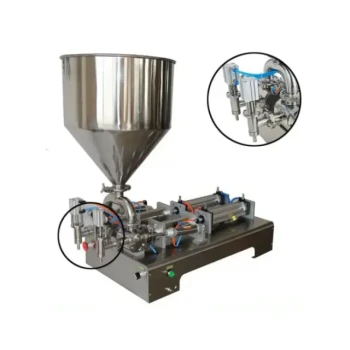
Automated honey-filling machinery guarantees product safety by utilizing a fully enclosed operating system combined with high-precision metering technology. This dual approach isolates the honey from the external environment, effectively preventing secondary contamination and ensuring the final packaged product meets strict industry hygiene and purity standards.
Core Insight: By replacing manual handling with a closed, automated loop, honey-filling machinery physically isolates the product from environmental pollutants and biological contaminants. This process not only secures sanitary compliance but also preserves the honey's delicate biological stability.
The Mechanics of Contamination Prevention
To understand how automation ensures safety, one must look at how the machinery physically handles the product.
The Enclosed Operating System
The primary defense against contamination is physical isolation. Automated machinery utilizes a fully enclosed system that shields the honey during the critical transfer from storage tank to bottle. This barrier prevents dust, airborne particulates, and insects from entering the product stream.
Precision Metering and Flow Control
Safety is also a function of cleanliness. High-precision metering systems dispense exact volumes, preventing spills and overfills that create sticky surfaces where bacteria can breed. By maintaining a clean filling environment, the risk of cross-contamination between units is drastically reduced.
Eliminating Manual Handling Risks
Human interaction is a significant vector for pathogens in food processing. Automated systems remove the need for manual scooping, pouring, or leveling. By eliminating direct human contact during the filling phase, the machinery removes the most unpredictable variable in food safety.
Preserving Product Integrity
Safety extends beyond preventing bacteria; it also involves maintaining the chemical stability of the honey to prevent spoilage.
Controlling Air Exposure
Honey is hygroscopic, meaning it absorbs moisture from the air, which can lead to fermentation and spoilage. Automated fillers operate at high speeds in closed loops, significantly reducing the time honey is exposed to the atmosphere. This prevents moisture absorption and inhibits microbial growth.
Protecting Natural Enzymes
Honey contains heat-sensitive enzymes like amylase and catalase that are vital to its quality and anti-microbial properties. Professional filling machines are engineered to handle viscous fluids without generating excessive heat or shear force. This preserves the honey’s natural enzyme activity and volatile aromatic compounds.
Sanitation and Material Standards
The construction and maintenance capabilities of the machinery provide the final layer of safety.
Automated Cleaning Protocols (CIP/SIP)
Advanced industrial fillers often integrate Cleaning-in-Place (CIP) and Sterilization-in-Place (SIP) systems. These functions allow the internal piping and nozzles to be flushed and sterilized automatically. This ensures the entire fluid path is sanitary without requiring disassembly, which could re-introduce contaminants.
Food-Grade Material Compliance
Safety relies on the hardware itself. These machines are constructed with sanitary piping and food-grade materials that resist corrosion. This ensures that no heavy metals or chemical residues leach into the honey, maintaining compliance with antibiotic residue monitoring and food safety regulations.
Understanding the Trade-offs
While automation offers superior safety, there are operational realities to consider.
Maintenance Complexity
The "closed system" that ensures safety also makes visual inspection difficult. Operators must rely on sensors and rigorous maintenance schedules to ensure the internal CIP/SIP systems are functioning correctly. If a sensor fails, a contamination issue within the piping might go unnoticed longer than in an open, manual setup.
Viscosity Management
Honey viscosity changes with temperature. While machines prevent overheating for safety, incorrect viscosity settings can cause equipment strain or inconsistent fills. This requires a skilled operator to balance flow rate with the machine’s mechanical limits to prevent wear that could introduce particulate matter.
Making the Right Choice for Your Goal
Selecting the right machinery depends on which aspect of "safety" is most critical to your market positioning.
- If your primary focus is Regulatory Compliance: Prioritize machines with integrated CIP/SIP systems and documented sanitary piping to satisfy strict health inspections.
- If your primary focus is Product Quality (Raw Honey): Prioritize machines with low-shear pumps and minimized air exposure to protect natural enzymes and prevent fermentation.
- If your primary focus is Brand Consistency: Prioritize high-precision volumetric metering to ensure identical net weights and eliminate the mess associated with manual filling.
Automated filling is the definitive method for scaling production while guaranteeing the biological safety and chemical purity required by modern retail markets.
Summary Table:
| Safety Feature | Mechanism of Action | Impact on Honey Quality |
|---|---|---|
| Enclosed System | Physical isolation from environment | Prevents dust, insects, and airborne contaminants |
| Precision Metering | High-accuracy volumetric dispensing | Eliminates spills and bacterial breeding grounds |
| Air Exposure Control | Rapid, closed-loop processing | Prevents moisture absorption and fermentation |
| CIP/SIP Systems | Automated cleaning and sterilization | Ensures sanitary fluid paths without disassembly |
| Low-Shear Pumps | Gentle fluid handling | Preserves heat-sensitive enzymes and aromatics |
Elevate Your Honey Production with HONESTBEE
Maximize your product safety and operational efficiency with HONESTBEE’s professional-grade beekeeping machinery. As a dedicated partner to commercial apiaries and distributors, we provide a comprehensive wholesale range, including high-precision honey-filling machines, hive-making equipment, and essential industry consumables.
Our solutions are designed to help you meet strict regulatory standards while preserving the natural integrity of your honey. Contact us today to discover how our specialized hardware and beekeeping tools can scale your business and protect your brand quality.
References
- Sergey Paramonov. Aspects of pesticide and agrochemical application in the field of beekeeping. DOI: 10.17816/phf21225
This article is also based on technical information from HonestBee Knowledge Base .
Related Products
- Fully Automatic Honey Filling Packaging Machine for Processing Line
- Automatic Honey Filling and Filtering Machine for Beekeeping Bottle Filling
- Precision Durable Efficient HONESTBEE Rotary Honey Filling Machine
- Semi Automatic Small Honey Bottle Filling Machine Honey Filler
- Precision Automated Packaging Turntable Honey Spoon Filling Sealing Packing Machine
People Also Ask
- Why are fully automatic honey filling and packaging lines essential? Boost Your Honey's Market Value and Quality
- What is a fully-automatic honey filler? Streamline Your Production with High-Precision Automation
- How do automated honey filling and packaging machines affect profitability? Boost Margins with HONESTBEE Technology
- How do automated honey filling and packaging machines contribute to the market value of honey products? Maximize Your ROI
- How do industrial-grade automated honey filling and packaging machines mitigate the risk of physical contamination?