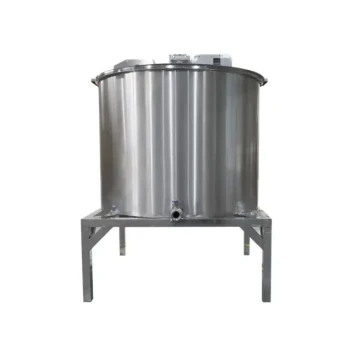
The absence of professional equipment creates a critical bottleneck that locks beekeepers into traditional, low-efficiency production cycles. Without access to modern harvesting and processing tools, producers are unable to adopt advanced techniques, resulting in stagnant honey yields and the inability to effectively recover high-value by-products.
A lack of mechanization forces beekeepers to rely on raw honey volume rather than value addition. This dependence on manual methods limits yield potential, wastes valuable resources like beeswax, and prevents the vertical integration necessary for a resilient, profitable business model.
The Stagnation of Production Efficiency
Impact on Honey Yield
The lack of modern extraction equipment, specifically centrifugal extractors, forces beekeepers to use destructive harvesting methods. Centrifugal extraction preserves the honeycomb, allowing it to be returned to the hive for immediate reuse.
Without this technology, bees must consume significant energy and resources to rebuild the wax comb rather than producing honey. Consequently, the lack of equipment directly suppresses the annual honey yield per hive.
Limitations of Hive Standardization
The absence of professional hive-making machinery results in non-standardized, lower-quality housing for bee colonies. Traditional or handmade hives often fail to meet the precise biological needs of the bees.
Precision-manufactured hives improve colony colonization rates and simplify the harvesting process. Lacking these standardized tools prevents the transition from wild honey gathering to sustainable, semi-artificial beekeeping practices.
Economic Vulnerability and Missed Revenue
The High-Value By-product Gap
A major consequence of insufficient processing equipment is the inability to recover by-products. Without high-efficiency separators, beekeepers cannot isolate pure beeswax, royal jelly, or propolis from the raw harvest.
This restricts producers to selling low-value mixtures of honey and wax. They miss out on the lucrative market for raw materials used in skincare, candles, and batik, significantly lowering their potential economic returns.
Barriers to Vertical Integration
The lack of specialized tools—such as constant-temperature heaters, mixers, and molds—prevents the conversion of raw materials into consumer goods. Beekeepers cannot produce high-margin items like body creams, artisanal soaps, or honey beverages.
This forces reliance on bulk honey sales, which are subject to market price volatility. Access to processing equipment is the key to diversifying revenue streams and mitigating economic risk.
Quality Control and Supply Chain Integrity
Hygiene and Consumer Trust
Manual or traditional processing often fails to meet strict urban hygiene standards. Professional filtration and filling equipment are required to remove impurities and ensure consistent product purity.
Without these tools, the shelf life of the product is compromised. This lack of standardization makes it difficult to build the consumer trust necessary to penetrate higher-end retail markets.
Supply Chain Inefficiencies
A lack of small-scale filling and processing equipment hinders the "short-chain" supply model. Beekeepers are forced to transport raw materials long distances for processing, rather than packaging locally.
Local processing capabilities reduce logistics losses and carbon emissions. The absence of this equipment increases operational costs and disconnects the producer from the local consumer base.
Understanding the Operational Trade-offs
Capital vs. Opportunity Cost
Avoiding the investment in professional equipment saves upfront capital but incurs a heavy opportunity cost. While traditional methods are cheaper to start, they cap revenue potential at a subsistence level.
Skill Requirements
Adopting professional equipment introduces a need for technical training and maintenance. However, the trade-off for this added complexity is a drastic reduction in manual labor and a significant increase in processing speed.
Making the Right Choice for Your Goal
To overcome the limitations of traditional beekeeping, align your equipment investment with your specific objectives:
- If your primary focus is Maximizing Yield: Prioritize centrifugal extractors and standardized hive machinery to preserve combs and boost honey production per hive.
- If your primary focus is Profit Margin: Invest in separation and heating equipment to extract pure beeswax and create high-value derivatives like cosmetics or candles.
- If your primary focus is Market Access: Focus on filtration and filling units to ensure hygiene standards are met for retail distribution.
The shift from traditional to professional equipment is not just an upgrade in tools, but a fundamental transition from raw material gathering to a sustainable, value-added industry.
Summary Table:
| Impact Area | Without Professional Equipment | With Professional Equipment (HONESTBEE) |
|---|---|---|
| Honey Yield | Destructive harvest; bees waste energy rebuilding comb | Centrifugal extraction preserves comb for reuse |
| By-product Value | Beeswax and propolis are lost or contaminated | High-efficiency separation of pure wax & royal jelly |
| Product Quality | Inconsistent hygiene; short shelf life | Standardized filtration and precision filling |
| Revenue Model | Low-margin bulk sales; price volatility | High-margin value-added goods & retail branding |
| Operational Cost | High manual labor; significant resource waste | Automated processing; reduced logistics losses |
Scale Your Beekeeping Business with HONESTBEE
Don't let manual processes bottleneck your growth. HONESTBEE empowers commercial apiaries and distributors with the professional tools needed to dominate the market. From precision hive-making machinery and high-capacity centrifugal extractors to automated honey-filling lines, we provide the end-to-end solutions you need to maximize every drop of value.
Whether you are looking to improve hive standardization or diversify into high-margin beeswax and cultural merchandise, our wholesale equipment ensures superior efficiency and quality. Contact us today to discuss how our specialized machinery can transform your honey production into a high-yield, value-added enterprise!
References
- Tadesse Haftu Gezu. Survey on honey production system, challenges and Opportunities in selected areas of Hadya Zone, Ethiopia. DOI: 10.5897/jabsd2014.0232
This article is also based on technical information from HonestBee Knowledge Base .
Related Products
- Electric Double Wall Honey Filtering Machine Purifier Equipment for Honey Processing Plant
- Honey Concentrating and Filtering Dehumidifier Machine 2T Capacity for Honey
- 0.5T Capacity Honey Dehumidifier Dryer with Vacuum Heating and Thickening Filtering Machine
- All-Stainless Steel Pivoting Honey Uncapping Fork for Beekeeping
- Double Wall Honey Heating Stirring Homogenizer Mixing Machine with Various Capacity
People Also Ask
- What types of equipment are used in honey filtering? Build an Efficient System for Pure, Marketable Honey
- What is the process of filtering honey? A Guide to Clean, Pure, and Market-Ready Honey
- What is the overall importance of using the right equipment in honey filtering? Boost Quality & Marketability
- What steps are involved in maintaining honey filtering equipment? A Guide to Protecting Your Honey Quality
- How should honey filtering equipment be properly maintained? Extend Equipment Life & Protect Honey Purity