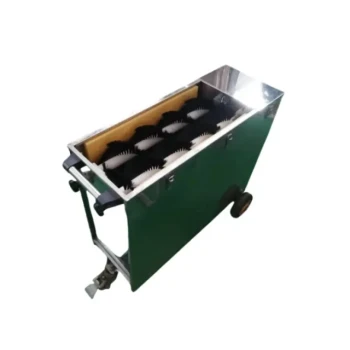
Industrial-grade production transforms beekeeping from an artisanal craft into a scalable enterprise. By manufacturing standardized beehives, protective gear, and harvesting tools, this technology significantly reduces labor intensity and operational risks. It provides the essential physical infrastructure required to shift from small-scale management to high-efficiency, large-scale commercial operations.
Core Takeaway While traditional beekeeping relies on variable, labor-intensive methods, commercialization demands consistency. Industrial-grade equipment provides the "material foundation" for this shift, ensuring that hardware is uniform, durable, and compatible with automated systems to achieve true economies of scale.
Establishing the Foundation for Scale
The Role of Standardization
The primary contribution of industrial manufacturing is absolute uniformity. High-precision hive-making machines produce components—such as frames, bottom boards, and supers—that are strictly identical.
This standardization is critical because it ensures interchangeability. In a commercial operation, a frame from Hive A must fit perfectly into Hive B, eliminating the need for custom fitting and streamlining colony management.
Enabling Rapid Infrastructure Expansion
Industrial-grade machinery allows for the mass production of hive components. Unlike manual construction, which is a bottleneck, automated manufacturing enables apiaries to rapidly deploy thousands of units.
This capability creates the economies of scale necessary for modern transformation. It allows operations to grow their infrastructure at a speed that matches commercial demand.
Enhancing Operational Efficiency
Reducing Labor and Risk
As noted in the primary reference, specialized hardware directly addresses the human element of beekeeping. Advanced protective clothing and ergonomic harvesting tools reduce the physical toll and safety risks associated with managing aggressive colonies.
By lowering labor intensity, commercial operators can manage more hives per worker. This efficiency is the defining characteristic of a profitable large-scale enterprise.
Preparing for Automation
Standardized hardware is the prerequisite for downstream automation. Automated honey extraction lines and processing systems only function correctly if the input materials (the hives and frames) have consistent dimensions.
Industrial production ensures this hardware compatibility. It bridges the gap between the field (the apiary) and the factory (the processing plant).
Optimizing Bee Biology
Precision manufacturing does more than help the beekeeper; it supports the bees. Industrial machines ensure internal dimensions align with bee biology, specifically maintaining the correct "bee space."
This precision improves overwintering conditions and enhances disease resistance. Healthy, robust colonies are the production units of the industry; protecting them through better housing directly impacts commercial yield.
Completing the Commercial Value Chain
Advanced Processing and Compliance
Commercialization extends beyond the hive. Industrial-grade honey filling machines and automated processing lines enable the deep processing of honey byproducts.
These systems utilize precise dosage control to minimize waste and ensure compliance with food safety standards. This level of quality control is mandatory for entering high-value retail markets.
Diversified Revenue Streams
The efficiency gained through industrial equipment allows for a dual-revenue model. Beekeepers can effectively manage the logistics of pollination services while simultaneously harvesting high-quality products.
The added value from processed goods helps compensate for the high management costs of pollination. This financial balance incentivizes further expansion of the operation.
Understanding the Trade-offs
The Requirement of Capital Investment
Transitioning to industrial-grade equipment requires significant upfront capital. While it reduces long-term labor costs, the initial purchase of manufacturing machinery and automated lines creates a barrier to entry for smaller operators.
Specificity vs. Adaptability
Industrial standardization is powerful, but it can be rigid. To be effective, mass production must be paired with data-driven planning, such as GIS modeling, to ensure the standardized equipment is actually suitable for the local climate (e.g., insulation for cold regions).
Making the Right Choice for Your Goal
To leverage industrial equipment effectively, align your investment with your specific commercial objective:
- If your primary focus is Rapid Expansion: Prioritize hive-making machinery to secure a supply of standardized, interchangeable components for mass colony deployment.
- If your primary focus is Market Penetration: Invest in automated filling and processing lines to ensure food safety compliance and consistent product packaging.
- If your primary focus is Efficiency Optimization: Focus on precision hardware that ensures compatibility with future automated extraction systems to reduce long-term labor costs.
Success in commercial beekeeping is no longer just about biology; it is about deploying the right industrial infrastructure to support it.
Summary Table:
| Key Support Factor | Impact on Commercialization | Primary Benefit |
|---|---|---|
| Standardization | Ensures interchangeability of hive components | Streamlined colony management at scale |
| Mass Production | Enables rapid deployment of thousands of units | Faster infrastructure expansion |
| Hardware Compatibility | Foundation for automated extraction & processing | Drastic reduction in labor costs and intensity |
| Precision Manufacturing | Optimizes 'bee space' and internal hive biology | Higher colony health and honey yields |
| Quality Control | Automated filling and processing systems | Compliance with food safety & retail standards |
Elevate Your Commercial Operation with HONESTBEE
Transitioning from artisanal craft to a scalable enterprise requires the right industrial foundation. HONESTBEE specializes in supporting commercial apiaries and distributors by providing the high-precision machinery and standardized equipment necessary for global competition.
Our value to your business:
- Comprehensive Wholesale Range: From durable hives to specialized hardware and essential consumables.
- Advanced Machinery: High-efficiency hive-making machines and automated honey-filling lines to reduce labor costs.
- Diversified Growth: Enhance your revenue through our honey-themed cultural merchandise and professional processing tools.
Ready to transform your beekeeping infrastructure for maximum efficiency? Contact HONESTBEE today to discuss your wholesale needs!
References
- Joseph Ondunga, Reuben Oyoo Mosi. Socio-economic and cultural factors influencing farmers’ group participation for commercialization of apiculture among small holder farmers in Homa bay county, Kenya. DOI: 10.33687/ijae.009.03.3587
This article is also based on technical information from HonestBee Knowledge Base .
Related Products
- Queen Bee Artificial Insemination Instrument Equipment for Instrumental Insemination
- Stainless Steel J Hook Hive Tool for Beekeeping
- Stainless Steel Queen Grafting Tool for Beekeeping and Bee Queen Grafting
- HONESTBEE Professional Mini J-Hook Hive Tool for Beekeeping
- Stainless Steel Honey Bee Smoker Hive and Honeycomb Smoker for Beekeeping
People Also Ask
- Why is maintaining sanitary conditions important during artificial insemination? Protect Your Queen from Fatal Infections
- Why are artificial insemination instruments critical in bee hybridization? Master Genetic Control & Pure Breeding
- What is the core value of bee artificial insemination instruments in breed improvement? Achieve Precise Genetic Control
- Why is professional bee artificial insemination equipment considered a core tool for genetic control in honeybee breeding? Ensure 100% Purity
- Why is high-purity CO2 used for queen bee artificial insemination? Unlock Precision Breeding & Faster Egg-Laying