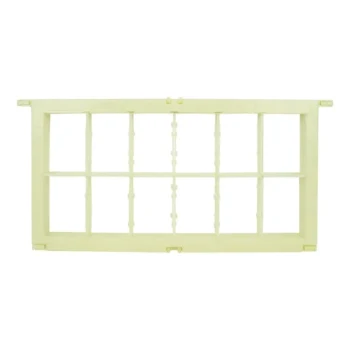
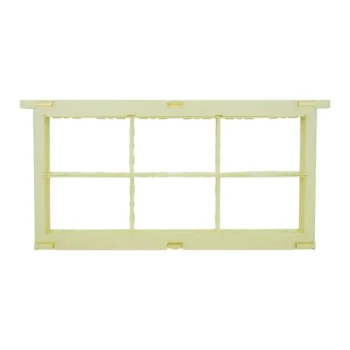
A measuring frame with a 5x5 cm grid acts as a standardized template for converting visual observations of a honeycomb into quantifiable data. By overlaying this grid onto a hive frame, you calculate the specific surface area occupied by capped brood, honey, or pollen and apply conversion factors to derive precise population counts or resource weights.
By standardizing the measurement of comb surface area, the 5x5 cm grid allows you to move beyond rough visual estimates. It provides a scientific basis for evaluating a colony's breeding capacity and nutritional status.
Transforming Surface Area into Data
To evaluate a colony effectively, you must convert physical space on the frame into actionable metrics. The measuring frame facilitates this by breaking the comb down into manageable, 25-square-centimeter units.
The Grid Overlay Process
The technician places the wire or plastic grid directly against the face of the honeycomb. This segments the irregular patches of brood or food into countable squares.
Quantifying the Coverage
You count the number of 5x5 cm squares fully occupied by the target substance (brood, pollen, or honey). For squares that are only partially filled, you estimate the coverage to the nearest fraction to maintain accuracy.
Key Metrics for Colony Evaluation
The primary value of the grid frame lies in what it measures. It targets three critical indicators of colony health and performance.
Assessing Breeding Capacity (Capped Brood)
Measuring the area of capped brood allows you to estimate the colony's reproductive potential. Since capped brood represents the next generation of workers soon to emerge, this metric is a leading indicator of future colony strength and labor availability.
Evaluating Nutritional Status (Pollen and Honey)
The grid quantifies the stores of "bee bread" (processed pollen) and honey. Accurate measurement of pollen area provides a direct assessment of the colony’s protein status, which is essential for larval development.
Estimating Honey Reserves
While total honey production is often weighed in supers, the grid frame evaluates honey storage distribution within the brood nest. This helps determine if the colony has sufficient immediate energy reserves for the brood.
From Grid Counts to Hard Numbers
The raw count of grid squares is not the final data point. You must apply a conversion factor to translate area into biological units.
Calculating Population
According to standard field metrics, there are approximately 4 worker cells per square centimeter. By multiplying the total measured surface area by this factor, you can accurately estimate the total number of developing bees.
Deriving Resource Weight
Similar conversion logic applies to food stores. The surface area of capped honey can be translated into estimated weight, allowing you to track resource accumulation without disturbing the entire hive structure to weigh it.
Understanding the Trade-offs
While the 5x5 cm grid is a robust tool for scientific evaluation, it is distinct from other methods of hive assessment.
Precision vs. Efficiency
The grid offers high granularity, showing exactly where resources are located on a frame. However, it is a manual, labor-intensive process compared to simply weighing honey supers, which provides a faster aggregate of foraging efficiency but lacks detail on colony structure.
Manual Measurement vs. Digital Automation
The grid relies on human observation. In contrast, emerging digital image monitoring systems use photography and algorithms to count brood automatically. While digital methods reduce invasiveness and human error, the physical grid remains a reliable, low-tech field standard for immediate assessment.
Making the Right Choice for Your Goal
To select the best evaluation method for your apiary, consider your specific data requirements.
- If your primary focus is breeding analysis: Use the 5x5 cm grid to calculate exact brood counts and predict population spikes.
- If your primary focus is nutritional health: Use the grid frame to quantify protein reserves (bee bread) relative to the brood population.
- If your primary focus is total production output: Rely on weighing honey supers before and after harvest for the most direct measure of foraging success.
The 5x5 cm measuring frame is the bridge between observation and calculation, turning a visual inspection into a definitive scientific evaluation.
Summary Table:
| Metric Category | Measurement Target | Key Conversion/Indicator |
|---|---|---|
| Breeding Capacity | Capped Brood Area | ~4 worker cells per cm² to predict population |
| Nutritional Status | Pollen (Bee Bread) | Quantifies protein reserves for larval growth |
| Energy Reserves | Capped Honey Area | Estimates immediate weight of food stores |
| Population Logic | 25 cm² (one 5x5 grid) | Represents ~100 potential worker bees |
Optimize Your Apiary Performance with HONESTBEE
Precise measurement is the first step toward scaling a successful beekeeping operation. At HONESTBEE, we understand the technical needs of commercial apiaries and distributors. Whether you require professional-grade measuring tools, specialized hive-making machinery, or high-efficiency honey-filling equipment, our comprehensive wholesale portfolio has you covered.
From essential consumables to advanced hardware, we provide the tools you need to turn data into production success. Contact us today to discuss how our bulk supply solutions can enhance your efficiency and strengthen your business.
References
- Rositsa Shumkova, Peter Hristov. The Herbal Supplements NOZEMAT HERB® and NOZEMAT HERB PLUS®: An Alternative Therapy for N. ceranae Infection and Its Effects on Honey Bee Strength and Production Traits. DOI: 10.3390/pathogens10020234
This article is also based on technical information from HonestBee Knowledge Base .
Related Products
- JZBZ Langstroth Queen Rearing Frame for Beekeeping
- Heavy Duty Castellated Iron Frame Spacer for Honey Supers
- Wooden Bee Hive Frames for Beekeeping and Wholesale
- Professional Sectional Comb Honey Frame with 250g Cassette System for Beekeeping
- Ergonomic Plastic Frame Spacer Tool for Rapid Hive Management Beekeeping
People Also Ask
- Why use finishing colonies for queen cell capping? Secrets to Superior Queen Quality and Performance
- How do queen rearing frames and grafting needles function together? Master the Doolittle Method for High-Quality Queens
- What is the purpose of queen rearing frames? Master Controlled Queen Production for Your Apiary
- What are the functions of queen rearing frames and artificial queen cells? Master Bee Genetic Improvement
- What roles do professional queen rearing frames and artificial queen cells play? Scaling Your Queen Bee Production