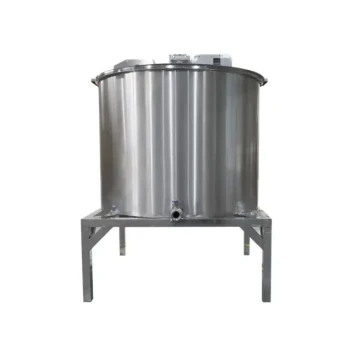
Automated honey processing equipment functions primarily to standardize raw honey through an integrated cycle of filtering, dehydration, sterilization, and refining. These systems serve to precisely control moisture levels and eliminate impurities while simultaneously safeguarding nutritional components, thereby extending shelf life and ensuring the rigorous hygiene required for modern industrial food standards.
The core value of this equipment lies in its ability to transform variable raw material into a stable, high-value commodity. By mechanically regulating moisture and sterility, automation bridges the gap between traditional beekeeping and pharmaceutical-grade manufacturing without compromising the honey's natural bioactive properties.
The Core Operational Functions
Extraction and Separation
The processing cycle begins with the separation of raw honey from beeswax honeycombs. Industrial equipment utilizes mechanical means, such as centrifugal force, to extract the liquid efficiently.
This process reduces material loss compared to manual handling. It prepares the raw material for downstream processing by separating the bulk product from the wax cappings quickly and cleanly.
Precision Filtration and Refining
Once extracted, the honey undergoes multi-stage filtration. The primary goal is to remove physical impurities such as wax particles, debris, and pollen clumps without stripping the honey of its character.
This refining process ensures the final product meets the high purity standards required for consumer and pharmaceutical markets. It converts a primary agricultural product into a polished, commercial-grade commodity.
Moisture Control and Dehydration
One of the most critical functions of this equipment is the regulation of water content. Automated systems precisely dehydrate the honey to achieve specific moisture levels.
Controlling moisture is essential for halting fermentation and extending shelf life. It ensures consistency across large batches, regardless of the environmental conditions during harvest.
Sterilization and Biological Stabilization
To meet hygiene standards, the equipment integrates sterilization processes. This step is designed to eliminate yeasts and spoilage organisms that compromise long-term storage.
However, advanced machinery performs this sterilization while preserving nutritional modules. The goal is to sanitize the product while retaining natural antibacterial components, phenolic compounds, and vitamins.
Hygiene and Standardization
Closed-Loop Sterility
Modern processing centers utilize closed-loop operating systems. This design ensures that the honey remains in a strictly sterile environment throughout filtration, sterilization, and handling.
By isolating the product from the open air, the equipment prevents external bacterial contamination. This is the hardware guarantee necessary for producing medicinal-grade honey.
Automated Filling and Packaging
The final stage of the facility involves automated filling machines. These replace labor-intensive manual pouring with precise metering controls.
Volumetric filling ensures product consistency and uniform packaging specifications. This precision minimizes waste and ensures the final product is ready for the high-end retail market.
Understanding the Operational Trade-offs
Balancing Purity with Bio-Activity
A critical operational challenge is removing impurities without degrading the honey's quality. While sterilization is necessary for shelf stability, aggressive processing can damage sensitive nutrients.
High-quality equipment is designed to navigate this trade-off. It aims to maximize the retention of physicochemical properties and flavor profiles while still achieving the sterility required for industrial distribution.
Capital Investment vs. Efficiency
Implementing this level of automation requires significant upfront investment. However, this is offset by the economic redundancy created through efficiency.
By reducing labor costs and minimizing product loss, automated centers shorten the return on investment. This scalability allows operations to reinvest in biological management tools, enhancing the overall resilience of the apiary.
Making the Right Choice for Your Goal
- If your primary focus is Pharmaceutical Grade Quality: Prioritize equipment with advanced closed-loop sterilization and filtration systems to maximize purity and prevent bacterial contamination.
- If your primary focus is Commercial Scalability: Focus on high-throughput extraction and automated filling machines to maximize consistent output and reduce labor overhead.
- If your primary focus is Product Preservation: Ensure your dehydration and refining modules utilize precise controls to retain natural phenolic compounds and vitamins.
True industrial modernization requires equipment that treats honey not just as food, but as a precise biological compound requiring sterile, standardized handling.
Summary Table:
| Core Function | Industrial Goal | Key Mechanism |
|---|---|---|
| Extraction | Efficient separation | Centrifugal force and mechanical separation |
| Filtration | Purity & refining | Multi-stage removal of wax and debris |
| Dehydration | Moisture control | Precision evaporation to halt fermentation |
| Sterilization | Biological stability | Closed-loop systems to eliminate spoilage yeast |
| Automated Filling | Scaling & consistency | Volumetric metering for precise packaging |
Modernize Your Honey Production with HONESTBEE
Transitioning from traditional beekeeping to pharmaceutical-grade manufacturing requires the right technological partner. HONESTBEE provides commercial apiaries and distributors with the specialized hardware needed to scale, including honey-filling machines, hive-making equipment, and comprehensive industrial consumables.
Our value to your business:
- Maximize Efficiency: Reduce labor costs and material loss with high-throughput machinery.
- Ensure Quality: Maintain bioactive properties while meeting rigorous hygiene standards.
- End-to-End Support: From machinery to cultural merchandise, we supply your entire operation.
Ready to elevate your production standards? Contact our experts today to build your automated facility.
References
- Subhajit Pal, Swarnali Bhattacharya. APITOURISM IN AGRITOURISM: A FUSION OF GREENERY, APICULTURE & TOURISM IN THE VALLEY OF JAMPUI HILLS OF NORTH EAST INDIA. DOI: 10.51470/plantarchives.2023.v23.no1.008
This article is also based on technical information from HonestBee Knowledge Base .
Related Products
- Fully Automatic Honey Filling Packaging Machine for Processing Line
- Automatic Honey Filling and Filtering Machine for Beekeeping Bottle Filling
- Automatic Single-Dose Snap & Squeeze Honey Sachets Packing Machine
- Manual Honey Filling Machine Bottling Machine for Honey
- Electric Double Wall Honey Filtering Machine Purifier Equipment for Honey Processing Plant
People Also Ask
- Why are fully automatic honey filling and packaging lines essential? Boost Your Honey's Market Value and Quality
- What is a fully-automatic honey filler? Streamline Your Production with High-Precision Automation
- How do automated honey filling and packaging machines affect profitability? Boost Margins with HONESTBEE Technology
- How do automated honey filling and packaging machines contribute to the market value of honey products? Maximize Your ROI
- How do industrial-grade automated honey filling and packaging machines mitigate the risk of physical contamination?