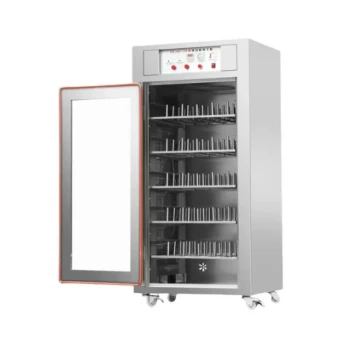
Forced convection cabinet dryers provide a decisive technical advantage over natural air drying by establishing a strictly controlled thermal environment. Through the use of precise temperature regulation systems (e.g., 55°C ± 2°C) and fan-forced air circulation, these units deliver constant heat transfer that is independent of external weather conditions. This mechanism significantly accelerates the dehydration process, allowing bee pollen to reach equilibrium moisture content in approximately 9 hours, compared to the prolonged and inconsistent timelines of natural drying.
Core Takeaway: By decoupling the dehydration process from environmental fluctuations, forced convection drying enables rapid moisture removal that secures microbiological stability while minimizing the degradation of bioactive compounds.
The Mechanics of Controlled Dehydration
Consistent Heat Transfer
Natural air drying relies on passive evaporation, which is notoriously inefficient and subject to weather variables.
Forced convection dryers utilize active air circulation to strip the boundary layer of moisture surrounding the pollen granules. This ensures that every granule receives uniform heat exposure, eliminating "wet spots" that often occur in static drying methods.
Drastic Reduction in Processing Time
The primary technical benefit of this equipment is speed.
By maintaining constant parameters, forced convection systems can complete the drying cycle in roughly 9 hours. This rapid throughput is critical for commercial scalability, whereas natural drying creates bottlenecks due to its slowness and unpredictability.
Precise Environmental Independence
High-quality cabinet dryers allow operators to dial in exact temperatures.
While natural drying exposes pollen to humidity spikes and temperature drops, a cabinet dryer maintains a specific set point (such as 55°C). This precision ensures the process remains efficient regardless of the ambient climate outside the facility.
Biological and Chemical Preservation
Inhibition of Microbial Growth
Speed is a safety feature.
Fresh bee pollen has a high initial moisture content (often 20-30%), making it an ideal breeding ground for bacteria and mold. Because forced convection dryers reduce moisture content rapidly, they narrow the window of time in which microbes can multiply, effectively inhibiting spoilage before it starts.
Retention of Bioactive Compounds
Prolonged exposure to oxygen and fluctuating temperatures degrades the nutritional value of pollen.
By shortening the drying cycle, forced convection minimizes the duration the pollen is exposed to oxidative stress. This helps preserve sensitive bioactive components, ensuring the final product maintains its chemical stability and sensory characteristics.
Understanding the Trade-offs
The Risk of Thermal Overdrive
While the primary reference notes efficient drying at 55°C, it is vital to understand the limits of heat application.
If the temperature is not precisely calibrated, there is a risk of overheating. Excessive heat can lead to lipid rancidity or the loss of volatile aromatic compounds. The advantage of the machine is not just heat, but the control of that heat; operators must calibrate the system to balance drying speed with nutrient retention.
Making the Right Choice for Your Goal
To maximize the value of a forced convection system, align your settings with your specific objectives:
- If your primary focus is Microbiological Safety: Prioritize the rapid 9-hour cycle to quickly drop moisture below 12.5%, stopping mold growth immediately.
- If your primary focus is Nutrient Preservation: Utilize the precise temperature controls to maintain lower temperatures (e.g., closer to 40-42°C) while relying on airflow for dehydration, protecting heat-sensitive proteins.
- If your primary focus is Commercial Consistency: Leverage the independence from weather conditions to standardize your drying times, ensuring every batch meets the same sensory and stability metrics for transport.
The ultimate value of forced convection is not just faster drying, but the ability to reproduce a high-quality result continuously.
Summary Table:
| Feature | Natural Air Drying | Forced Convection Cabinet Drying |
|---|---|---|
| Drying Time | Prolonged & Unpredictable | ~9 Hours (Consistent) |
| Temperature Control | Passive / Weather Dependent | Precise (e.g., 55°C ± 2°C) |
| Moisture Removal | Inconsistent (Static) | Uniform (Fan-Forced Airflow) |
| Microbial Safety | High Risk of Mold/Spoilage | Inhibits Growth via Rapid Dehydration |
| Nutrient Retention | Low (Oxidative Stress) | High (Shortened Cycle) |
| Scalability | Low / Limited by Space | High / Commercial Efficiency |
Scale Your Apiary Operations with HONESTBEE Professional Equipment
Transitioning from manual processes to automated efficiency is the key to commercial success in beekeeping. At HONESTBEE, we empower commercial apiaries and global distributors by supplying high-performance beekeeping machinery designed for precision and durability.
Whether you need specialized forced convection dryers for premium pollen production, advanced honey-filling machines, or robust hive-making hardware, our comprehensive wholesale catalog has you covered. We bridge the gap between traditional beekeeping and modern industrial excellence, providing the tools and essential consumables you need to ensure product stability and maximize yield.
Ready to upgrade your processing facility? Contact our experts today to receive a tailored quote and discover how HONESTBEE can streamline your path to a higher-quality harvest.
References
- Carlos Mario Zuluaga‐Domínguez, Marta Quicazán. Effects of Solar Drying on the Structural and Thermodynamic Characteristics of Bee Pollen. DOI: 10.17533/udea.vitae.v29n3a350572
This article is also based on technical information from HonestBee Knowledge Base .
Related Products
- HONESTBEE Professional Cabinet Bottle Dryer
- High Quality Honey Dehumidifier Dryer Thickening Machine for Beekeeping
- High Performance Cordless Electric Bee Shaker for Beekeeping
People Also Ask
- Why use a Cabinet Drier for pollen at 38–41°С? Protect Sample Integrity and Heavy Metal Data Accuracy
- What is the role of an industrial forced-air drying oven in bee bread fermentation? Optimize Moisture and Nutrients
- What is the primary purpose of a constant temperature drying oven in bee bread production? Achieve Perfect Fermentation
- How do forced circulation drying ovens sterilize beekeeping tools? Efficient Oxidation for Metal Equipment Safety
- What are the technical requirements for using a constant temperature drying oven for raw propolis? Expert Guide