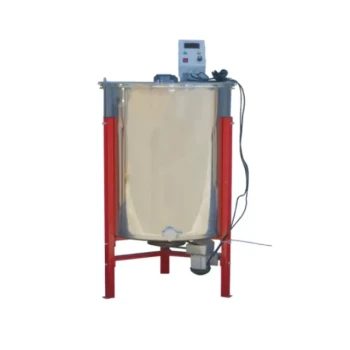
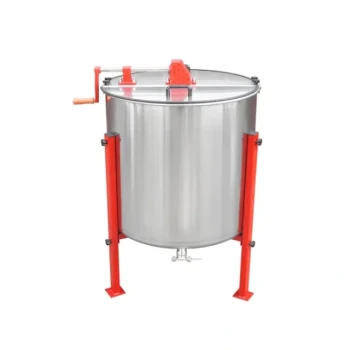
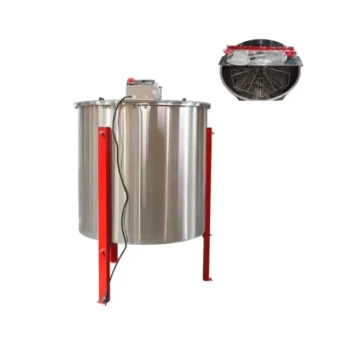
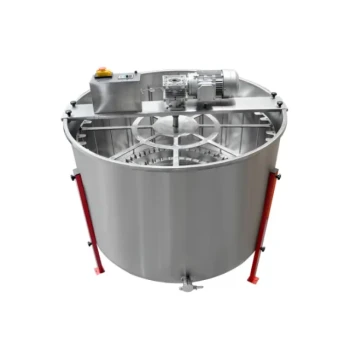
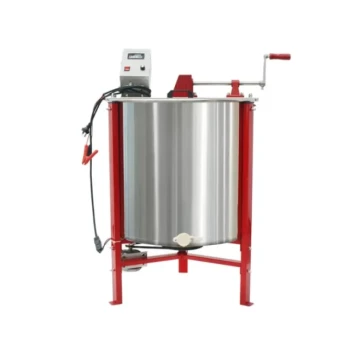
The primary function of a Centrifugal Honey Extractor is to isolate liquid honey from the honeycomb through the application of high-speed rotational force. This mechanical process expels the honey from the cells without compromising the physical integrity of the wax structure. Consequently, the empty honeycombs are preserved for immediate reuse within the apiary.
The extractor’s true value lies in resource conservation: by preserving the wax comb, it eliminates the need for bees to consume honey to rebuild their hive. This shifts the colony's energy expenditure from construction to nectar collection, significantly boosting production efficiency.
The Mechanics of Extraction
Leveraging Centrifugal Force
The device operates by spinning honeycomb frames at high velocities within a drum. This rotation generates sufficient centrifugal force to throw the honey outwards, effectively separating it from the comb. This mechanized method ensures a high collection rate compared to gravity-based drainage.
Maintaining Structural Integrity
Unlike primitive harvesting methods that crush the comb, this extractor leaves the physical structure of the wax intact. The honeycomb exits the machine empty but structurally sound. This preservation is the defining technical advantage of centrifugal extraction.
Efficiency and Biological Impact
Reducing Colony Energy Expenditure
Bees must consume significant amounts of honey to secrete wax and rebuild damaged combs. By returning intact frames to the hive, you remove this metabolic burden from the colony. This allows the bees to redirect their energy toward nectar collection rather than reconstruction.
Shortening the Production Cycle
Because the bees do not need to rebuild the hive infrastructure, they can immediately begin refilling the cells. This drastically shortens the time required for subsequent honey storage. For commercial apiaries, this acceleration is critical for maximizing yield during short flowering seasons.
Operational Requirements and Trade-offs
The Requirement for Filtration
While efficient, the centrifugal process inevitably dislodges beeswax fragments and other solid impurities along with the honey. Therefore, the extracted honey requires subsequent physical filtration. This step is necessary to remove particulates and achieve commercial clarity while preserving natural enzymes.
Material Considerations
Honey is naturally acidic, which presents a risk of corrosion for processing equipment. It is critical that extractors, particularly Stainless Steel models, are used to resist this acidity. This prevents chemical contamination and ensures the final product meets food safety standards.
Making the Right Choice for Your Apiary
To optimize your honey production, align your equipment choice with your specific operational goals.
- If your primary focus is Production Volume: Prioritize centrifugal extraction to maximize the reuse of combs, which directly reduces the energy bees spend on wax secretion.
- If your primary focus is Product Purity: Ensure your extractor utilizes stainless steel components to prevent corrosion from honey acidity and maintain strict hygiene standards.
Centrifugal extraction transforms beekeeping from a resource-intensive cycle of rebuilding into a streamlined system of continuous harvest.
Summary Table:
| Feature | Centrifugal Extraction Benefit | Impact on Honey Production |
|---|---|---|
| Mechanism | High-speed rotational force | Rapidly expels liquid honey from honeycomb cells. |
| Comb Integrity | Preserves wax structure | Allows immediate reuse of frames by the bee colony. |
| Energy Efficiency | Reduces wax secretion needs | Redirects bee energy from construction to nectar collection. |
| Material | Stainless Steel construction | Prevents corrosion from acidity and ensures food safety. |
| Output | High-volume yield | Shortens the production cycle for faster harvesting. |
Scale Your Honey Production with HONESTBEE
Are you looking to maximize your harvest efficiency and preserve your colony's resources? HONESTBEE specializes in supporting commercial apiaries and distributors with high-performance centrifugal honey extractors and a complete range of stainless steel processing machinery.
From industrial-grade honey-filling machines to essential hive-making tools and consumables, we provide the hardware and expertise needed to streamline your operations. Contact us today to discover how our wholesale solutions and honey-themed merchandise can grow your business and enhance your yield.
References
- M. Polat, Mustafa Agâh Tekindal. Economic analysis of beekeeping enterprises producing chestnut honey Black Sea region in Türkiye. DOI: 10.1080/23311932.2023.2237279
This article is also based on technical information from HonestBee Knowledge Base .
Related Products
- electric honey extractor honey centrifuge 3 frame honey extractor stainless steel honey frame extractor
- Manual Hand Crank 4 Frame Honey Extractor Centrifuge for Beekeeping
- Professional 4 Frame Self Reversing Electric Honey Extractor for Beekeeping
- 24 Frame Honey Extractor Commercial Radial Honey Frame Extraction Machine
- Electric 4 Frame Tangential Honey Extractor
People Also Ask
- What are the characteristics of electric honey extractors? Boost Your Apiary Efficiency with Automated Technology
- What are the disadvantages of using an electric honey extractor? Weighing Cost, Power, and Comb Safety
- What are the advantages of an electric honey extractor? Boost Efficiency and Scale Your Honey Production
- What are the technical advantages of electric honey extractors? Maximize Yield and Protect Your Bee Colony
- How does an electric honey extractor affect the quality of honey? Preserve Flavor & Purity with Precision Extraction