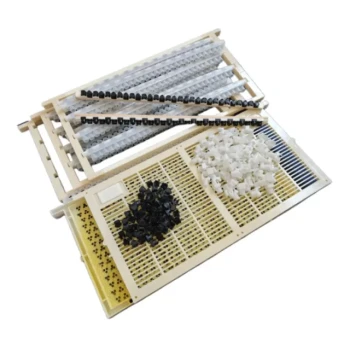
Precision breeding tools and data recording systems serve as the critical feedback loop for effective conservation. They allow breeders to move beyond guesswork by accurately tracking essential behavioral and phenological traits, ensuring that native honeybee subspecies remain genetically distinct, productive, and resilient against threats like the Varroa mite.
The Core Insight Conservation is not just about keeping bees alive; it is about maintaining their adaptation to specific environments. Data-driven management ensures that selected populations are perfectly synchronized with local climatic conditions and floral resources, securing the long-term vitality of the subspecies.
The Mechanics of Protective Breeding
Monitoring Behavioral and Phenological Traits
To protect a native subspecies, you must first understand its unique rhythm. Precision tools allow for the exact tracking of worker bee foraging cycles and queen egg-laying rhythms.
By recording this data, breeders can verify that the colony’s biological clock matches the local environment. This synchronization is critical for survival during seasonal shifts or periods of resource scarcity.
Selecting for Disease Resistance
Modern breeding is not solely about honey production; it is about resilience. Data recording systems are essential for monitoring Varroa mite tolerance and other disease resistance markers.
Systematic recording allows breeders to identify specific colonies that naturally suppress mite populations. Propagating these traits reduces reliance on chemical treatments and strengthens the overall health of the native population.
Ensuring Genetic Integrity
Protective breeding requires proof of identity. High-precision sampling and fixation tools are necessary to collect fragile tissues, such as worker bee wings, without causing mechanical damage.
The structural integrity of the wing is a prerequisite for calculating the Cubital Index, a key metric for classifying subspecies. Even minor tears from improper handling can skew classification results, leading to the accidental inclusion of hybridized bees in a conservation program.
Understanding the Trade-offs
The Fragility of Data
The reliance on precision metrics introduces a specific vulnerability: mechanical error. As noted with wing sampling, a physical deformation during collection renders the data useless.
If the input data—whether physical samples or behavioral logs—is flawed, the breeding decisions based on that data will be incorrect. This requires a higher level of discipline and training than traditional beekeeping.
Safety vs. Access
Some native subspecies exhibit high defensiveness or collective aggression. While not a "breeding tool" in the genetic sense, specialized protective gear is a prerequisite for data collection.
Without robust barriers against stings, breeders cannot perform the frequent, detailed inspections required for data recording. The trade-off is that working with these resilient but aggressive subspecies requires significant investment in safety equipment to ensure operational continuity.
Making the Right Choice for Your Goal
To apply these principles effectively, align your tooling with your specific objective:
- If your primary focus is Genetic Purity: Prioritize high-precision fixation tools to ensure wing samples are undamaged for accurate Cubital Index classification.
- If your primary focus is Long-Term Vitality: Invest in data systems that track phenological traits, ensuring your population remains adapted to local floral and climatic cycles.
True protective breeding relies on the rigorous application of data to turn raw biological potential into sustainable survival.
Summary Table:
| Feature | Importance in Breeding | Key Benefit |
|---|---|---|
| Data Recording Systems | Tracks foraging cycles and phenology | Ensures bees are synchronized with local climate |
| Precision Sampling Tools | Protects wing integrity for Cubital Index | Guarantees accurate subspecies classification |
| Disease Monitoring | Identifies Varroa mite tolerance markers | Promotes natural resilience without chemicals |
| Advanced Safety Gear | Enables frequent and detailed inspections | Allows safe data collection from aggressive native species |
Elevate Your Conservation Impact with HONESTBEE
Protecting the genetic legacy of native honeybee subspecies requires more than dedication—it requires precision. At HONESTBEE, we specialize in supporting commercial apiaries and distributors with the high-performance tools and machinery necessary for scientific breeding and efficient management.
Whether you are scaling a conservation project or managing a distribution network, our comprehensive wholesale offering provides everything from specialized hive-making and honey-filling machinery to the high-precision hardware needed for data-driven selection. Partner with us to ensure your colonies are resilient, productive, and perfectly adapted.
Ready to upgrade your apiary’s technical capabilities? Contact us today to explore our wholesale solutions.
References
- Cédric Alaux, Axel Decourtye. Pitting Wild Bees Against Managed Honey Bees in Their Native Range, a Losing Strategy for the Conservation of Honey Bee Biodiversity. DOI: 10.3389/fevo.2019.00060
This article is also based on technical information from HonestBee Knowledge Base .
Related Products
- Stainless Steel Beekeeping Queen Grafting Tool for Honey Bee Rearing
- Plastic Beekeeping Honey Bee Larvae Grafting Tools for Queen Rearing and Chinese Grafting
- Double Head Beekeeping Grafting Tools for Beekeepers
- Queen Bee Artificial Insemination Instrument Equipment for Instrumental Insemination
- Plastic Chinese Queen Grafting Tool for Bee Queen Rearing
People Also Ask
- What is the process of grafting in honey bee queen rearing? A Master Guide for Commercial Success
- Why is it necessary for migratory beekeeping enterprises to utilize professional queen bee rearing tools? Boost Resilience
- What is the step-by-step process for using a queen grafting tool? Master Larva Transfer for Better Queen Rearing
- What is the primary function of a queen grafting tool? Master Precise Larval Transfer for High Queen Acceptance
- What are the benefits of using a queen grafting tool for queen rearing? Master Precision for Superior Bee Genetics