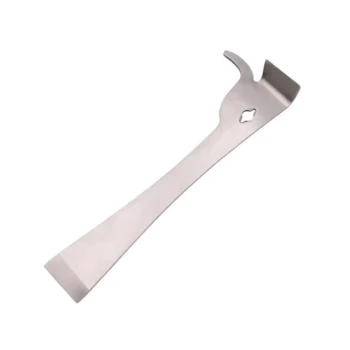
A hand-held lever, or hive tool, is an absolute necessity because honeybees naturally seal hive components with a resinous substance called propolis, effectively cementing frames in place. This specialized tool provides the mechanical leverage required to break these strong seals without destroying the delicate honeycomb, while also serving as a scraper to maintain internal hive hygiene.
Core Takeaway: Beekeeping requires force and precision; the hive tool converts manual effort into mechanical advantage, allowing you to pry apart propolis-sealed components and scrape away debris without damaging the hive's wooden structure or the wax comb.
Overcoming the Hive's Structural Integrity
The Propolis Seal
Bees secrete propolis to fill gaps, stabilize the hive, and reinforce components.
This natural "glue" hardens significantly, making it nearly impossible to separate boxes or lift frames using only your hands.
The Necessity of Mechanical Advantage
The primary function of the hand-held lever is to provide mechanical advantage.
By inserting the tool between components, you can exert controlled force to break the propolis seal. This allows for precise prying rather than brute-force pulling, which is essential for working with tightly fitted parts.
Protecting Delicate Components
Preserving the Honeycomb
The honeycomb structure is fragile and easily damaged by erratic movements.
If you attempt to jerk a frame loose by hand, the sudden release of friction can cause the frame to snap or the wax to crumble. The lever allows for a smooth, vertical lift that keeps the comb intact.
Preventing Damage to Wooden Frames
Professional hive tools are designed with specific leverage structures to interact safely with wood.
Using improvised tools—like screwdrivers or knives—often results in gouging the wooden frames or hive bodies. The hive tool distributes pressure more evenly to prevent structural damage to the hardware.
Hygiene and Maintenance
The Scraper Function
Beyond leverage, the tool acts as a heavy-duty scraper.
It is used to remove excess beeswax (burr comb) and propolis buildup that distorts the spacing of the frames.
Ensuring Frame Recyclability
Regular scraping is vital for the long-term utility of your equipment.
By cleaning residues from the hive body and frame edges, you ensure the frames fit correctly and can be recycled for future seasons.
Understanding the Common Pitfalls
The Risk of Component Gouging
While the tool is designed to protect wood, it is still a hard metal instrument.
Applying leverage at the wrong angle or with excessive force can gouge the wooden rabbets (frame rests), creating rough spots where pests can hide or propolis can accumulate more heavily.
Hygiene Cross-Contamination
Because the tool is used to scrape waste and propolis, it becomes a vector for hive pathogens.
Moving a dirty tool between different hives without cleaning it can spread diseases. The tool itself requires regular cleaning to remain an asset rather than a liability.
Making the Right Choice for Your Goal
To get the most out of your equipment, match your technique to your objective:
- If your primary focus is Inspection and Maintenance: Prioritize using the tool's scraper edge to remove burr comb from the top and bottom bars, ensuring frames sit flush when the hive is closed.
- If your primary focus is Honey Extraction: Focus on using the lever's flat end to gently break the propolis seal between the frame ears and the hive body before lifting, protecting the honey-filled wax from cracking.
The hive tool is the extension of the beekeeper's hand; use it to apply force where the bees have built strength, and precision where they have built fragility.
Summary Table:
| Feature of Hive Tool | Primary Function | Benefit to Beekeeper |
|---|---|---|
| Mechanical Leverage | Breaks hardened propolis seals | Allows frame removal without damaging hive structure |
| Scraper Edge | Removes burr comb and debris | Maintains proper frame spacing and hive hygiene |
| Flat/Hook End | Provides controlled prying force | Prevents sudden movements that could crack wax frames |
| Steel Construction | Durable heavy-duty cleaning | Ensures long-term equipment utility and recyclability |
Elevate Your Beekeeping Operation with HONESTBEE
Maximize your apiary's productivity and protect your investment with high-quality tools designed for professionals. HONESTBEE specializes in serving commercial apiaries and distributors with a comprehensive wholesale range, including:
- Precision Beekeeping Tools: Durable hive tools and hardware built for heavy-duty use.
- Advanced Machinery: State-of-the-art honey-filling and hive-making machines.
- Essential Consumables: A full spectrum of supplies to keep your colonies thriving.
- Cultural Merchandise: Unique honey-themed products to diversify your retail portfolio.
Whether you are scaling your production or stocking a distribution network, our expert team is ready to provide the equipment you need to succeed.
Contact HONESTBEE today to discuss your wholesale requirements!
References
- Telly Yarita Macías Zambrano, Yesenia Dioselina Macías Zambrano. Honey, pollen and propolis in therapeutic treatments for COVID-19. DOI: 10.53730/ijhs.v6n1.3766
This article is also based on technical information from HonestBee Knowledge Base .
Related Products
- HONESTBEE Professional Long Handled Hive Tool with Precision Cutting Blade
- Professional Multi-Function Stainless Steel Hive Tool
- HONESTBEE Premium Italian Style Hive Tool with Hardwood Handle
- Ergonomic Plastic Frame Spacer Tool for Rapid Hive Management Beekeeping
- Professional Grade Foldable Beehive Handles
People Also Ask
- Why are professional hive tools considered indispensable? Master Beekeeping Maintenance with Precision Leverage
- What is the role of professional hive tools in routine apiary maintenance? Expert Tips for Hive Health and Longevity
- What is a bee hive tool? Discover Why It’s the Most Essential Hand Tool for Every Beekeeper
- How do hive tools and queen rearing equipment facilitate the bee colony splitting process? Restore Your Apiary Faster
- Why are professional hive tools & observation equipment necessary for queen rearing evaluation? Master Your Quality