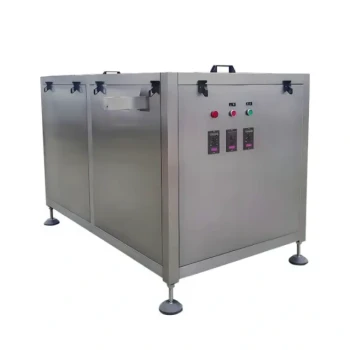
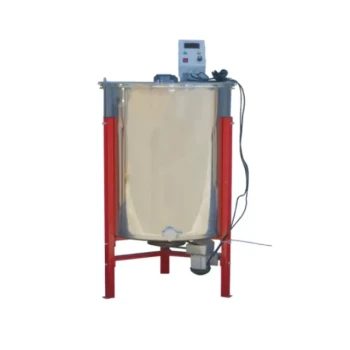
A high-speed benchtop centrifuge is necessary to generate the intense physical force required to separate microscopic pollen grains from the liquid honey matrix. Specifically, speeds of approximately 3500 rpm force the pollen to aggregate rapidly at the bottom of the tube, creating a concentrated sediment that gravity alone cannot achieve.
The Core Insight Pollen content in honey is extremely low and suspended in a dense, sugary liquid. The centrifuge acts as a mechanical accelerator, enriching trace biological material into a high-density sample while allowing for the removal of interfering fluids.
Overcoming the Physical Properties of Honey
To understand why a centrifuge is non-negotiable, you must first understand the physical obstacles presented by honey samples.
The Challenge of Low Concentration
Pollen is present in honey in trace amounts. Because the quantity is so small, analyzing raw honey directly under a microscope often yields insufficient data.
Specific Gravity and Suspension
Pollen grains have a specific gravity that causes them to remain suspended in the viscous honey solution. Without external force, these particles will not settle efficiently, making manual extraction impossible.
The Mechanics of Extraction
The benchtop centrifuge solves the suspension problem through a process of solid-liquid separation.
Creating the Sediment Pellet
By spinning the sample at high speeds (often 3500 rpm for up to 45 minutes), the centrifuge applies force that exceeds the natural buoyancy of the pollen. This drives the solid palynological material to the bottom of the test tube, forming a tight pellet or sediment.
Enabling Microscopic Clarity
The primary goal is to create a slide with high pollen density. The centrifugation process concentrates the solids, ensuring the sample meets the visual requirements for accurate microscopic examination and identification.
Purification Through Washing cycles
This equipment also facilitates purification. After the pollen settles, the liquid supernatant (containing sugars and other interfering substances) can be removed. Through multiple cycles of washing and spinning, you isolate the pollen from the sugary matrix, resulting in a cleaner sample.
Understanding the Process Constraints
While essential, the centrifugation process requires precise control to be effective.
The Necessity of High Speed
Low-speed centrifugation is often inadequate for this application. The force must be sufficient to overcome the viscosity of the diluted honey; otherwise, smaller pollen grains may remain suspended and be lost during the decanting phase.
Time Management
Speed alone is not always enough. As noted in the data, efficient settling can require significant run times (e.g., 45 minutes). Rushing this process leads to poor sedimentation and inaccurate analysis of the honey's floral source.
Making the Right Choice for Your Analysis
When establishing your protocol for melissopalynology (honey pollen analysis), consider your specific analytical goals.
- If your primary focus is quantitative accuracy: Ensure your centrifuge can maintain 3500 rpm consistently to prevent the loss of lighter pollen grains during the separation process.
- If your primary focus is image clarity: Utilize the centrifuge for multiple washing cycles to fully remove dissolved sugars that distort microscopic visibility.
By leveraging high-speed separation, you transform a cloudy, distinct mixture into a clear, concentrated dataset ready for analysis.
Summary Table:
| Feature | Requirement for Honey Analysis | Benefit |
|---|---|---|
| Rotational Speed | Approx. 3500 rpm | Overcomes honey's viscosity to force sediment formation. |
| Process Goal | Solid-Liquid Separation | Creates a concentrated pollen pellet for microscopic clarity. |
| Typical Run Time | Up to 45 minutes | Ensures even the smallest pollen grains settle effectively. |
| Application | Purification/Washing | Removes sugary supernatant to prevent visual distortion. |
Scale Your Honey Production and Quality Control with HONESTBEE
At HONESTBEE, we understand that precision in honey analysis is just as critical as efficiency in the field. As a leading provider for commercial apiaries and distributors, we offer a comprehensive wholesale range of beekeeping tools, machinery, and essential consumables.
Whether you need advanced honey-filling machines, specialized hive-making hardware, or laboratory-grade equipment to ensure your honey's purity and origin, we have the expertise to support your growth. Our portfolio is designed to enhance your operational value—from the hive to the final bottled product.
Ready to elevate your beekeeping business? Contact us today to discuss our wholesale offerings and discover how our specialized equipment can streamline your success!
References
- Gülsüm YETKİN, Serdar Makbul. Melissopalynological and Physico-Chemical Properties of Cimil Plateau (Rize) Honey. DOI: 10.53501/rteufemud.1209594
This article is also based on technical information from HonestBee Knowledge Base .
Related Products
- Fully Automatic High Speed Centrifugal Bottle Unscrambler
- electric honey extractor honey centrifuge 3 frame honey extractor stainless steel honey frame extractor
- Professional 4 Frame Self Reversing Electric Honey Extractor for Beekeeping
- Manual Hand Crank 4 Frame Honey Extractor Centrifuge for Beekeeping
People Also Ask
- What is the technical purpose of using a high-speed centrifuge in honey analysis? Ensure Purity and Quality Standards
- What role does a high-speed centrifuge play in the preliminary processing of raw honey? Enhancing Purity and Clarity
- Why are 15ml centrifuge tubes essential for honey sampling? Ensure Sample Integrity and Analytical Accuracy
- How does a rotational viscometer contribute to the quality assessment of honey? Ensure Perfect Texture and Flow
- What are the advantages of using 15 mL centrifuge tubes for bee pollen? Enhance Sample Integrity and Chemical Resistance