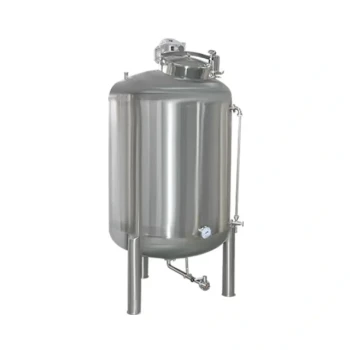
A metal support frame is critical because it acts as an internal skeleton to prevent the collection tank from imploding. When the vacuum pump removes air to harvest honey, it creates a powerful pressure differential where the external atmosphere pushes inward against the tank walls. Without this structural reinforcement, the tank would collapse or permanently deform under the stress.
The support frame ensures the tank retains its shape against the immense force of atmospheric pressure. Its primary role is to maintain structural rigidity, guaranteeing a stable vacuum environment and preserving the physical integrity of the honey storage space.
The Mechanics of Structural Reinforcement
Counteracting Pressure Differentials
A vacuum pump functions by evacuating air from the tank to create suction. This lowers the internal pressure significantly compared to the outside environment.
The resulting pressure differential exerts a continuous inward force on every square inch of the tank's surface. The metal frame absorbs this load, preventing the external atmosphere from crushing the container.
Providing Essential Rigidity
Many tanks are designed to hold liquid, not to withstand negative pressure (suction). Materials that hold honey well may not naturally possess the stiffness required to resist vacuum forces.
The integrated metal frame adds the necessary structural rigidity. It ensures the walls remain static rather than buckling inward when the system reaches operating vacuum levels.
Operational Integrity and Safety
Preserving Storage Capacity
The primary reference notes that the frame preserves the "integrity of the storage space." If a tank were to deform, its internal volume would decrease unpredictable.
By maintaining the tank's geometry, the frame ensures you utilize the full rated capacity for honey collection. It prevents the walls from encroaching on the harvested product.
Stabilizing the Vacuum Environment
For a vacuum harvester to work efficiently, the pressure must remain constant. A tank that flexes or warps creates volume fluctuations that can destabilize the vacuum.
The frame ensures a stable vacuum environment. This consistency allows the pump to operate efficiently and maintains the steady suction required to pull honey from the combs.
Understanding the Trade-offs
Internal Obstructions and Cleaning
While the frame provides necessary strength, placing a structure inside a food storage tank introduces cleaning challenges.
Honey is viscous and sticky; an internal frame creates additional surface area and potential crevices where product can linger. Operators must be diligent during cleaning to ensure no residue is left behind on the support struts.
Material Weight and Cost
Adding a metal framework increases the overall weight of the collection unit. This can impact portability if the system is designed to be mobile.
Furthermore, because the frame contacts food product, it requires high-quality, corrosion-resistant materials. This necessity invariably increases the manufacturing cost compared to non-reinforced gravity tanks.
Making the Right Choice for Your Goal
To ensure your vacuum harvesting system remains safe and efficient, consider the following factors regarding the tank construction:
- If your primary focus is Equipment Longevity: Prioritize tanks with heavy-duty internal framing to prevent material fatigue from repeated pressure cycles.
- If your primary focus is Hygiene and Maintenance: Ensure the internal frame design minimizes blind spots or crevices where honey can become trapped and difficult to clean.
A robust support frame is not an optional accessory; it is the fundamental component that makes vacuum harvesting physically possible and safe.
Summary Table:
| Feature | Purpose | Benefit |
|---|---|---|
| Structural Reinforcement | Counteracts pressure differentials | Prevents tank implosion and deformation |
| Mechanical Rigidity | Supports tank walls | Ensures physical integrity under high vacuum |
| Volume Preservation | Maintains tank geometry | Guarantees full storage capacity for honey |
| Pressure Stability | Minimizes wall flexing | Maintains consistent suction for efficient harvesting |
Maximize Your Harvest with HONESTBEE Professional Equipment
At HONESTBEE, we understand the engineering precision required for high-volume honey production. As a leading provider for commercial apiaries and distributors, we offer a comprehensive wholesale range of beekeeping tools, specialized machinery, and essential consumables.
From honey-filling machines to heavy-duty harvesting systems designed for longevity and safety, our portfolio is built to support your business growth. Whether you are scaling your operations or sourcing high-quality honey-themed cultural merchandise, we provide the expertise and hardware you need.
Contact us today to explore our wholesale solutions and see how our equipment can enhance your apiary's efficiency!
References
- Agus Sutejo, Agmi Sinta Putri. Karakteristik Alat Pemanen Madu Tipe Isap dengan Variasi Tekanan Vakum. DOI: 10.23960/jabe.v4i2.10906
This article is also based on technical information from HonestBee Knowledge Base .
Related Products
- Professional Honey Storage Tank with Agitation System
- Stainless Steel Honey Storage Tank with Lid for Honey
- Stainless Steel Honey Storage and Settling Tank with Double Strainer
- Stainless Steel Uncapping Tank with Stand and Strainer
- Heavy Duty Stainless Steel Honey Processing Machine Decrystallizing Tank
People Also Ask
- What economic role do honey storage tanks play? Boost Your Revenue Through Strategic Inventory Management
- What roles do industrial honey storage tanks and filtration meshes play in processing? Ensure Purity & Consistency
- What is the purpose of a honey storage tank? Streamline Your Honey Processing for Quality & Efficiency
- What are honey storage tanks used for? Essential Features for Quality Preservation and Profit
- How do large honey storage tanks and gravity fall filling systems improve honey packaging efficiency and safety?