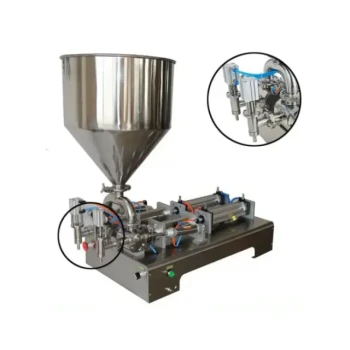
Automated honey-filling machines are the technological linchpin that allows commercial apiaries to bridge the gap between bulk extraction and retail distribution. These systems provide the critical hygiene controls and precise volumetric measurements necessary to transfer honey from storage tanks to market-ready containers without compromising the product's integrity.
Core Takeaway For large-scale operations, automation is not a luxury but a prerequisite for market viability; it guarantees the physicochemical stability of the honey and eliminates the variation inherent in manual processing, ensuring compliance with strict international food safety standards.
The Imperative of Hygiene and Product Stability
Eliminating Secondary Contamination
In mass production, the greatest risk to honey quality occurs during the transfer phase. Manual handling introduces significant risks of secondary contamination from human contact or environmental exposure.
Automated machines utilize enclosed operations that isolate the honey during filling. This strict hygiene protection is the only reliable method to prevent microbial contamination and ensure the product remains safe for consumption.
Preserving Physicochemical Properties
Honey is a sensitive biological product; its quality can degrade if exposed to improper handling or environmental fluctuations.
The primary reference indicates that automation ensures the stability of the product's physicochemical properties. By standardizing the transfer speed and environment, these machines prevent the degradation that can occur during slower, inconsistent manual filling processes.
Precision Economics and Standardization
Exact Volumetric Control
Commercial success depends on delivering a consistent product that meets net weight regulations. Automated filling provides high-precision volumetric measurement, ensuring every jar contains exactly what the label claims.
This consistency is vital for brand reputation. It prevents consumer complaints regarding under-filled containers and avoids legal issues associated with weight discrepancies.
Minimizing Raw Material Loss
When honey yields fluctuate due to environmental factors, protecting every ounce of output is critical.
Precision metering systems effectively prevent honey overflow and measurement errors. By minimizing raw material loss, producers maximize their yield from each harvest, directly impacting the bottom line.
Operational Efficiency and Scale
Handling Seasonal Production Surges
Honey production is rarely linear; it often comes in intense seasonal waves.
Industrial-grade filling machines significantly increase packaging efficiency, allowing apiaries to handle these seasonal production surges without bottlenecks. This speed ensures bulk honey is converted into retail packaging while fresh, rather than sitting in storage.
Meeting Export Requirements
Accessing high-value export markets requires adherence to rigorous international standards.
The standardized hygiene and precise weight control provided by automation are often decisive factors for entering these markets. Manual operations simply cannot consistently meet the strict data and safety requirements of global supply chains.
Understanding the Risks of Manual Processing
The Cost of Inconsistency
While manual filling may seem cost-effective for hobbyists, it introduces "hidden costs" for commercial entities.
The primary pitfall is measurement error. Overfilling thousands of units by a small margin results in massive product loss over time, while inconsistent sealing can lead to spoilage or leakage.
The Barrier to Branding
Manual processing limits a producer's ability to scale their brand.
Without the standardized appearance and assured safety that automation provides, honey products cannot compete for shelf space in professional retail environments. Automation is the hardware foundation required for professional branding and distribution.
Making the Right Choice for Your Goal
To determine how to integrate this technology into your workflow, assess your primary business objective:
- If your primary focus is Market Entry and Export: Prioritize automation to meet international food safety standards and guarantee the hygienic compliance required for high-value trade.
- If your primary focus is Profitability and Yield: Focus on the machine's precision metering capabilities to eliminate overflow, minimize waste, and maximize the economic return on every liter of honey produced.
Ultimately, automated filling allows producers to shift from simple extraction to professional manufacturing, securing both product quality and economic growth.
Summary Table:
| Feature | Manual Filling | Automated Filling |
|---|---|---|
| Hygiene Control | High risk of secondary contamination | Enclosed systems; minimizes microbial risk |
| Precision | Variable; prone to overflow/underfill | High-precision volumetric metering |
| Efficiency | Slow; bottleneck during peak seasons | High-speed; manages seasonal production surges |
| Product Loss | Significant waste through errors | Optimized yield with minimal raw material loss |
| Market Readiness | Limited to local/hobbyist sales | Meets international food safety & export standards |
Scaling Your Apiary Operations with HONESTBEE
At HONESTBEE, we understand that for commercial apiaries and distributors, precision is the difference between profit and loss. We offer a comprehensive suite of professional beekeeping machinery, including high-precision honey-filling machines and specialized hive-making hardware, designed to transform your bulk honey into market-ready assets.
Why partner with HONESTBEE?
- Industry-Leading Equipment: From extraction to packaging, our machinery ensures compliance with global safety standards.
- Maximum Yield: Minimize raw material waste with our precision metering technology.
- Total Solutions: We supply everything from heavy machinery to essential industry consumables and cultural merchandise.
Ready to enhance your production capacity and access high-value export markets? Contact our experts today to find the perfect wholesale solutions for your business.
References
- D. Panigrahi, S. Samal. Bee Flora Diversity in Dhenkanal District of Odisha. DOI: 10.20546/ijcmas.2020.909.450
This article is also based on technical information from HonestBee Knowledge Base .
Related Products
- Fully Automatic Honey Filling Packaging Machine for Processing Line
- Automatic Honey Filling and Filtering Machine for Beekeeping Bottle Filling
- Precision Durable Efficient HONESTBEE Rotary Honey Filling Machine
- Precision Automated Packaging Turntable Honey Spoon Filling Sealing Packing Machine
- Semi Automatic Small Honey Bottle Filling Machine Honey Filler
People Also Ask
- Why are fully automatic honey filling and packaging lines essential? Boost Your Honey's Market Value and Quality
- What is a fully-automatic honey filler? Streamline Your Production with High-Precision Automation
- How do automated honey filling and packaging machines affect profitability? Boost Margins with HONESTBEE Technology
- How do automated honey filling and packaging machines contribute to the market value of honey products? Maximize Your ROI
- How do industrial-grade automated honey filling and packaging machines mitigate the risk of physical contamination?