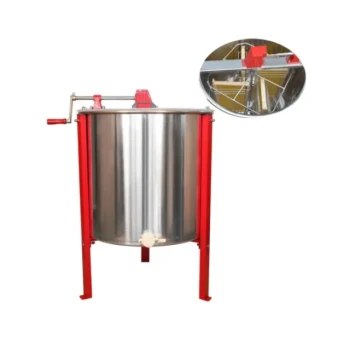
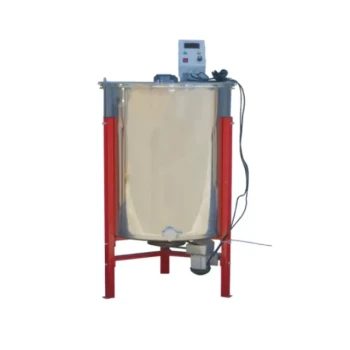
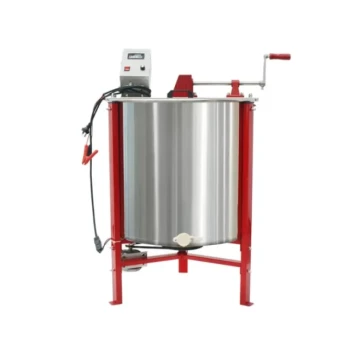
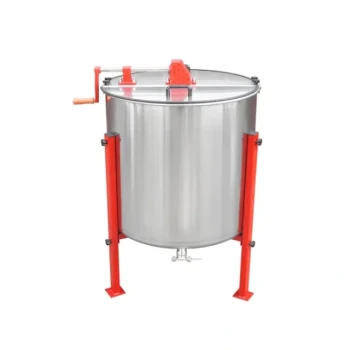
Balancing frames properly is the single most critical factor for safe and effective honey extraction. If the weight within the extractor is not distributed evenly, the centrifugal force generated during operation causes the machine to become unsteady and shake violently. This instability forces the operator to either physically hold the unit down or run it at inefficiently low speeds, and in severe cases, can cause the extractor to tip over or suffer permanent mechanical damage.
The Core Insight: An unbalanced extractor fights against physics, turning rotational energy into destructive vibration. Balancing frames ensures the stability required to reach the high speeds necessary for efficient honey removal while protecting both the operator and the machinery.
The Mechanics of Instability
The Source of Vibration
Honey extractors rely on centrifugal force to pull honey from the comb. This requires high-speed rotation.
If the frames are not spaced evenly or if the weight differs significantly from one side of the basket to the other, the center of gravity shifts. This creates an oscillating force that manifests as violent shaking.
Operational Interruptions
When an extractor creates this "wobble," it becomes impossible to operate hands-free.
The operator is often forced to physically restrain the unit to keep it from "walking" across the floor. This increases fatigue and prevents the beekeeper from performing other tasks during the spin cycle.
Risks to Equipment and Safety
Mechanical Stress and Damage
The primary reference highlights that severe imbalance does more than just annoy the operator; it damages the machine.
Excessive vibration puts undue stress on the central shaft, bearings, and gears. Over time, running an unbalanced load will loosen components and shorten the lifespan of the extractor.
Catastrophic Failure
In extreme cases, the kinetic energy of an unbalanced load can overwhelm the unit's base.
If the imbalance is severe enough, the honey extractor can fall over. This presents a significant safety hazard to anyone standing nearby and risks destroying both the equipment and the harvest.
Impact on Extraction Efficiency
Reduced Spinning Speed
To mitigate shaking, operators often intuitively reduce the speed of the motor.
However, honey extraction relies on speed. Lowering the RPM (revolutions per minute) reduces the centrifugal force, resulting in less honey being pulled from the comb.
Incomplete Harvests
Because the machine cannot be run at full power, significant amounts of honey may remain trapped in the cells.
This leads to waste and requires additional, time-consuming spin cycles to try and retrieve the remaining honey.
Common Pitfalls to Avoid
Ignoring Weight Discrepancies
A common mistake is assuming that all frames are equal. A frame fully capped with honey is significantly heavier than a partially filled one.
Placing a heavy frame opposite a light frame guarantees imbalance. You must pair frames of similar weight opposite one another to maintain equilibrium.
Mismatched Frame Dimensions
As noted in the supplementary data, verifying frame dimensions is critical.
If a frame is too small or does not seat properly in the basket, it may shift position as the machine accelerates. This sudden movement instantly throws the machine off balance, potentially damaging the delicate wax comb or the metal basket itself.
Ensuring a Successful Extraction
Achieving balance requires careful selection and placement of your frames before the motor starts.
- If your primary focus is Equipment Longevity: Prioritize perfect weight distribution to prevent vibration that wears down bearings and gears over time.
- If your primary focus is Efficiency: Group frames by approximate weight before loading so you can run the extractor at full speed without stopping to readjust.
By respecting the physics of the extractor, you transform a potentially chaotic task into a smooth, efficient harvest.
Summary Table:
| Factor | Impact of Imbalance | Benefit of Proper Balance |
|---|---|---|
| Machine Stability | Violent shaking, "walking," or tipping over | Smooth, hands-free operation |
| Equipment Life | Stress on bearings, gears, and central shaft | Reduced wear and extended machine lifespan |
| Extraction Yield | Lower RPMs lead to honey left in cells | High-speed rotation for maximum honey recovery |
| Operator Safety | Risk of injury from moving parts or falling units | Controlled, predictable, and safe environment |
| Workflow | Constant interruptions to readjust load | Consistent, efficient batch processing |
Maximize Your Harvest with HONESTBEE Professional Equipment
Don't let mechanical instability slow down your apiary's productivity. At HONESTBEE, we specialize in supporting commercial apiaries and distributors with high-performance beekeeping machinery designed for durability and precision. From robust honey extractors and honey-filling machines to specialized hive-making equipment, our wholesale offerings provide the reliability you need for a seamless harvest.
Ready to upgrade your extraction setup? Contact us today to discover how our comprehensive range of tools and industry consumables can enhance your operation's efficiency and output.
Related Products
- HONESTBEE 72 Frame Industrial Electric Honey Extractor for Beekeeping
- Commercial Electric 12 Frame Honey Extractor Spinner Motorized Honey Extractor
- HONESTBEE 6 Frame Self Reversing Electric Honey Extractor for Beekeeping
- HONESTBEE 3-Frame Manual Acrylic Honey Extractor
- Stainless Steel Manual 8 Frame Radial Honey Extractor Machine for Beehives
People Also Ask
- What is the importance of balancing honeycomb frames within a honey extractor? Ensure Stability and Protect Machinery
- How is honey separated from the frames after they are uncapped? Efficient Extraction Methods for High Yields
- What are the main benefits of using a honey extractor? Maximize Yields and Protect Your Honeycomb
- What are the recommended methods for removing honey from the honeycomb? Top Extraction Techniques for Maximum Efficiency
- How do manual honey extractors compare to electric honey extractors? Choosing the Right Tool for Your Apiary Growth