Maintaining a controlled temperature of 20–22°C is mandatory because honey is a chemically active natural product, not an inert substance. Deviating from this range accelerates internal chemical reactions that fundamentally alter the sample's composition before it can be analyzed. This precise environment minimizes non-experimental degradation, ensuring that subsequent test results reflect the honey's actual quality rather than artifacts created by poor storage.
Honey is prone to the Maillard reaction, which generates Hydroxymethylfurfural (HMF) when exposed to temperature fluctuations. Because HMF possesses distinct fluorescence characteristics, its artificial formation during storage effectively corrupts fluorescence detection data used for authenticity and quality verification.
The Chemistry of Honey Stability
Honey as an Active System
Honey is defined as a chemically active product. Unlike synthetic standards that remain stable under broad conditions, honey is dynamic.
Its biological and chemical components are constantly interacting. The rate of these interactions is heavily dependent on thermal energy.
The Maillard Reaction and HMF
The primary threat to sample integrity during storage is the Maillard reaction. This is a chemical reaction between amino acids and reducing sugars.
Temperature fluctuations—even minor ones—accelerate this process. The most critical byproduct of this reaction in honey is Hydroxymethylfurfural (HMF).
Elevated temperatures drive the rapid accumulation of HMF. This accumulation is irreversible and serves as a permanent marker of thermal history.
Impact on Analytical Accuracy
Fluorescence Interference
The presence of HMF is not just a chemical change; it alters the optical properties of the sample.
HMF has distinct fluorescence characteristics. Many modern methods for verifying honey authenticity rely on fluorescence detection.
If a sample generates HMF due to improper storage (above 22°C), it will exhibit fluorescence that was not present at the time of collection.
Preserving the "Original" State
The goal of sample management is to capture a snapshot of the honey's original quality and authenticity.
If the storage environment causes degradation, the analytical results become a measurement of the storage conditions, not the honey itself.
Keeping the environment at 20–22°C creates a baseline stability. This ensures that any degradation detected is inherent to the sample, not a result of lab error.
Common Pitfalls and Distinctions
Storage vs. Preparation Temperatures
It is critical to distinguish between long-term storage and short-term preparation.
While storage requires 20–22°C to prevent slow chemical drift, preparing a sample for testing often requires higher temperatures.
Specifically, a constant temperature water bath at 50°C is often used to dissolve crystals or reduce viscosity.
The Limits of Thermal Exposure
This higher temperature (50°C) is permissible only for short durations during the dissolution process.
It allows for homogenization and the dissolution of sugar crystals without causing immediate thermal damage.
However, prolonged exposure to 50°C would disastrously spike HMF levels. Therefore, once preparation is complete, samples must return to the 20–22°C safety zone.
Making the Right Choice for Your Goal
To ensure the validity of your honey analysis, you must apply the correct thermal protocol based on your immediate objective.
- If your primary focus is Sample Management/Storage: Maintain a strict ambient environment of 20–22°C to prevent the formation of Maillard reaction products like HMF.
- If your primary focus is Sample Preparation (Liquefaction): Utilize a precision water bath at 50°C to dissolve crystals rapidly without overheating local antioxidative components.
- If your primary focus is Fluorescence Detection: Verify that storage logs show no thermal excursions, as HMF fluorescence will mimic or mask authenticity markers.
Strict temperature discipline is the only way to guarantee that your data represents the honey, not the history of its handling.
Summary Table:
| Storage Parameter | Requirement | Impact of Deviation |
|---|---|---|
| Storage Temp | 20–22°C | High temps trigger Maillard reaction & HMF buildup |
| Chemical State | Active | Fluctuations alter amino acid/sugar composition |
| HMF Levels | Minimal | Excess HMF corrupts fluorescence detection data |
| Prep Temp | 50°C (Short-term) | Necessary for liquefaction; long exposure ruins sample |
| Analytical Goal | Originality | Poor storage measures lab error, not honey quality |
Secure Your Honey Quality with HONESTBEE Professional Solutions
At HONESTBEE, we understand that precision is paramount for commercial apiaries and distributors. Whether you are managing sample integrity or scaling production, we provide the expert tools you need to succeed.
Our value to your business:
- Comprehensive Equipment: From precision honey-filling machines to industrial-grade hive-making hardware.
- Wholesale Excellence: A full spectrum of beekeeping tools and essential industry consumables.
- Niche Branding: Unique honey-themed cultural merchandise to elevate your retail presence.
Don't let improper storage or outdated equipment compromise your product's authenticity. Contact HONESTBEE today to optimize your apiary operations and secure your supply chain with industry-leading equipment!
References
- Tatjana Dramićanin, Miroslav D. Dramićanin. Detection of Adulterated Honey by Fluorescence Excitation-Emission Matrices. DOI: 10.1155/2018/8395212
This article is also based on technical information from HonestBee Knowledge Base .
Related Products
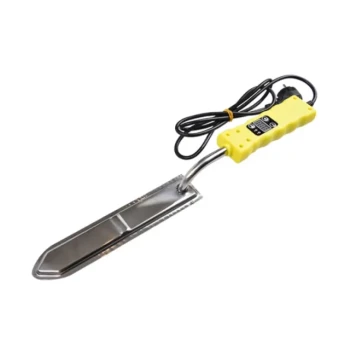
- Professional Electric Honey Uncapping Knife with Heated Digital Temperature Control for Beekeeping
- Digital Honey Refractometer for Precision Measurement of Optimal Honey Quality
- Precision Honey Refractometer Instrument for Quality Assessment
- Electric Hot Honey Uncapping Knife with Thermostat
- 0.5T Capacity Honey Dehumidifier Dryer with Vacuum Heating and Thickening Filtering Machine
People Also Ask
- Why are electric honey uncapping knives essential? Boost Efficiency & Preserve Comb for Professional Honey Extraction
- What is an electric uncapping knife and how is it used? Master Faster Honey Extraction with Heat
- What are the advantages and disadvantages of using an electric knife for uncapping honey frames? Boost Extraction Speed
- What are the drawbacks of using an electric knife for uncapping honey frames? Cost and Power Constraints Explained
- How should an electric uncapping knife be utilized? Master Efficient Honey Extraction with Heated Precision