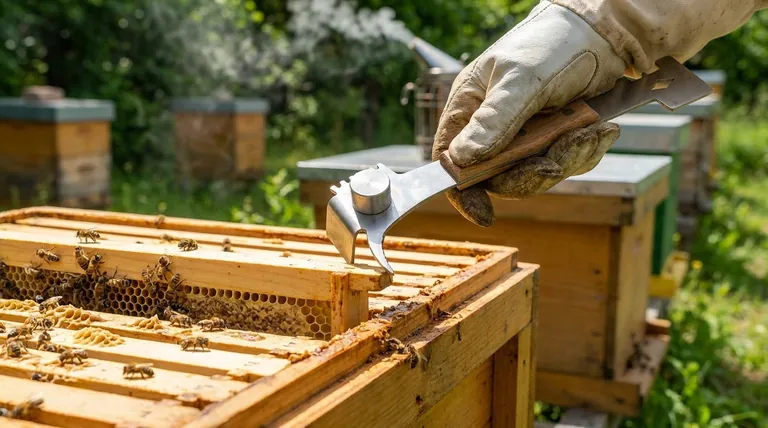
The Beekeeper's Dilemma: Force vs. Finesse
Approach a healthy beehive and you'll notice it's sealed shut. Not by lock and key, but by a substance far more tenacious: propolis. This resinous, sticky "bee glue" is the colony's master building material, used to seal every drafty crack and weld every component—from the lid to the floor—into a single, solid unit.
The central challenge for any beekeeper isn't managing the bees themselves, but managing their architecture. Every inspection begins with a physical problem: how do you break this incredibly strong seal without sending shockwaves of panic through a colony of 50,000 defensive insects?
The answer lies not in brute force, but in applied physics. It lies in the elegant design of the humble hive tool.
More Than a Pry Bar: An Extension of Intent
A hive tool is often mistaken for a simple crowbar. In reality, it's closer to a surgical instrument. Its design is a masterclass in mechanical advantage, engineered to translate a beekeeper's calm intentions into precise, quiet actions.
The genius is in its geometry. Each end of a hive tool is shaped to solve a different physical problem presented by the propolis-sealed hive. Understanding these shapes is the first step from being a hive visitor to a hive manager.
The Flat Blade: The Primary Lever
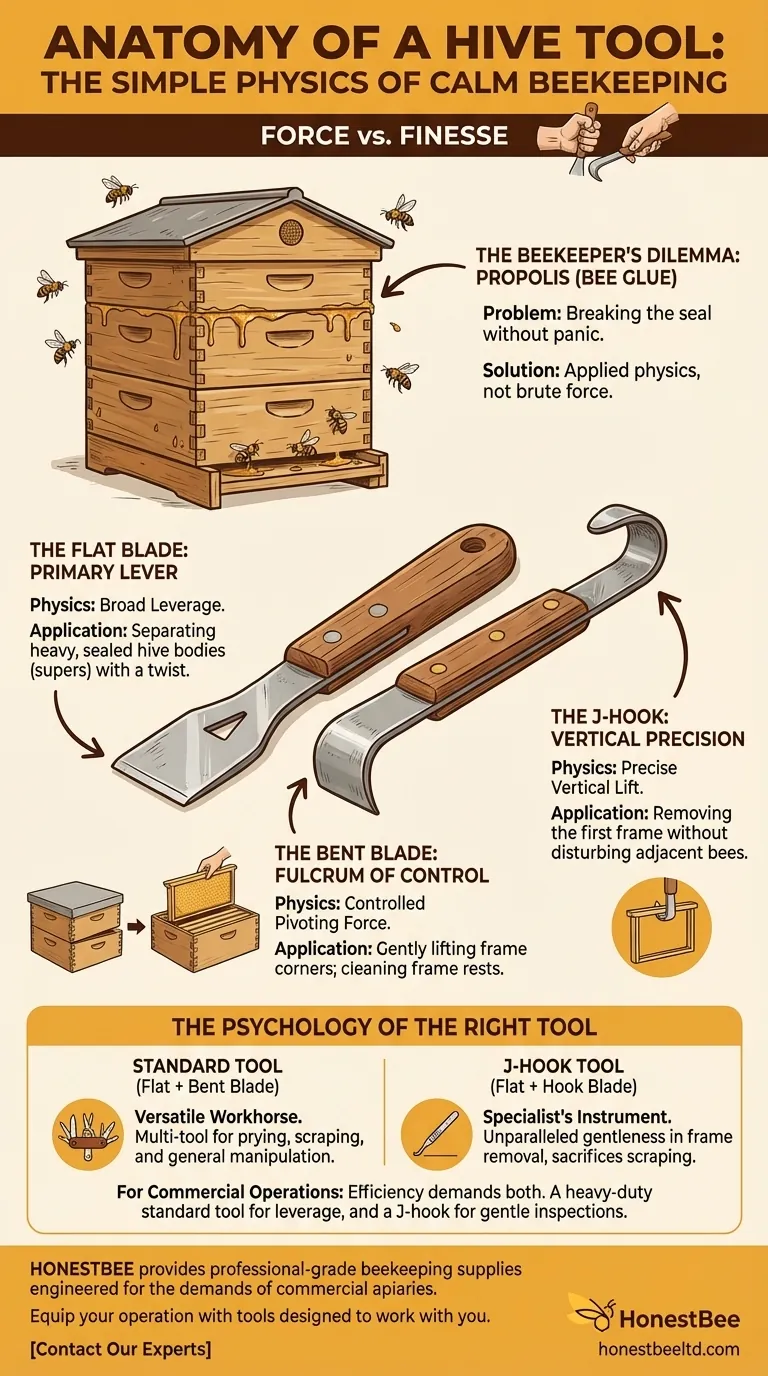
The straight, flat blade is your tool for overwhelming force, applied gracefully. Its wide, beveled edge is designed to be wedged between two heavy hive bodies (supers).
With a simple twist of the wrist, the tool acts as a lever, transforming a small amount of effort into enough force to break the toughest propolis bonds. This is the tool's bluntest function, used for the heaviest work, like separating a 50-pound honey super that feels glued to the box below it.
The Bent Blade: The Fulcrum of Control
The bent, or curved, end is where force becomes finesse. Its shape is not arbitrary; it's designed to create a pivot point.
By resting the curve on the solid edge of the hive box, you can insert the tip under a frame's ear and lift it with controlled, gentle leverage. This prevents the sudden, jarring movements that agitate a colony. It also acts as a perfect pull-scraper, its angle allowing you to clean propolis from the recessed frame rests inside the hive body—a task impossible for a straight blade.
The J-Hook: A Study in Vertical Precision
The J-hook represents the peak of specialized design. Its purpose is singular and critical: to remove the very first frame from a tightly packed hive.
Trying to pry the first frame out with a standard tool often results in rolling and crushing bees against the adjacent frame. The J-hook solves this by reaching down, hooking under the top bar, and using the hive wall as a fulcrum to lift the frame straight up. It's a clean, vertical extraction. An act of surgical precision that preserves bee life and colony morale.
The Psychology of the Right Tool
Choosing a hive tool is a reflection of a beekeeper's workflow. The two most common designs present a classic trade-off.
- The Standard Tool: Combines the Flat Blade and the Bent Blade. It is the versatile workhorse, excellent for prying, scraping, and general manipulation. It's the multi-tool of the apiary.
- The J-Hook Tool: Combines the Flat Blade with the Hook. It sacrifices the bent blade's scraping utility for unparalleled gentleness in frame removal. It is the specialist's instrument.
For a commercial beekeeper, this isn't an either/or choice. Efficiency at scale demands both. A long, heavy-duty standard tool provides the leverage to separate hundreds of stubborn boxes without fatiguing the operator. A J-hook ensures that inspections, especially of sensitive nucleus colonies, are done with the utmost care.
| Tool End Shape | Primary Mechanical Advantage | Best Application Scenario |
|---|---|---|
| Flat Blade | Broad Leverage | Separating heavy, propolis-sealed hive bodies. |
| Bent/Curved Blade | Controlled Pivoting Force | Gently lifting frame corners; cleaning frame rests. |
| Hook (J-Hook) | Precise Vertical Lift | Removing the first frame without disturbing the colony. |
Ultimately, a quality hive tool does more than pry and scrape. It builds confidence. It allows you to work calmly and deliberately, and the bees respond in kind. For a commercial operation, where every action is multiplied across hundreds of hives, the reliability and design of these simple tools are paramount to both productivity and colony health.
HONESTBEE provides professional-grade beekeeping supplies engineered for the demands of commercial apiaries. We understand that the right tool isn't a cost, but an investment in efficiency and control. Equip your operation with tools designed to work with you, not against you. Contact Our Experts
Visual Guide
Related Products
- HONESTBEE Professional Long Handled Hive Tool with Precision Cutting Blade
- Professional Multi-Function Stainless Steel Hive Tool
- HONESTBEE Premium Italian Style Hive Tool with Hardwood Handle
- Ergonomic Plastic Frame Spacer Tool for Rapid Hive Management Beekeeping
- Professional Grade Foldable Beehive Handles
Related Articles
- Force and Finesse: The Hive Tool as the Beekeeper's Critical Interface
- The Essential Guide to Hive Tools in Modern Beekeeping
- The Apiary as a System: Why Your Hive Tool is More Than Just Steel
- How to Choose Hive Tools That Match Your Beekeeping Workflow
- The Beekeeper's Scalpel: How a Simple Hive Tool Governs Apiary Health


















