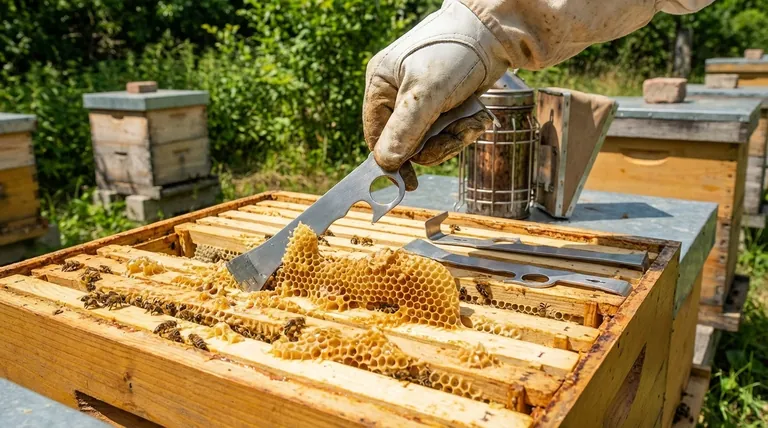
The propolis seal is like concrete. Your gloves are getting slick with honey. You pry, you strain, and the hive body finally gives with a jarring crack. A few feet away, a stubborn vine of kudzu has begun its slow, inexorable crawl up the side of another hive stand.
These are familiar moments of friction in an apiary. And in these moments, the standard hive tool—a simple pry bar—feels inadequate. The temptation to reach for a tool with a real edge is immense.
This is the origin story of the sharpened hive tool. It’s a brilliant adaptation, but one that carries a hidden psychological tax.
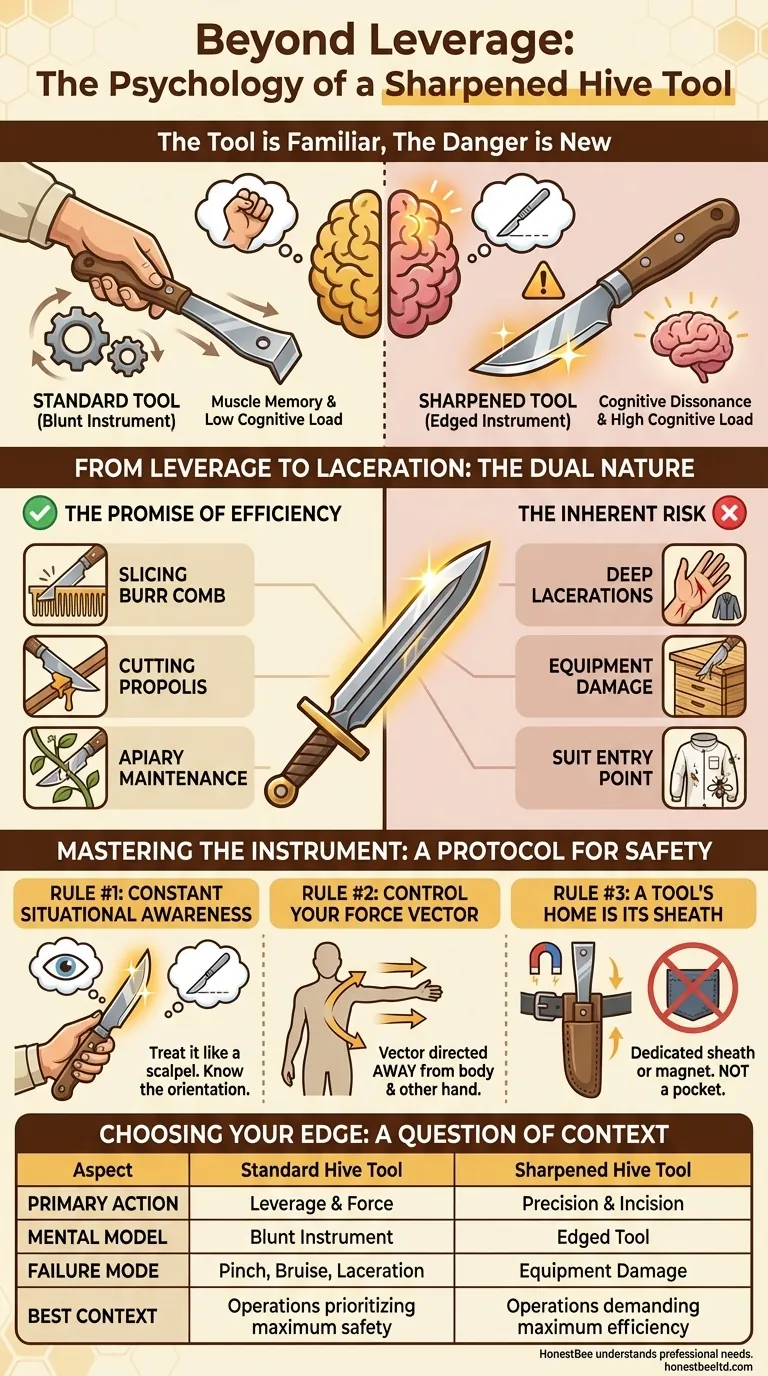
The Tool is Familiar, The Danger is New
Your mind has years of muscle memory associated with a hive tool. You treat it as an extension of your fist: a blunt instrument for leverage. You pry, scrape, and wedge with it without a second thought.
Sharpening one edge fundamentally breaks this mental model.
The tool looks nearly identical, but it is now a blade. The cognitive dissonance is where the danger lies. Your instincts tell you to use it as a pry bar, but one slip, one misplaced motion, and it will cut just as effectively as a utility knife.
From Leverage to Laceration: The Dual Nature of a Sharpened Edge
The decision to carry a sharpened tool is a conscious trade-off between efficiency and risk. Understanding both sides is critical.
The Promise of Efficiency
A sharpened edge transforms the tool from a single-purpose lever into a multi-functional instrument. Its utility expands dramatically:
- Slicing Burr Comb: Cleanly remove unwanted comb instead of crushing it.
- Cutting Propolis: Sever thick, stubborn seals with precision rather than brute force.
- Apiary Maintenance: Instantly cut tangled vines, ropes, or other obstructions without needing a separate knife.
For a commercial beekeeper, where seconds saved across hundreds of hives add up to hours, this efficiency is not a luxury; it's a necessity.
The Inherent Risk
The trade-off is a constant, heightened state of awareness. A standard tool might pinch a finger. A sharpened tool can:
- Inflict deep lacerations through a bee suit and gloves.
- Damage expensive equipment with an accidental slip.
- Create an entry point for defensive bees if your suit is sliced open during an inspection.
The risk isn't just injury; it's the potential for a routine inspection to spiral into a chaotic and dangerous situation.
Mastering the Instrument: A Protocol for Safety
Using a sharpened hive tool safely requires overriding your old instincts and adopting a new, disciplined protocol. It’s less about rules and more about a mindset.
Rule #1: Constant Situational Awareness
Treat it as if it were a scalpel. Always know the orientation of the blade in your hand. Never run a finger along the edge, even with gloves on. This constant awareness is the foundation of its safe use.
Rule #2: Control Your Force Vector
Every motion you make—prying, cutting, or scraping—creates a force vector. Always ensure that vector is directed away from your body and your other hand. If the tool slips, it must travel into empty space, not into your leg or arm.
Rule #3: A Tool's Home is its Sheath
A pocket is not a holster. Dropping a sharpened tool into a pocket is a recipe for a ruined bee suit and a potential injury. When not in your hand, its proper place is in a dedicated sheath on your belt, a tool magnet, or a specific compartment in your toolbox.
Choosing Your Edge: A Question of Context
The choice between a standard and sharpened hive tool isn't about being a "beginner" or an "expert." It's about matching the tool to the operational context and the operator's discipline.
| Aspect | Standard Hive Tool | Sharpened Hive Tool |
|---|---|---|
| Primary Action | Leverage & Force | Precision & Incision |
| Mental Model | Blunt Instrument (Low Cognitive Load) | Edged Tool (High Cognitive Load) |
| Failure Mode | Pinch, Bruise | Laceration, Equipment Damage |
| Best Context | Operations prioritizing maximum safety | Operations demanding maximum efficiency |
For commercial apiaries and distributors supplying them, efficiency is non-negotiable. The right tool is paramount, and HONESTBEE understands that professionals operate on this fine edge of risk and reward. We provide durable, professional-grade equipment, including specialized hive tools, designed for the realities of large-scale beekeeping.
If your operation demands tools that can keep up, Contact Our Experts
Visual Guide
Related Products
- HONESTBEE Professional Long Handled Hive Tool with Precision Cutting Blade
- Professional Multi-Function Stainless Steel Hive Tool
- HONESTBEE Premium Italian Style Hive Tool with Hardwood Handle
- Ergonomic Plastic Frame Spacer Tool for Rapid Hive Management Beekeeping
- Professional Grade Foldable Beehive Handles
Related Articles
- Force and Finesse: The Hive Tool as the Beekeeper's Critical Interface
- The Essential Guide to Hive Tools in Modern Beekeeping
- The Apiary as a System: Why Your Hive Tool is More Than Just Steel
- How to Choose Hive Tools That Match Your Beekeeping Workflow
- The Beekeeper's Scalpel: How a Simple Hive Tool Governs Apiary Health


















