The Most Important Tool is the One You Just Used
A beekeeper’s hive tool is a simple object of forged steel. It is a lever, a scraper, a pry bar. In the hands of a professional, it moves with practiced efficiency.
But psychologically, we misclassify it. We see it as a blunt instrument when we should see it as a scalpel.
Like a surgeon moving between patients, a beekeeper moves between colonies. And the sticky residue left on the tool after prying open a single hive—a blend of propolis, wax, and honey—is not just debris. It is a perfect, biological snapshot of that colony's health.
Moving to the next hive without cleaning the tool is like a surgeon using the same scalpel twice. It's an invisible gamble with devastating odds.
Propolis: The Double-Edged Sword
Bees use propolis as an antimicrobial sealant, a sort of external immune system for the hive. It’s a brilliant evolutionary defense.
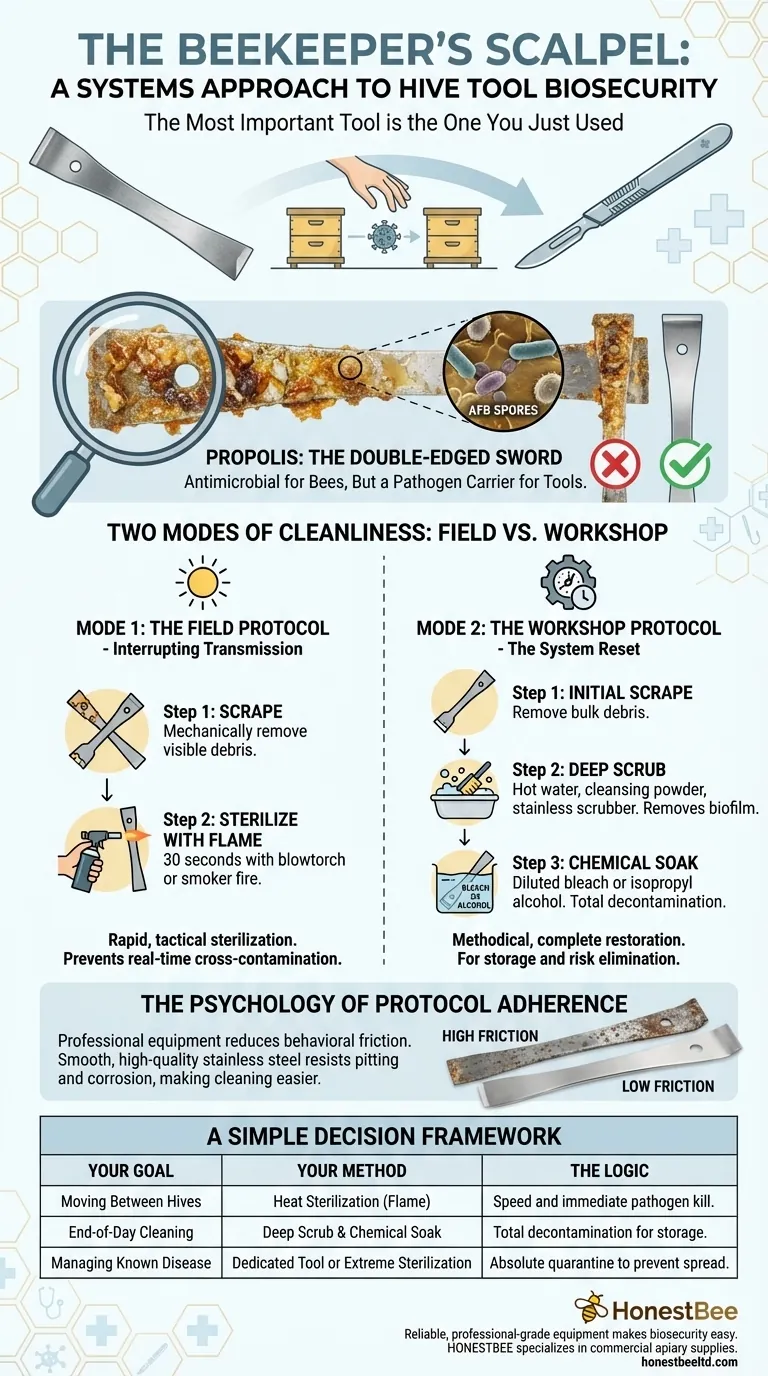
But on a steel tool, this sticky, resinous substance becomes a liability. Its adhesive properties make it a highly effective carrier for microscopic pathogens. Spores of American Foulbrood (AFB), one of the most destructive brood diseases, can become trapped in a thin layer of propolis, remaining viable and ready to infect the next healthy colony.
The failure to clean a hive tool isn't a failure of tidiness. It is a failure of biosecurity.
Two Modes of Cleanliness: Field vs. Workshop
Effective biosecurity isn’t about a single, rigid protocol. It’s about adapting your method to the immediate context. Your goal in the middle of an apiary is different from your goal at the end of the day.
This creates two distinct modes of operation.
Mode 1: The Field Protocol — Interrupting Transmission
When you are in the apiary, moving from one hive to the next, your objective is singular: prevent cross-contamination in real-time.
The protocol must be fast, effective, and require minimal equipment.
- Step 1: Scrape. Mechanically remove all visible wax and propolis.
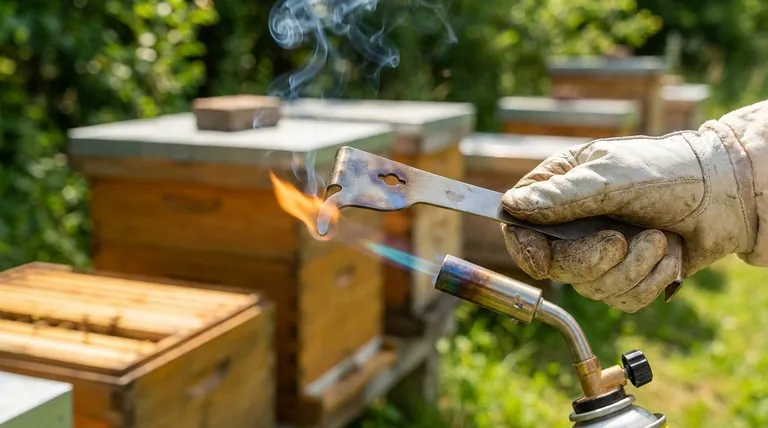
- Step 2: Sterilize with Flame. This is the gold standard in the field. Heating the tool with a handheld blowtorch for 30 seconds, or placing it in the hot fire pot of your smoker, effectively incinerates any remaining pathogens.
This isn't about deep cleaning; it's a rapid, tactical sterilization designed to break the chain of infection before it can start.
Mode 2: The Workshop Protocol — The System Reset
At the end of the day or the season, the objective changes. The goal is now a complete restoration of the tool, preparing it for storage and eliminating any residual risk.
This is a more methodical, multi-step process.
- Step 1: The Initial Scrape. Again, always start by removing the bulk of physical debris.
- Step 2: The Deep Scrub. Using hot water, a powerful cleansing powder, and a stainless-steel scrubber, you scour every surface. This removes the biofilm that chemical sanitizers can't penetrate.
- Step 3: The Chemical Soak. Submerge the cleaned tool in a diluted bleach solution or isopropyl (rubbing) alcohol. A soak in alcohol is particularly effective, as the tool can be stored in the solution, ensuring it remains sterile until its next use.
The Psychology of Protocol Adherence
We know what we should do. The challenge is that protocols create friction. It’s easier to just move to the next hive.
This is where the design and quality of your equipment become part of your risk management system. A tool that is poorly constructed, rusts easily, or has a pitted surface is harder to clean. It adds friction to a critical task, making it more likely to be skipped.
Professional-grade equipment, built from high-quality, smooth stainless steel, is inherently easier to maintain. The surface resists pitting and corrosion, making both scraping and sterilization more effective. Investing in well-made tools isn't a luxury; it's a way of reducing the behavioral friction that so often leads to biosecurity failures.
This principle is the foundation of a scalable, professional operation.
A Simple Decision Framework
| Your Goal | Your Method | The Logic |
|---|---|---|
| Moving Between Hives | Heat Sterilization (Flame) | Speed and immediate pathogen kill. |
| End-of-Day Cleaning | Deep Scrub & Chemical Soak | Total decontamination for storage. |
| Managing Known Disease | Dedicated Tool or Extreme Sterilization | Absolute quarantine to prevent spread. |
Ultimately, the hive tool is an extension of the beekeeper’s intent. Its condition reflects a deeper understanding of the interconnected, fragile system that is an apiary. Keeping it clean is one of the smallest actions that provides the greatest protection.
The foundation of a robust biosecurity protocol is reliable, professional-grade equipment that makes the right thing the easy thing to do. HONESTBEE specializes in supplying commercial apiaries and distributors with wholesale beekeeping equipment designed for durability and ease of maintenance, ensuring your operation is built on a foundation of quality.
To ensure your protocols are supported by the right equipment, Contact Our Experts.
Visual Guide
Related Products
- HONESTBEE Professional Long Handled Hive Tool with Precision Cutting Blade
- Professional Multi-Function Stainless Steel Hive Tool
- HONESTBEE Premium Italian Style Hive Tool with Hardwood Handle
- Ergonomic Plastic Frame Spacer Tool for Rapid Hive Management Beekeeping
- Professional Grade Foldable Beehive Handles
Related Articles
- Force and Finesse: The Hive Tool as the Beekeeper's Critical Interface
- The Essential Guide to Hive Tools in Modern Beekeeping
- The Apiary as a System: Why Your Hive Tool is More Than Just Steel
- How to Choose Hive Tools That Match Your Beekeeping Workflow
- The Beekeeper's Scalpel: How a Simple Hive Tool Governs Apiary Health


















