The Space Between Us
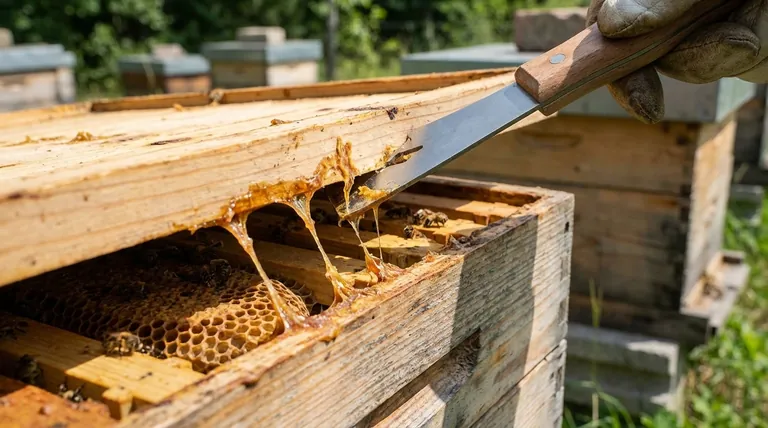
A honeybee hive is a fortress. It's a perfectly calibrated environment, sealed from the outside world not with locks and bolts, but with a sticky, resinous glue called propolis. The bees use it to seal every crack, reinforcing their home against weather, predators, and disease.
This creates a fundamental challenge for the beekeeper. How do you enter this sealed world to inspect, manage, and heal it without your entry being perceived as an act of war?
The answer lies in a simple piece of steel: the hive tool. But to see it as a mere pry bar is to misunderstand its purpose entirely. It's not a crowbar; it's a key, a scalpel, and a conductor's baton, all in one.
The First Contact: A Dialogue of Force and Finesse
Your first action in any inspection is to break the propolis seal. This is the most critical moment. A sudden, jarring movement sends shockwaves of panic through the colony.
Instead, the hive tool facilitates a conversation.
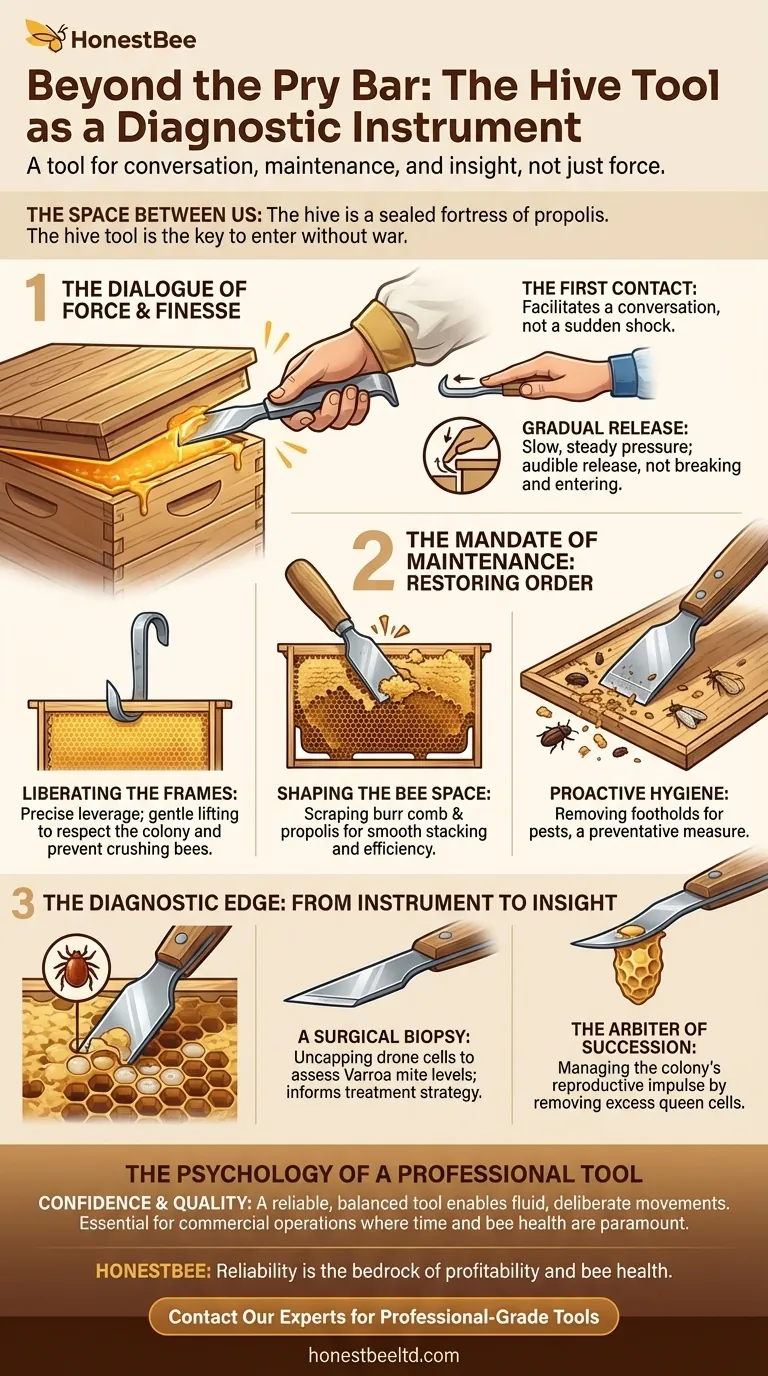
You slide the flat edge into the seam between the lid and the top box. You apply slow, steady pressure. You feel the resistance, then the gradual, audible release as the propolis gives way. This isn't breaking and entering; it's a polite request for access, executed with mechanical grace.
Liberating the Frames
Once inside, the same principle applies. Frames are welded to the hive body with wax and propolis. The hive tool, especially a J-hook style, allows you to apply precise leverage. You're not ripping the frame out; you're gently lifting it, creating just enough space to extract it without rolling or crushing the bees who call it home.
It is a small action that shows immense respect for the colony's intricate social structure.
The Mandate of Maintenance: Restoring Order
A beekeeper's work is a constant negotiation with the bees' architectural instincts. Bees abhor a vacuum, filling any gap larger than a "bee space" with excess burr comb.
The hive tool is a sculptor's chisel.
Shaping the Bee Space
Scraping burr comb and excess propolis from the tops of frames and the edges of boxes isn't just janitorial work. It's an act of restoring order. It ensures boxes stack flush, frames fit properly, and your next inspection is smoother.
For a commercial operation, this meticulous maintenance is the foundation of efficiency. It prevents wasted time and broken equipment.
Proactive Hygiene
The tool's flat edge is also perfect for cleaning the bottom board of debris and dead bees. This is preventative medicine. By removing potential footholds for pests like wax moths and Small Hive Beetles, you are solving problems before they can begin.
The Diagnostic Edge: From Instrument to Insight
This is where the hive tool transcends its physical form. In the hands of a skilled beekeeper, it becomes an extension of their senses—a diagnostic instrument for assessing the colony's hidden health.
A Surgical Biopsy
The most significant threat to honeybees is the parasitic Varroa mite, which reproduces within capped brood cells. How do you see inside?
You use the sharp edge of the hive tool to perform a micro-surgery. You carefully uncap a few drone cells and inspect the developing pupae. This single, precise action gives you a critical data point on the level of infestation, informing your treatment strategy for the entire apiary.
The Arbiter of Succession
During swarm season, you may need to manage the colony's reproductive impulse by removing excess queen cells. The hive tool becomes the instrument of this high-stakes decision. A gentle nick or a careful scrape is all it takes to direct the future of thousands of lives.
The Psychology of a Professional Tool
The effectiveness of these delicate operations depends entirely on the beekeeper's confidence. And that confidence is directly tied to the quality of the tool in their hand.
A flimsy tool that bends under pressure causes hesitation. Hesitation leads to jerky, uncertain movements, which agitate the bees and can damage the hive.
A well-balanced, durable tool with a finely honed edge becomes a seamless extension of your will. The movements become fluid, deliberate, and calm. The bees notice.
For commercial apiaries, where time is money and colony health is paramount, equipment failure is not an option. A bent hive tool can delay the inspection of an entire yard, and a dull edge can damage expensive woodenware. This is why professional-grade equipment isn't a luxury; it's a non-negotiable component of a successful operation. At HONESTBEE, we build our wholesale supplies on the principle that reliability is the bedrock of profitability and bee health.
The hive tool is the first and last thing you pick up. It's the physical interface between your knowledge and the biological reality of the colony. It needs to be worthy of that trust. To equip your operation with tools that reflect this professional philosophy, Contact Our Experts.
Visual Guide
Related Products
- HONESTBEE Professional Long Handled Hive Tool with Precision Cutting Blade
- Professional Multi-Function Stainless Steel Hive Tool
- HONESTBEE Premium Italian Style Hive Tool with Hardwood Handle
- Ergonomic Plastic Frame Spacer Tool for Rapid Hive Management Beekeeping
- Professional Grade Foldable Beehive Handles
Related Articles
- Force and Finesse: The Hive Tool as the Beekeeper's Critical Interface
- The Essential Guide to Hive Tools in Modern Beekeeping
- The Apiary as a System: Why Your Hive Tool is More Than Just Steel
- How to Choose Hive Tools That Match Your Beekeeping Workflow
- The Beekeeper's Scalpel: How a Simple Hive Tool Governs Apiary Health


















