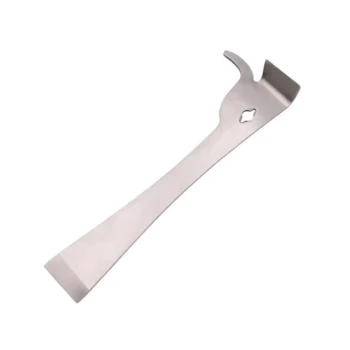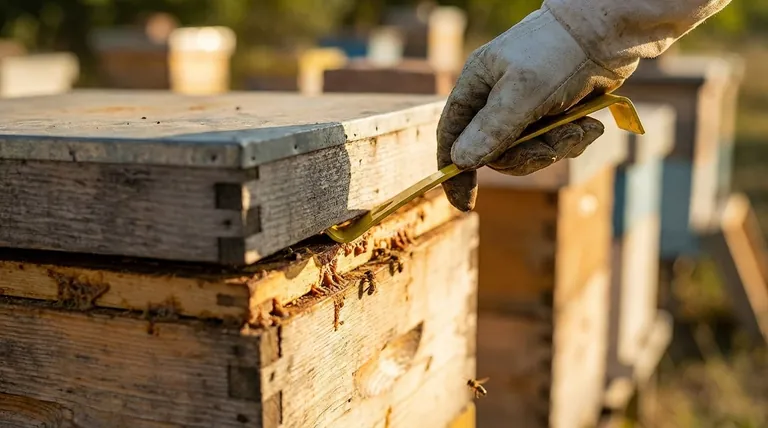
It’s a warm afternoon in the apiary. You approach a hive, and the colony’s work is evident in the hard, amber-like seams of propolis sealing the hive bodies together. This is the first test of your inspection, and it’s a test of your most fundamental tool.
With the wrong tool, this moment is a struggle of brute force—a jarring, inefficient prying that sends vibrations through the colony. With the right tool, it’s a quiet, clean pop. The seal breaks with minimal effort. This single moment defines the difference between a frustrating task and a confident, professional workflow.
The Physics of Persuasion
The design of a standard hive tool is not an accident; it is a masterclass in applied physics, refined over decades. The central challenge is managing two opposing needs: raw power and delicate precision.
The Fulcrum and the Force
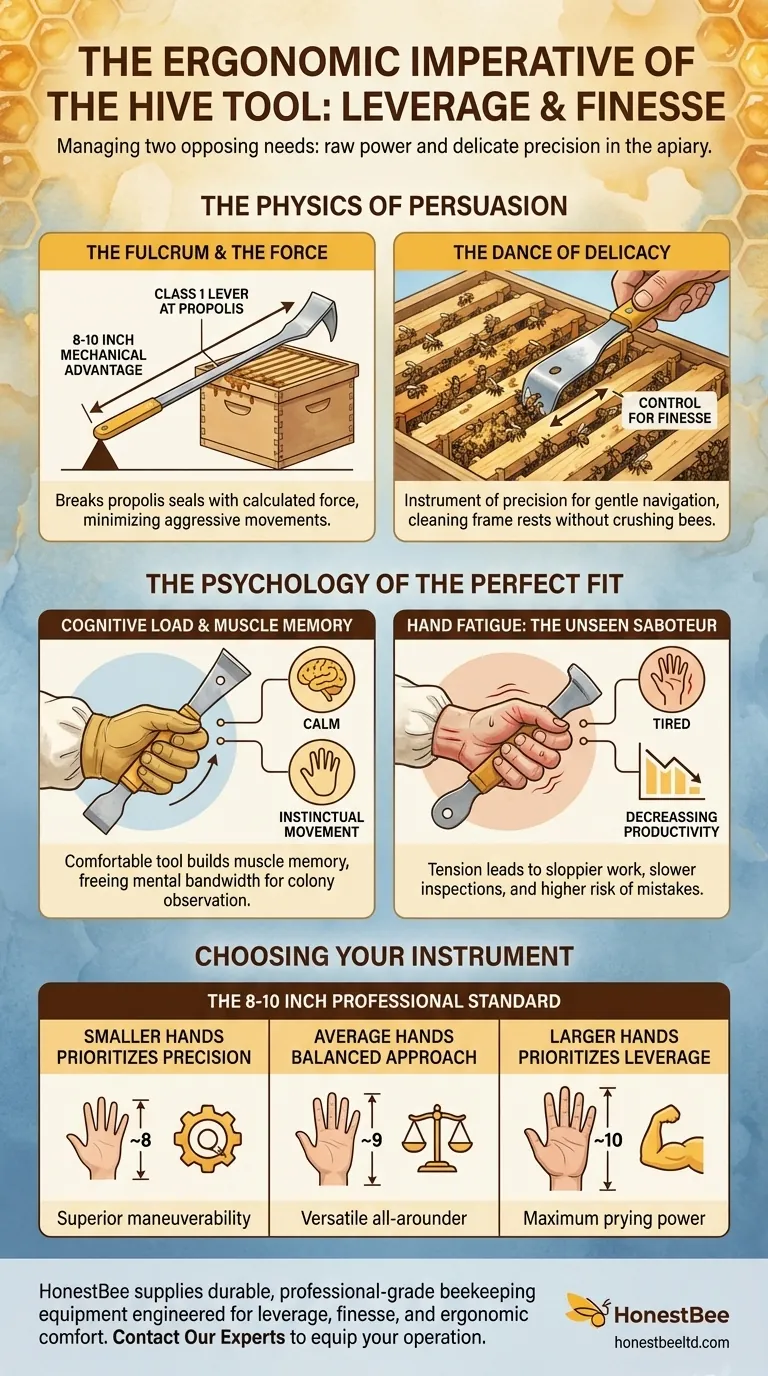
Bees use propolis as a structural glue and a microbial shield. It can be incredibly strong. A hive tool longer than 8 inches provides the necessary leverage to act as a proper Class 1 lever.
You aren't just prying; you are applying calculated force at a distance. The length of the tool multiplies your effort, allowing you to break the toughest seals without sudden, aggressive movements that could anger the colony or damage your woodenware. A tool closer to 10 inches maximizes this mechanical advantage.
The Dance of Delicacy
Once inside the hive, the mission changes from force to finesse. You need to navigate the tight, bee-filled spaces between frames. Here, a tool that is too long becomes a liability.
It’s like trying to write your name with a meter stick. The 8-10 inch range provides the control necessary to gently nudge frames, scrape away excess burr comb, and clean frame rests without accidentally rolling the queen or crushing workers. It’s an instrument of precision, not just a pry bar.
The Psychology of the Perfect Fit
The most overlooked variable in tool selection is not its material or shape, but its relationship with your own body. The right hive tool feels less like an object you are holding and more like an extension of your own hand.
Cognitive Load and Muscle Memory
An ill-fitting tool consumes mental bandwidth. If it’s too long and clumsy, or too short and ineffective, you are constantly focused on compensating for the tool's shortcomings. This is a distraction from what truly matters: observing the colony’s health, spotting signs of disease, and finding the queen.
A tool that fits your hand comfortably builds muscle memory. Your movements become instinctual, fluid, and efficient. This frees your mind to focus entirely on the bees, turning a mechanical task into a diagnostic observation.
Hand Fatigue: The Unseen Saboteur
For commercial beekeepers inspecting dozens or hundreds of colonies, efficiency is paramount. An uncomfortable tool creates tension and fatigue in the hand and wrist. This fatigue leads to sloppier work, slower inspections, and a higher risk of mistakes as the day wears on. Personal comfort is not a luxury; it is a direct driver of productivity and safety.
Choosing Your Instrument
The 8-10 inch range is the professional standard because it represents the sweet spot in the trade-off between leverage and control. Your personal choice within that range is about optimizing for your own body and style.
| User Profile | Recommended Size | Primary Advantage |
|---|---|---|
| Smaller Hands / Prioritizes Precision | ~8 inches | Superior maneuverability |
| Average Hands / Balanced Approach | ~9 inches | Versatile all-arounder |
| Larger Hands / Prioritizes Leverage | ~10 inches | Maximum prying power |
A tool significantly outside this range introduces non-negotiable flaws. One that's too short lacks the power to do its primary job, forcing you to use damaging force. One that's too long is a hazard within the tight confines of a bustling colony.
For commercial apiaries and equipment distributors, providing tools that adhere to these professional standards is non-negotiable. It's an investment in efficiency, colony health, and the beekeeper's own endurance. At HONESTBEE, we supply durable, professional-grade beekeeping equipment engineered to meet these precise demands.
To equip your operation with tools designed for leverage, finesse, and ergonomic comfort, Contact Our Experts.
Visual Guide
Related Products
- HONESTBEE Professional Long Handled Hive Tool with Precision Cutting Blade
- Professional Multi-Function Stainless Steel Hive Tool
- HONESTBEE Premium Italian Style Hive Tool with Hardwood Handle
- Ergonomic Plastic Frame Spacer Tool for Rapid Hive Management Beekeeping
- Professional Grade Foldable Beehive Handles
Related Articles
- Force and Finesse: The Hive Tool as the Beekeeper's Critical Interface
- The Essential Guide to Hive Tools in Modern Beekeeping
- The Apiary as a System: Why Your Hive Tool is More Than Just Steel
- How to Choose Hive Tools That Match Your Beekeeping Workflow
- The Beekeeper's Scalpel: How a Simple Hive Tool Governs Apiary Health