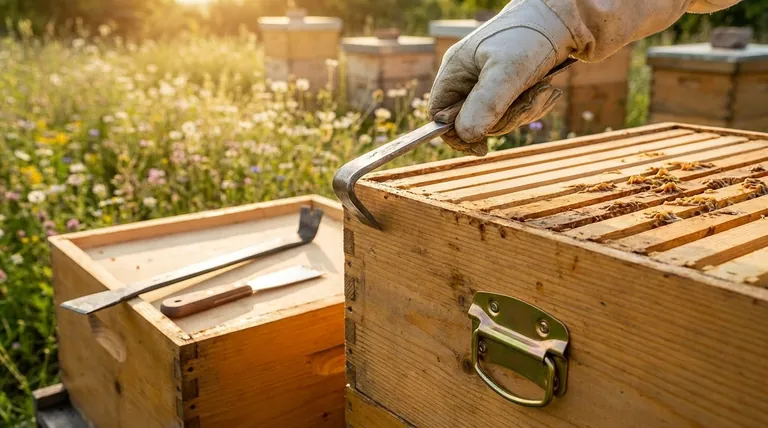
The First Word in a Conversation
Before a beekeeper lifts a frame or smells the honey, there is the hive tool.
It is the first point of contact. The key that unlocks a sealed world. With a gentle pry, it breaks the propolis bond—the hive’s powerful, resinous glue. That single motion is the first word in a delicate conversation with a colony of tens of thousands.
The choice of this tool is not trivial. It’s a decision about intent. It reflects your approach to the hive: are you entering with brute force or with finesse? For a commercial beekeeper, this choice dictates efficiency, colony health, and ultimately, profitability.
The Anatomy of Intent
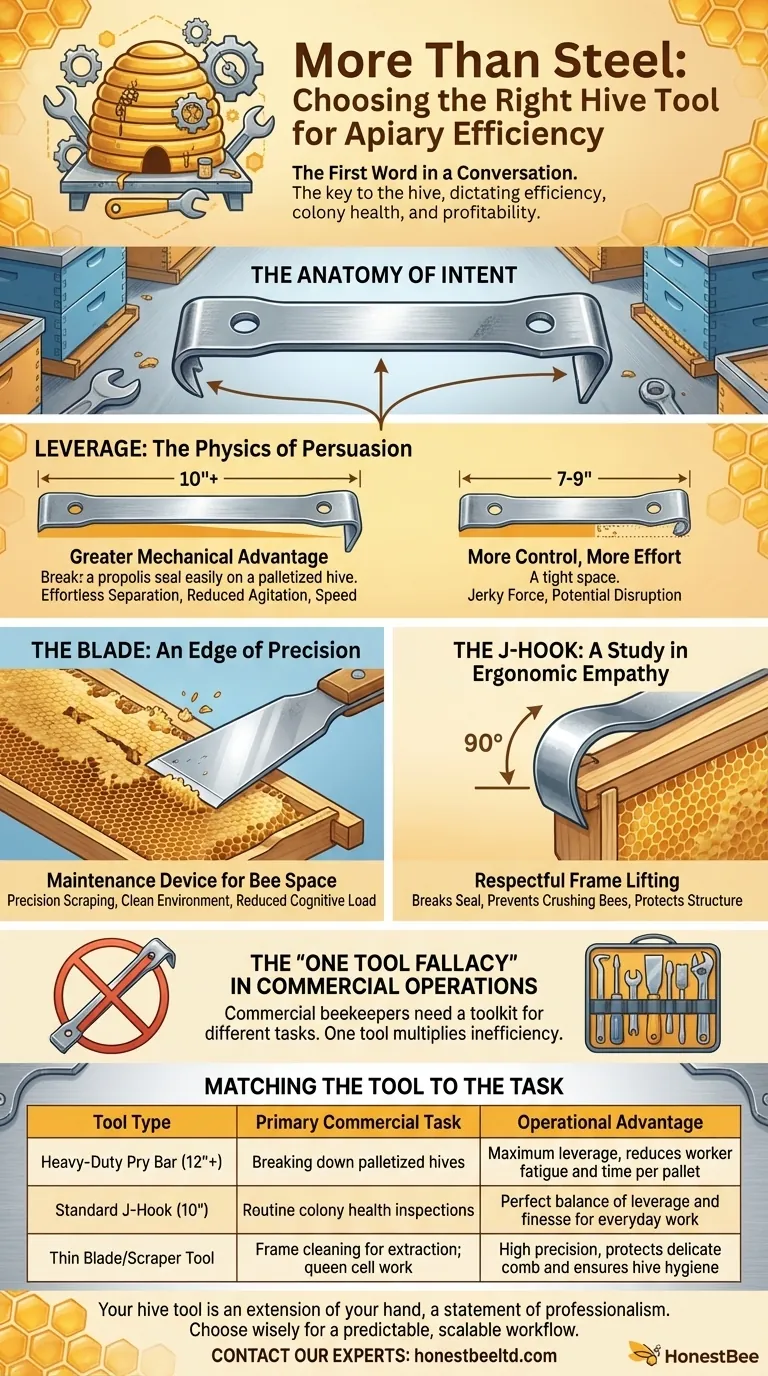
A hive tool seems simple: a piece of flattened steel. But its design is a masterclass in purpose-built engineering. Every curve and edge is a solution to a specific problem posed by bee biology and hive mechanics.
Leverage: The Physics of Persuasion
Bees use propolis to seal every gap, making hive bodies feel like they are welded together. Separating them requires leverage.
- Longer Tools (10"+): Provide greater mechanical advantage. They make separating heavily propolized boxes feel effortless, reducing the jarring, aggressive motions that agitate a colony. This is crucial in large-scale operations where speed and minimal stress are paramount.
- Shorter Tools (7-9"): Offer more control in tight spaces but demand more physical effort. Using a tool that’s too small for the job tempts a beekeeper into using jerky, inefficient force, turning a smooth inspection into a battle.
The friction isn't just physical; it's a disruption to the colony's state. The right leverage persuades the hive to open; the wrong leverage forces it.
The Blade: An Edge of Precision
The tool's blade is for more than just prying. It’s a maintenance device for preserving the single most important architectural principle of a beehive: bee space.
A beekeeper scrapes away excess burr comb and propolis buildup. A clean frame and a clean hive body reduce inspection time. It makes the colony’s status easier to "read." A dull or thick blade makes this scraping tedious. A sharp, well-defined edge does it with surgical precision.
This isn’t just about tidiness. It’s about cognitive load. A clean, predictable environment allows the beekeeper to focus on what matters—queen health, brood patterns, and resource levels—instead of fighting the equipment.
The J-Hook: A Study in Ergonomic Empathy
The 90-degree bend on a standard hive tool is a quiet stroke of genius.
Its purpose is to hook under the ear of a frame and lift it straight up, breaking the propolis seal without crushing a single bee between adjacent frames. This simple design demonstrates a profound understanding of the beekeeper’s core challenge: interacting with the colony’s structure without causing harm.
It is a tool of empathy, designed to respect the inhabitants of the hive.
The "One Tool Fallacy" in Commercial Operations
Hobbyists often search for a single, perfect hive tool. Professionals understand this is a fallacy.
Just as a mechanic has more than one wrench, a commercial beekeeper needs a toolkit optimized for different tasks. Sticking with a familiar but suboptimal tool out of habit creates a drag on efficiency that multiplies across hundreds or thousands of hives.
The cumulative cost of seconds wasted at each hive, of colonies unnecessarily agitated, or of woodenware damaged by the wrong tool is significant.
For commercial apiaries, equipping teams with the right tools isn't an expense; it's an investment in a predictable, scalable workflow. HONESTBEE specializes in supplying durable, purpose-built equipment for distributors and commercial operations that recognize this principle.
Matching the Tool to the Task
The choice of a hive tool should be a conscious, strategic decision based on the specific demands of your operation.
| Tool Type | Primary Commercial Task | Operational Advantage |
|---|---|---|
| Heavy-Duty Pry Bar (12"+) | Breaking down palletized hives | Maximum leverage reduces worker fatigue and time per pallet. |
| Standard J-Hook (10") | Routine colony health inspections | The perfect balance of leverage and finesse for everyday work. |
| Thin Blade/Scraper Tool | Frame cleaning for extraction; queen cell work | High precision protects delicate comb and ensures hive hygiene. |
Your hive tool is more than steel. It is an extension of your hand and a statement of your professionalism. It communicates your respect for the bees and your commitment to efficient, calm, and effective work.
Choosing the right equipment is the foundation of a successful operation. Contact Our Experts
Visual Guide
Related Products
- HONESTBEE Professional Long Handled Hive Tool with Precision Cutting Blade
- Professional Multi-Function Stainless Steel Hive Tool
- HONESTBEE Premium Italian Style Hive Tool with Hardwood Handle
- Ergonomic Plastic Frame Spacer Tool for Rapid Hive Management Beekeeping
- Professional Grade Foldable Beehive Handles
Related Articles
- Force and Finesse: The Hive Tool as the Beekeeper's Critical Interface
- The Essential Guide to Hive Tools in Modern Beekeeping
- The Apiary as a System: Why Your Hive Tool is More Than Just Steel
- How to Choose Hive Tools That Match Your Beekeeping Workflow
- The Beekeeper's Scalpel: How a Simple Hive Tool Governs Apiary Health


















