The First Point of Contact
Approaching a beehive is an exercise in sensory awareness. The collective hum vibrates through the wood, and the air is thick with the scent of honey and wax. Your first action, the one that bridges your world and theirs, is with a hive tool.
This simple piece of steel is often mistaken for a crude pry bar. But to a skilled beekeeper, it's a scalpel, a diagnostic probe, and a communication device all in one. The goal is not to force entry but to negotiate it. The bees have meticulously sealed every gap with propolis—a potent antimicrobial resin that acts as their external immune system. Breaking that seal is an invasive procedure. The quality of the entire inspection hinges on how you perform this first step.
The Language of Leverage: Prying and Lifting
At its most basic, the hive tool is a lever. But its purpose isn't to apply maximum force; it's to apply precise, controlled pressure.
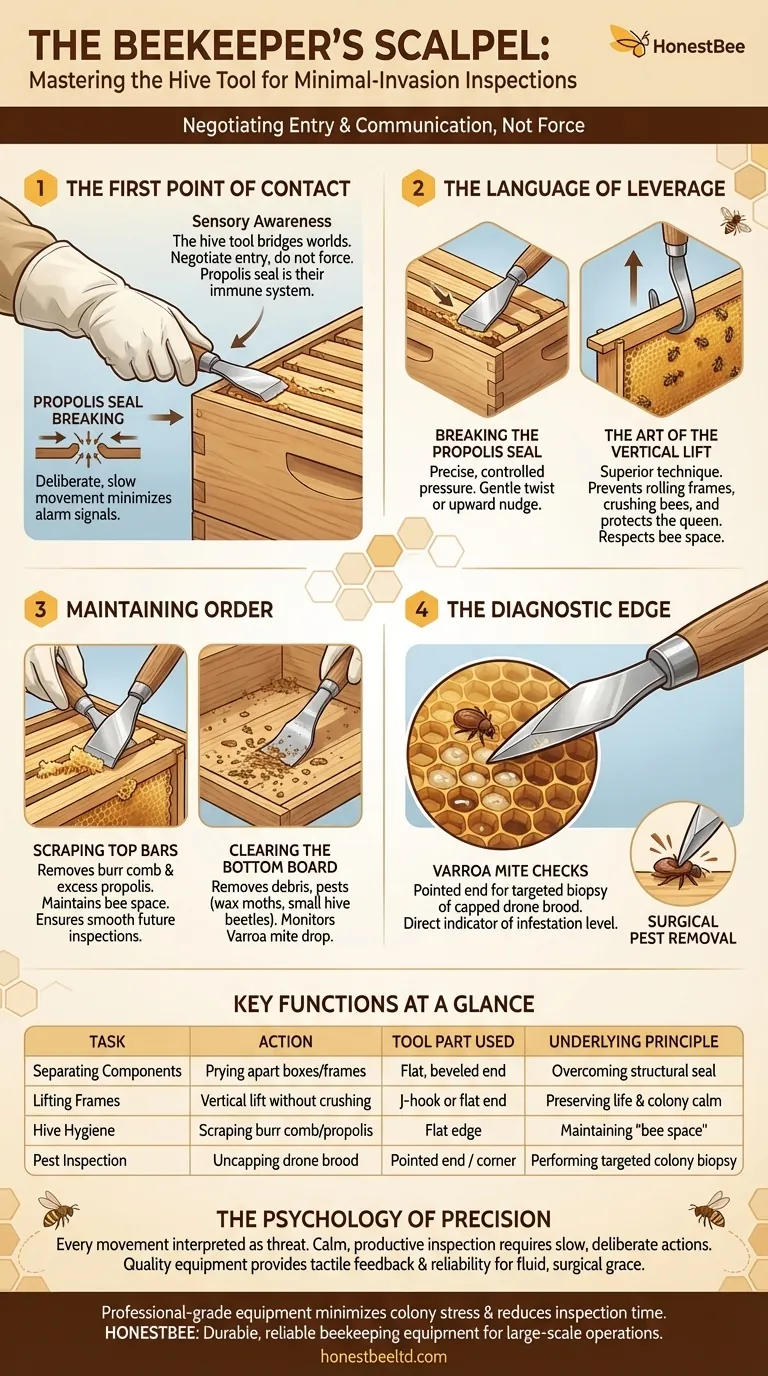
Breaking the Propolis Seal
When you slide the flat, beveled edge of the tool between two hive bodies, you are performing a delicate separation. A gentle twist or an upward nudge, repeated at several points, is all that's needed. The sound of propolis cracking is the sound of the hive's defenses being breached. Doing it slowly and deliberately minimizes the alarm signals that ripple through the colony.
The Art of the Vertical Lift
Once inside, frames are glued in place with propolis and burr comb. Simply prying them sideways is a recipe for disaster—it rolls the frames, crushing bees and potentially killing the queen.
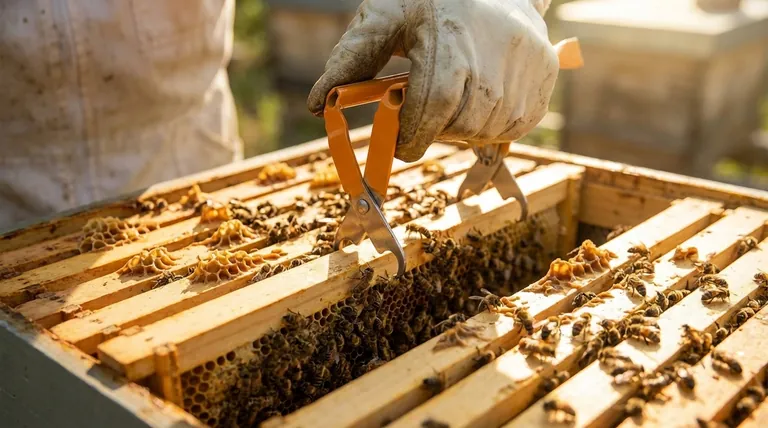
This is where tool design reveals its genius. A standard tool can be used to gently pry the end of a frame loose. But a J-hook style tool allows for a superior technique. By catching the frame's top bar, it enables a perfectly vertical lift. This single motion is the difference between a clumsy intrusion and a clean, efficient examination. It respects the bees' space and preserves their lives.
Maintaining Order: The Tool as Janitor and Sculptor
A beehive is a masterclass in spatial engineering. The bees build their world around a precise measurement known as "bee space." Violate it, and they will fill the gap with burr comb.
Your hive tool is the instrument you use to restore that order.
- Scraping Top Bars: Running the flat edge across the tops of the frames removes the burr comb and excess propolis that stick frames together. This isn't just cleaning; it's architectural maintenance that ensures frames can be removed smoothly on your next inspection.
- Clearing the Bottom Board: The bottom board is a ledger of the colony's recent history. Scraping it clean removes debris that can harbor pests like wax moths and Small Hive Beetles. It also gives you a clear canvas to monitor for Varroa mite drop, providing critical data for your pest management strategy.
The Diagnostic Edge: From Macro to Micro Inspection
A great beekeeper learns to read the hive. The hive tool is the pen used to uncover its secrets. The sharp, pointed end transforms the tool from a lever into a precision probe.
Its most critical diagnostic use is for Varroa mite checks. Mites preferentially reproduce in capped drone brood. By using the tool's tip to gently uncap a few drone cells, you perform a targeted biopsy. The number of mites found on those pupae is a direct indicator of the infestation level across the entire colony, allowing for timely and effective treatment.
Similarly, if pests are spotted, the tool becomes a surgical instrument for crushing or removing them with minimal collateral damage to the bees.
Key Functions at a Glance
| Task | Action | Tool Part Used | Underlying Principle |
|---|---|---|---|
| Separating Components | Prying apart boxes and frames sealed with propolis | Flat, beveled end | Overcoming the hive's structural seal |
| Lifting Frames | Lifting frames straight up without crushing bees | J-hook or flat end | Preserving life and colony calm |
| Hive Hygiene | Scraping excess burr comb and propolis | Flat edge | Maintaining "bee space" |
| Pest Inspection | Uncapping drone brood for Varroa mite checks | Pointed end / corner | Performing a targeted colony biopsy |
The Psychology of Precision
Every sudden, jarring movement you make is interpreted by the bees as a threat. A calm, productive inspection is born from slow, deliberate actions. Your confidence in these actions is directly tied to the quality of your equipment.
A flimsy tool that might bend, or a dull edge that slips, creates hesitation. This hesitation leads to jerky, uncertain movements, which in turn agitate the colony. A solid, well-designed hive tool feels like a natural extension of your hand. It provides the tactile feedback and reliability needed to work with the fluid, surgical grace that defines expert beekeeping.
For commercial apiaries and equipment distributors, this isn't a trivial detail—it's a cornerstone of operational efficiency. Professional-grade equipment minimizes colony stress, reduces inspection time, and protects the beekeeper's most valuable asset: their bees. At HONESTBEE, we focus exclusively on supplying the durable, reliable beekeeping equipment that large-scale operations depend on. Our tools are engineered not just to open a hive, but to do so with the precision and confidence your work demands.
Visual Guide
Related Products
- HONESTBEE Professional Long Handled Hive Tool with Precision Cutting Blade
- Professional Multi-Function Stainless Steel Hive Tool
- HONESTBEE Premium Italian Style Hive Tool with Hardwood Handle
- Ergonomic Plastic Frame Spacer Tool for Rapid Hive Management Beekeeping
- Professional Grade Foldable Beehive Handles
Related Articles
- Force and Finesse: The Hive Tool as the Beekeeper's Critical Interface
- The Essential Guide to Hive Tools in Modern Beekeeping
- The Apiary as a System: Why Your Hive Tool is More Than Just Steel
- How to Choose Hive Tools That Match Your Beekeeping Workflow
- The Beekeeper's Scalpel: How a Simple Hive Tool Governs Apiary Health


















