The Heaviest Part of Beekeeping
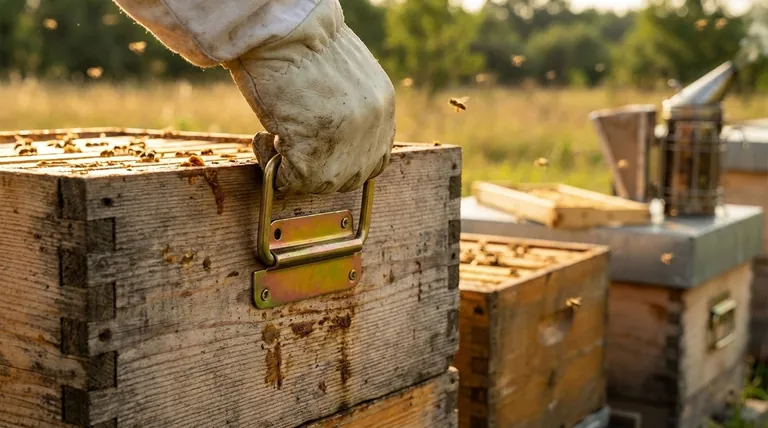
Imagine standing in a bee yard on a hot afternoon. The super in front of you is full of honey, weighing 60, maybe 80 pounds. Your back is already tired. The next ten seconds—the lift—is one of the most physically demanding, and potentially riskiest, moments in your day.
Our minds tend to focus on the big picture: colony health, nectar flow, market prices. We often overlook the tiny details that govern our physical reality. But in beekeeping, as in many complex systems, success is the sum of small, repeated efficiencies. The primary interface between you and that 80-pound box is not a screen or a lever; it's a simple handle. And its design changes everything.
The Deceptive Simplicity of a Grip
A handle seems trivial. It's a place to put your hands. Yet, the difference between a simple wooden cleat and an integrated, inset handle reveals a deep understanding of ergonomics, physics, and the psychology of physical work.
Ergonomics Is More Than Comfort; It's Control
A standard cleat handle—a strip of wood nailed to the box—offers a precarious, fingertip-only grip. When wearing gloves, that grip becomes even less secure. Every lift is a conscious effort, a calculation of risk.
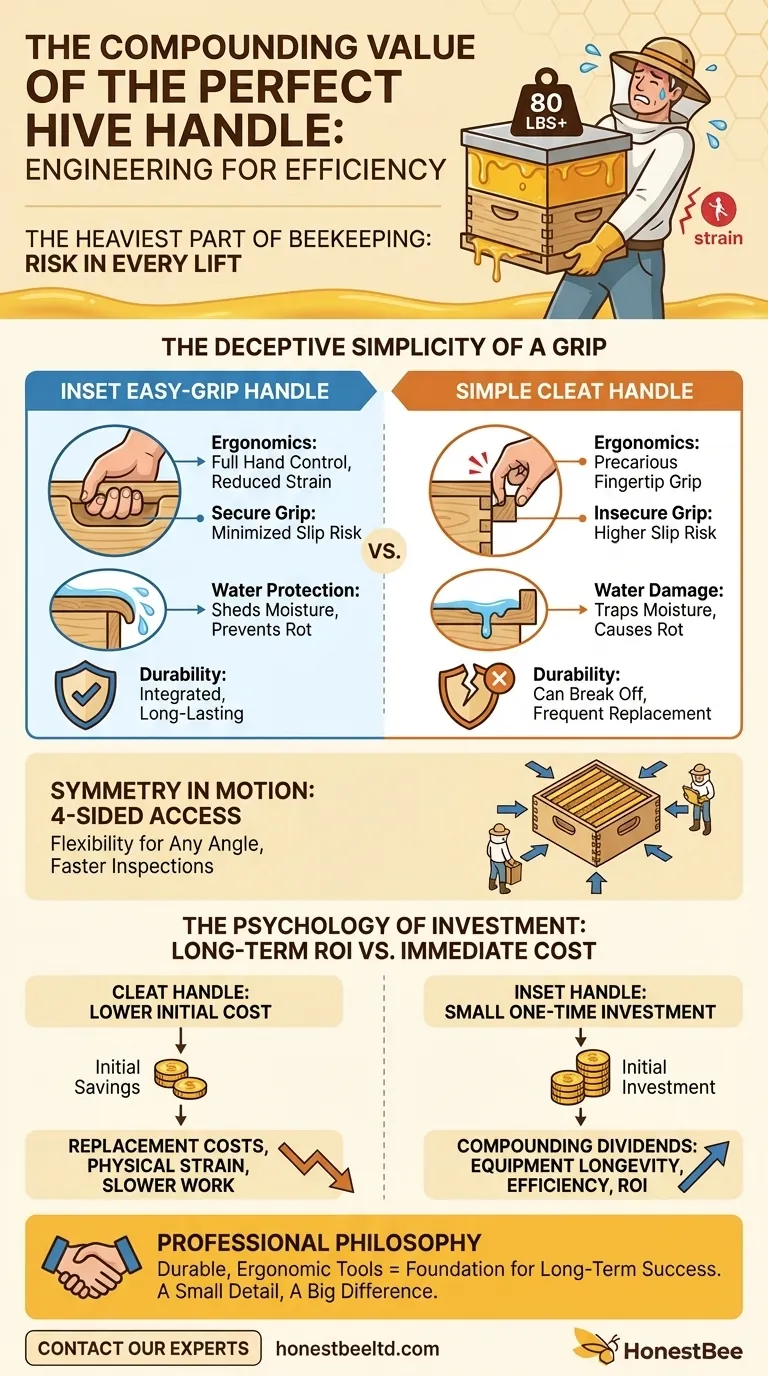
An inset, half-circle handle is different. It allows your fingers to curl naturally, engaging the full strength of your hand. This isn't just about comfort; it's about control. A secure grip reduces the mental and physical load, freeing you to focus on the bees. It minimizes the risk of a slip, a drop, or a sudden, jarring movement that could injure you or anger a colony.
Designing Against Nature's Persistent Force: Water
Wood rots. This is a fundamental truth. The most vulnerable point on a hive body is any joint where water can pool.
A cleat handle creates a perfect ledge for rainwater, trapping moisture directly against the hive wall. Over time, this guarantees decay.
The gentle, downward-facing curve of an inset handle is a beautifully simple piece of engineering. It actively sheds water. It leverages gravity to protect the wood's end-grain, preventing moisture from wicking in. This small design choice doesn't just make the handle last; it extends the life of the entire hive box, protecting your investment season after season.
Symmetry in Motion: The Logic of Four-Sided Access
Hives are rarely positioned in a way that’s convenient for the beekeeper. They are on uneven ground, packed in rows, or placed against a tree line. You don't always get a clean front or back approach.
Having a reliable grip point on all four sides of a hive body isn't a luxury; it's an operational necessity. It provides the flexibility to lift securely from any angle, making inspections faster, safer, and less disruptive to the colony. It eliminates the awkward shuffling and repositioning that waste time and energy.
The Psychology of a Small Investment
Why would anyone choose an inferior handle? The answer lies in the common human bias of prioritizing immediate, visible costs over gradual, invisible benefits.
| Feature Comparison | Inset Easy-Grip Handle | Simple Cleat Handle |
|---|---|---|
| Grip Security | High (Full hand grip) | Low (Fingertip grip) |
| Water Protection | Excellent (Sheds water) | Poor (Traps water, causes rot) |
| Durability | High (Integrated into box) | Low (Can break off) |
| Long-Term Cost | Lower (Extends equipment life) | Higher (Frequent replacement) |
A cleat handle is cheaper and faster to manufacture. Its cost is immediate and obvious. The cost of an inset handle—the extra time on a router—is also immediate.
However, the cost of a cleat handle is paid back with interest over time through replaced equipment, physical strain, and slower work. The inset handle is a small, one-time investment that pays compounding dividends in longevity and efficiency for years. Even the minor concern of pests like wax moths finding shelter in the inset is easily managed by routine inspections in any healthy, well-policed colony.
The Interface for a Successful Apiary
In commercial beekeeping, where margins are tight and labor is a significant cost, efficiency is paramount. The hive handle is more than a feature; it is the critical physical interface for every single hive manipulation.
Choosing equipment with well-engineered handles reflects a professional philosophy: an understanding that long-term success is built on a foundation of durable, ergonomic, and efficient tools. It’s a recognition that small, thoughtful details create a system that works with you, not against you.
For commercial apiaries and distributors focused on performance and ROI, these details are not trivial—they are foundational. Ensuring your woodenware is built with integrated, ergonomic handles is a direct investment in the longevity of your assets and the productivity of your team. Contact Our Experts
Visual Guide
Related Products
- Premium Comfort Grip Spring-Loaded Hive Handles
- Professional Drop-Style Hive Handles for Beekeeping
- Professional Grade Foldable Beehive Handles
- HONESTBEE Professional Long Handled Hive Tool with Precision Cutting Blade
- HONESTBEE Premium Italian Style Hive Tool with Hardwood Handle
Related Articles
- The Essential Guide to Hive Tools in Modern Beekeeping
- Leverage and Finesse: The Unseen Physics of a Simple Hive Tool
- The Beekeeper's Scalpel: How a Simple Hive Tool Governs Apiary Health
- How to Choose Hive Tools That Match Your Beekeeping Workflow
- Precision in Propolis: The Compounding Gains of a Modified Hive Tool