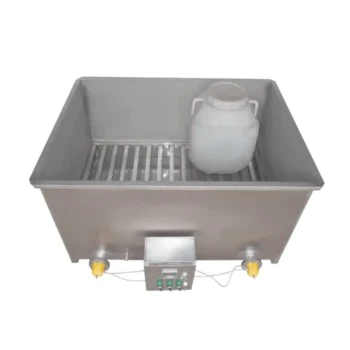
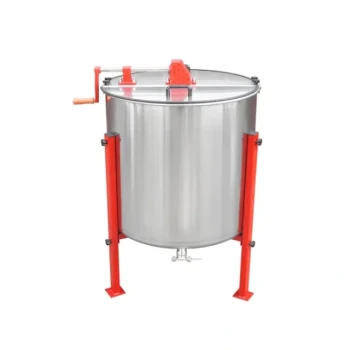
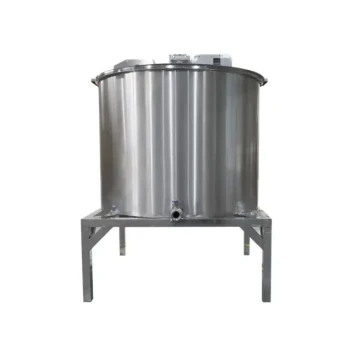
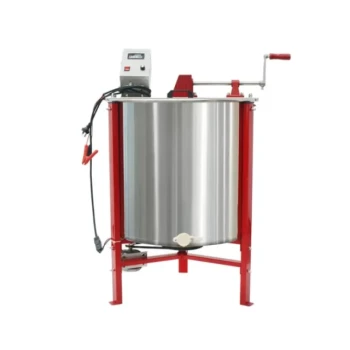
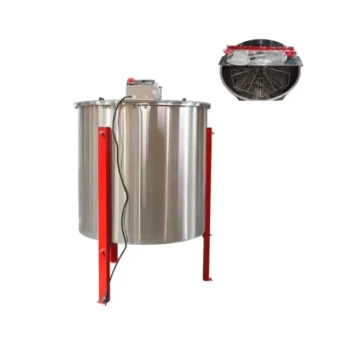
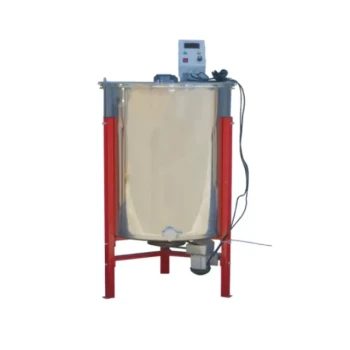
Stainless steel honey centrifuges elevate honey quality by utilizing mechanical centrifugal force to extract honey without damaging the honeycomb or introducing manual contaminants. This non-destructive process ensures a higher degree of purity, superior clarity, and strict adherence to food safety standards compared to manual pressing, which often incorporates wax, pollen, and external pollutants into the final product. For distributors and wholesalers, this technology is essential for securing premium market placement and meeting the rigorous demands of the global food supply chain.
Core Takeaway: Centrifugal extraction preserves the natural chemical profile and physical clarity of honey by replacing destructive crushing methods with high-speed rotation. This transition from manual to mechanized processing is the primary driver for achieving export-grade purity and maximizing hive productivity.
Enhancing Purity Through Advanced Material Science
Eliminating Metallic and Chemical Contamination
Industrial-grade stainless steel is chemically inert, meaning it does not react with the natural acidity of honey. Unlike older manual methods or reactive metal containers, stainless steel prevents acid corrosion and the leaching of heavy metals into the product. This ensures the honey maintains its natural physical and chemical properties from hive to barrel.
Reducing Water-Insoluble Solids
Traditional manual pressing involves crushing the honeycomb, which forces pollen, larvae secretions, and wax fragments into the honey. Centrifugal extractors spin the honey out of the cells while leaving the comb structure intact. This significantly reduces the presence of water-insoluble solids, resulting in a cleaner product that requires less aggressive filtration.
Maintaining Sensory Integrity and Market Value
Preserving Natural Clarity and Color
By utilizing multi-layer stainless steel screens during the centrifugal process, physical impurities are removed instantly. This process maintains the transparency and light-colored profile of high-end varieties like white honey. Maintaining these visual standards is critical for distributors aiming for high-end retail or international "Grade A" certifications.
Minimizing Oxidation and HMF Development
Mechanized extraction is significantly faster than manual dripping or pressing, which reduces the honey's exposure to air. Limited air exposure slows the development of Hydroxymethylfurfural (HMF), an indicator of heat damage and aging. A lower HMF level is a hallmark of fresh, high-quality honey and is a key metric for B2B quality control.
Improving Yield and Supply Chain Reliability
Accelerating the Production Cycle
Because centrifuges do not destroy the wax combs, they can be returned to the hive immediately after extraction. Bees do not need to expend energy and resources rebuilding the nest structure from scratch. This efficiency shortens the production cycle and allows for a higher annual yield per hive, ensuring a more consistent supply for wholesalers.
Ensuring Food Safety and Hygiene
Mechanical extraction eliminates the risks associated with direct manual contact, which is a frequent source of contamination in traditional pressing. Modern centrifuges are designed for rapid cleaning and sterilization. Our deep industry expertise ensures that our equipment meets the "zero-contamination" requirements of modern food safety audits.
Understanding the Trade-offs
Equipment Maintenance and Sanitization
While centrifuges improve quality, they require a disciplined cleaning protocol to prevent sugar crystallization or microbial growth in the drum. Distributors must ensure their suppliers provide equipment with high-polish finishes that facilitate easy sanitization. Failure to maintain the machinery can lead to batch-to-batch cross-contamination.
Initial Capital Expenditure
The transition from manual pressing to stainless steel centrifugation requires a higher initial investment. However, for large-scale operations, this is offset by reduced labor costs and the ability to command higher market premiums for purified honey. The long-term ROI is driven by the durability of the stainless steel and the increased volume of "Grade A" product.
Strategic Sourcing for Global Distribution
How to Apply This to Your Portfolio
Choosing the right extraction technology is a critical decision that impacts your entire supply chain's reputation. As a one-stop sourcing partner, we provide the technical expertise to match your production scale with the right equipment.
- If your primary focus is meeting international export standards: Prioritize high-capacity, multi-frame stainless steel centrifuges to ensure the lowest possible levels of HMF and insoluble solids.
- If your primary focus is maximizing producer yield: Focus on non-destructive centrifugal models that allow for immediate comb recycling, significantly boosting the total volume of your seasonal intake.
- If your primary focus is brand reputation and food safety: Source equipment with certified food-grade 304 or 316 stainless steel to guarantee a contaminant-free product that passes all third-party laboratory tests.
Empowering your producers with the right centrifugal technology is the most effective way to transform raw harvest into a high-value, globally competitive asset.
Summary Table:
| Feature | Manual Pressing | Stainless Steel Centrifuge |
|---|---|---|
| Honeycomb Integrity | Crushed and destroyed | Preserved and reusable |
| Purity & Clarity | High wax/pollen debris | High clarity; low insoluble solids |
| Contamination Risk | High (Manual contact/Oxidation) | Minimal (Inert material/Rapid process) |
| Production Yield | Low; bees must rebuild combs | High; immediate comb recycling |
| Chemical Profile | Risk of metallic leaching | Preserves natural HMF & acidity levels |
Scale Your Honey Business with HONESTBEE
As a premier global supplier, HONESTBEE empowers commercial apiaries, distributors, and B2B resellers with a comprehensive one-stop sourcing solution. We provide the full spectrum of beekeeping technology—from high-capacity stainless steel honey centrifuges and honey-filling machines to hive-making hardware and essential consumables.
Why Choose HONESTBEE for Your Wholesale Needs?
- Maximize Margins: Competitive wholesale pricing and robust OEM/ODM support for your brand.
- Reliable Supply Chain: Deep industry expertise paired with ultra-fast delivery and efficient order fulfillment.
- Premium Standards: Our equipment ensures your honey meets the most rigorous international food safety and "Grade A" certifications.
Ready to transform your production capacity and secure premium market placement? Contact our expert team today to explore our full-spectrum product portfolio and elevate your business!
References
- Sataca Omar Uacherequele, André S. Afonso. AVALIAÇÃO DE QUALIDADE E PRÁTICAS APÍCOLAS DO MEL PRODUZIDO NAS PROVÍNCIAS DE MAPUTO E INHAMBANE. DOI: 10.71248/kaxj9922
This article is also based on technical information from HonestBee Knowledge Base .
Related Products
- electric honey extractor honey centrifuge 3 frame honey extractor stainless steel honey frame extractor
- Professional Stainless Steel Honey Filtering Machine with Water Bath Heating for Beekeeping
- Heavy Duty Stainless Steel Honey Processing Machine Decrystallizing Tank
- Heavy Duty 304 Stainless Steel Honey Dipper
- Commercial 48-Frame Stainless Steel Honey Extractor
People Also Ask
- What are the characteristics of electric honey extractors? Boost Your Apiary Efficiency with Automated Technology
- What are the disadvantages of using an electric honey extractor? Weighing Cost, Power, and Comb Safety
- What are the advantages of an electric honey extractor? Boost Efficiency and Scale Your Honey Production
- What are the technical advantages of electric honey extractors? Maximize Yield and Protect Your Bee Colony
- How does an electric honey extractor affect the quality of honey? Preserve Flavor & Purity with Precision Extraction