Combs Mapping is a quantitative spatial analysis method utilized to convert the complex biological status of a honeybee colony into precise, measurable data. By calculating the exact surface area of specific hive components, researchers can mathematically evaluate how external factors, such as food supply during crop pollination, directly influence the queen's laying rates and the overall lifecycle turnover of the colony.
Core Takeaway This technique shifts colony evaluation from subjective observation to objective measurement by quantifying the surface area of reproductive and storage zones. It provides a direct correlation between resource availability (nectar and pollen) and colony productivity (brood development and queen performance).
The Mechanics of Combs Mapping
Measuring Functional Zones
The core utility of Combs Mapping lies in its ability to segment the hive into distinct, measurable categories.
Rather than looking at the hive as a whole, the technique isolates specific functional zones. It measures the surface area dedicated to eggs and larvae (early development), capped brood (pupating bees), honey storage (carbohydrate energy), and pollen storage (protein resources).
Converting Biology to Quantifiable Data
Beehive development is often chaotic and difficult to track with simple visual inspection.
Combs Mapping transforms this biological complexity into hard numerical data. By generating surface area calculations for each zone, evaluators obtain concrete metrics that allow for statistical comparison between colonies and over time.
Evaluating Colony Dynamics During Pollination
Assessing Nutritional Impact
During pollination, the availability of floral resources fluctuates, which can drastically alter colony behavior.
This technique allows evaluators to see exactly how changes in food supply affect the hive's internal structure. For example, a decrease in the pollen storage area can be mathematically correlated with a subsequent drop in brood production.
Monitoring Queen Performance
The technique provides a precise window into the queen's reproductive efficiency.
By measuring the egg and larvae area specifically, researchers can calculate the queen's laying rate. This data helps determine if the queen is underperforming or if the colony is successfully growing its population to meet pollination demands.
Tracking Colony Turnover
Colony turnover refers to the rate at which new bees replace dying foragers.
Combs Mapping tracks the progression from egg to capped brood, enabling an accurate assessment of this turnover. This ensures that the colony maintains a population explicitly capable of sustaining effective crop pollination.
Understanding the Trade-offs
High Precision vs. Labor Intensity
While Combs Mapping offers superior accuracy compared to visual estimation, it is inherently more demanding.
gathering precise surface area data requires rigorous measurement of every comb. This process is time-consuming and requires significant effort compared to standard hive inspections.
The "Snapshot" Limitation
Combs Mapping provides a detailed view of the colony at a single moment in time.
Because biological conditions in a hive change rapidly, a single map represents a static snapshot. To understand long-term trends, the mapping process must be repeated regularly, increasing the resource cost of the evaluation.
Making the Right Choice for Your Goal
To effectively utilize Combs Mapping, you must align the metrics with your specific objectives.
- If your primary focus is Queen Productivity: Prioritize the measurement of the egg and larvae surface area to determine immediate laying rates.
- If your primary focus is Resource Availability: Focus on the ratio between honey/pollen storage areas and the capped brood area to ensure the colony is not starving.
- If your primary focus is Colony Sustainability: Analyze the balance between capped brood and food stores to predict if the population will remain stable during the pollination contract.
By quantifying the hive's internal structure, you move beyond guessing and start measuring the true impact of the environment on your bees.
Summary Table:
| Metric Category | Functional Zone | Data Provided | Key Benefit |
|---|---|---|---|
| Reproductive | Eggs & Larvae | Queen laying rates | Monitors immediate fertility and growth potential |
| Development | Capped Brood | Population turnover | Predicts future forager availability for pollination |
| Resources | Honey & Pollen | Nutritional reserves | Correlates resource availability with colony stability |
| Spatial | Total Surface Area | Hive utilization | Replaces subjective observation with objective statistics |
Maximize Your Colony Potential with HONESTBEE
At HONESTBEE, we understand that precision in beekeeping leads to profitability for commercial apiaries and distributors. Whether you are conducting advanced research like Combs Mapping or managing large-scale pollination contracts, we provide the industrial-grade tools you need to succeed.
Our comprehensive wholesale offering includes:
- Specialized Machinery: Advanced hive-making and honey-filling machines to scale your operations.
- Beekeeping Equipment: A full spectrum of professional tools designed for durability and precision.
- Industry Consumables: Essential supplies to maintain colony health and productivity.
- Cultural Merchandise: Unique honey-themed products to diversify your portfolio.
Ready to elevate your beekeeping business with a partner who values data-driven results? Contact HONESTBEE today to explore our wholesale solutions and see how our expertise can streamline your production.
References
- Guilherme José de Paiva, Vagner de Alencar Arnaut de Toledo. Comportamento de <em>Apis mellifera</em> L. africanizada em flor de girassol (<em>Helianthus annuus</em> L.) e avaliação do desenvolvimento de uma colônia de <em>Apis mellifera</em> em área de girassol coberta. DOI: 10.4025/actascianimsci.v24i0.2308
This article is also based on technical information from HonestBee Knowledge Base .
Related Products
- Heavy Duty Castellated Iron Frame Spacer for Honey Supers
- Professional Bent Tine Honey Uncapping Fork with Ergonomic Grip
- Plastic Honey Comb Frames Cassette Box for Honey
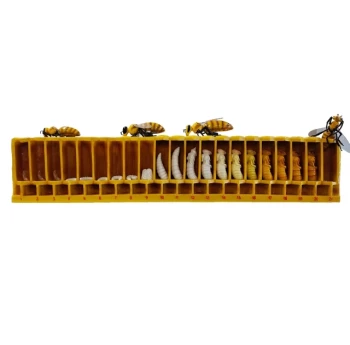
- Honey Bee Lifecycle Model: A Detailed Honeycomb Display of Bee Development
People Also Ask
- What are honey super frames and what foundation options are available? Choose the Best Support for Your Bees
- What are the reasons and drawbacks of using nine frames in a ten-frame honey super? Boost Extraction Speed Today
- What are honey super frames and how many are needed per box? A Beekeeper's Essential Guide
- What are honey super frames and their foundation options? Choose the Best Support for Your Hive's Honey Production
- Why might a beekeeper use fewer than the standard number of frames in a honey super? Boost Extraction Efficiency