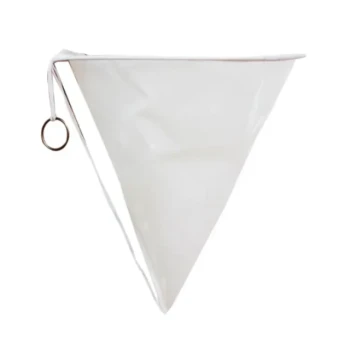
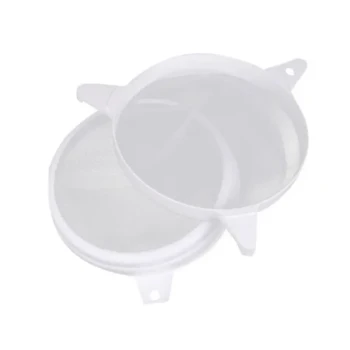
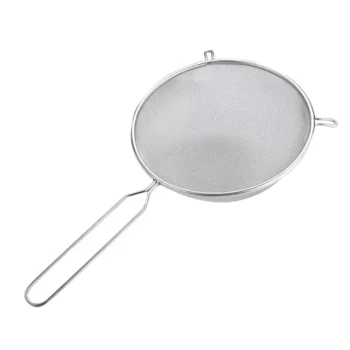
The inverted conical weaving basket serves as a primary, gravity-driven filtration mechanism. In the honey processing workflow, this device functions by physically separating liquid honey from solid byproducts found within harvested honeycombs. Its specific design allows clean honey to pass through the weave while effectively retaining solid impurities, ensuring the collected product meets basic purity standards.
The basket acts as a crucial sieve that relies on the density of its weave to isolate honey from wax and organic debris. Unlike mechanical methods, it utilizes simple gravity to ensure the structural integrity of the final liquid product.
The Mechanics of Gravity-Fed Filtration
How Separation Occurs
The core function of the basket lies in its specific weaving density. When harvested honeycombs are placed inside the inverted cone, gravity pulls the viscous honey downward. The weave acts as a selective barrier, calibrated to be permeable to the liquid honey but impermeable to larger solids.
Targeted Impurities
The primary role of the basket is to trap and remove specific contaminants introduced during harvest. This includes wax fragments from the comb structure and larval remains. By preventing these elements from entering the collection vessel below, the basket performs the essential first stage of purification.
Ensuring Product Quality
Physical Purity
The basket ensures the quality of the final product through physical separation. By removing solid matter, the device transforms the raw harvest into a cleaner liquid state. This is a critical step in preparing the honey for consumption or further refinement, such as fine straining.
Collection and Storage
Located directly beneath the basket is a collection vessel. This setup creates a seamless flow where the filtered honey is immediately consolidated. This containment prevents re-contamination and facilitates the transfer of the honey to subsequent processing stages.
Understanding the Trade-offs
Gravity vs. Centrifugal Force
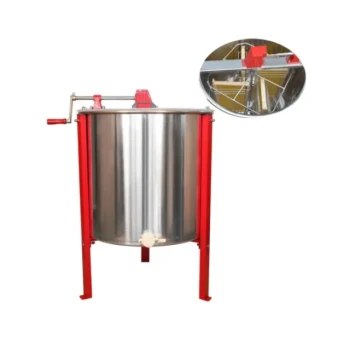
While the basket is effective for filtration, it relies on gravity, which can be a slower process compared to modern alternatives. Supplementary data indicates that centrifugal honey extractors use rapid rotation to sling honey out of frames. The basket method is passive and may require more time to achieve the same volume of separation.
Comb Preservation
A critical distinction must be made regarding the honeycomb itself. Using a basket often involves placing the comb directly inside for draining. In contrast, centrifugal extractors allow the wax honeycomb structure to remain intact. This allows beekeepers to return emptied combs to the hive, saving bees the energy required to rebuild them—a benefit not explicitly associated with the basket method.
Making the Right Choice for Your Goal
To select the appropriate processing equipment, you must identify your production priorities:
- If your primary focus is simple, low-tech filtration: Utilize the inverted conical weaving basket to effectively remove wax and larvae without the need for power equipment.
- If your primary focus is efficiency and comb reuse: Consider a centrifugal extractor, which separates honey faster and preserves the comb for the bees to reuse.
By understanding the function of the weaving basket, you can ensure your honey processing workflow achieves the necessary balance between purity and simplicity.
Summary Table:
| Feature | Inverted Conical Basket | Centrifugal Extractor |
|---|---|---|
| Primary Mechanism | Gravity-fed filtration | Centrifugal force (Rotation) |
| Function | Separates honey from wax/larvae | Slings honey out of cells |
| Comb Preservation | Generally crushed/drained | High (combs can be reused) |
| Processing Speed | Slow (passive) | Fast (active) |
| Best For | Simple, low-tech purification | High-efficiency commercial production |
Scale Your Honey Production with HONESTBEE
Are you looking to optimize your apiary's output? Whether you need traditional filtration tools or high-capacity machinery, HONESTBEE is your dedicated partner in beekeeping excellence. We provide commercial apiaries and distributors with a comprehensive range of professional equipment, including:
- Industrial Machinery: From hive-making to precision honey-filling machines.
- Processing Tools: Advanced extractors, filtration systems, and honey processing hardware.
- Wholesale Consumables: A complete spectrum of beekeeping essentials and cultural merchandise.
Maximize your yield and preserve product quality today. Contact our expert team at HONESTBEE to discuss our wholesale offerings and find the perfect equipment tailored to your business needs.
References
- Nikolina Domović Belec. Pčelarstvo u antici. DOI: 10.47054/ziva23731-2193db
This article is also based on technical information from HonestBee Knowledge Base .
Related Products
- Conical Nylon Honey Strainer Filter Bag for Beekeeping and Honey Filtration
- Professional Cone-Shaped Honey Filter with Reinforced Steel Ring
- Inverted Squeezable Honey Jar with No Drip Flip Top Cap for Easy Pouring
- Nylon Honey Strainer Square Filter Cloth for Honey Filters
- Two-Stage Plastic Honey Filter for Buckets
People Also Ask
- What is the primary function of specialized filtering bags in honey purification? Enhance Quality & Equipment Life
- What are the primary functions of using muslin cloth or stainless steel filters? Ensure Pure and Marketable Honey
- What are the benefits of using a honey strainer for beekeepers? Achieve Clean, High-Quality Honey Efficiently
- What is the primary function of a honey strainer in beekeeping? Achieve Commercial Purity & Visual Clarity
- What can I use to strain honey? A Beekeeper's Guide to Choosing the Right Filter