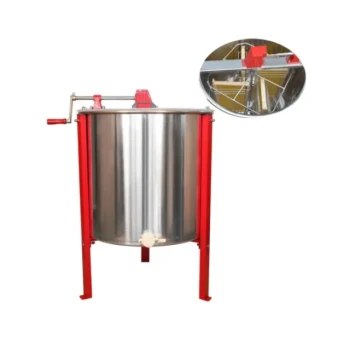
A professional honey extraction room serves as a definitive hygienic barrier. It isolates the raw product from external threats such as dust, pests, and airborne contaminants during the critical transition from hive to bottle. This controlled environment is essential for maintaining strict food safety standards and protecting the honey's delicate physicochemical properties and unique flavor profile.
The extraction room acts as a physical shield; without it, even the most advanced machinery cannot guarantee a product free from environmental contamination or flavor degradation.
The Critical Role of Environmental Isolation
Establishing a Hygienic Barrier
The primary function of the extraction room is physical isolation. By creating a closed environment, you prevent the entry of external contaminants that commonly degrade honey quality in open-air setups.
This isolation is vital during centrifugal extraction and filtration. It ensures that the honey remains pure and meets rigorous food safety standards required for commercial distribution.
Protecting Flavor and Chemistry
Honey is a chemically complex substance that is sensitive to its environment. The extraction room safeguards the physicochemical properties of the honey.
By controlling the atmosphere, you preserve the volatile aromatic compounds that give honey its distinct flavor profile. This preservation is directly linked to increased market competitiveness.
Enhancing Purity Through Specialized Infrastructure
Eliminating Impurities
Within the professional room, specialized equipment utilizes centrifugal forces and multi-stage filtration. This infrastructure is necessary to efficiently remove hive debris, beeswax particles, and larval fragments.
Unlike manual squeezing, which introduces contaminants, this mechanized approach housed in a clean room significantly improves clarity and purity.
Standardization of Product
Industrial-grade setups within these rooms often include settling tanks and temperature-controlled concentration equipment.
This allows for the standardization of honey that may have varying water content due to climate fluctuations. It ensures the final product meets specific grading evaluations regarding transparency and consistency.
Operational Efficiency and Quality Preservation
Reducing Exposure Risks
Speed is a quality factor. Professional rooms enable rapid, non-destructive harvesting.
This speed reduces the honey's exposure to high humidity and air. Minimizing this exposure time is critical to preventing secondary contamination and moisture absorption, which can lead to fermentation.
Preventing Nutritional Degradation
The equipment housed in these rooms uses food-grade materials to prevent chemical contamination.
More importantly, automated filling under sterile conditions preserves the natural antioxidant activity and nutritional components of the honey, which can be lost through improper handling in uncontrolled environments.
Understanding the Trade-offs
Maintenance of Sterile Conditions
A professional extraction room is not a "set it and forget it" solution. It requires a rigorous cleaning protocol to function as intended.
If the room is not maintained to sterile conditions, the complex machinery (such as multi-stage filters) can become a source of cross-contamination rather than a solution for purity.
Complexity vs. Volume
Investing in a professional room with industrial-grade centrifugal and concentration equipment significantly increases overhead.
For extremely small-scale hobbyists, the cost of maintaining this infrastructure may outweigh the gains in net honey output. However, for any producer aiming for commercial retail, the lack of such a facility often precludes market entry due to food safety regulations.
Making the Right Choice for Your Goal
Whether you are scaling up production or refining a boutique product, the extraction room is the foundation of your quality control.
- If your primary focus is Commercial Scalability: Prioritize a room designed for high-efficiency centrifugal extraction to maximize net output and minimize waste while ensuring consistent standardized grading.
- If your primary focus is Artisan Quality: Focus on a room that ensures sterile filtration and temperature control to preserve the specific flavor notes and antioxidant properties that define premium pricing.
By controlling the environment where extraction occurs, you transform honey processing from a simple harvest into a verifiable science of quality assurance.
Summary Table:
| Key Feature | Benefit for Honey Quality | Operational Impact |
|---|---|---|
| Hygienic Isolation | Prevents dust, pests, and airborne contaminants | Ensures compliance with food safety standards |
| Atmosphere Control | Preserves volatile aromatic compounds and chemistry | Maintains premium flavor profile and market value |
| Mechanized Extraction | High clarity through centrifugal force and filtration | Removes impurities without manual contamination |
| Climate Regulation | Prevents moisture absorption and fermentation | Standardizes water content and product consistency |
| Sterile Filling | Protects natural antioxidants and nutrition | Extends shelf life and preserves health benefits |
Elevate Your Honey Production with HONESTBEE
Transitioning from hive to bottle requires precision and hygiene. HONESTBEE specializes in supporting commercial apiaries and distributors with high-performance honey processing solutions. From industrial-grade centrifugal extractors and honey-filling machines to complete hive-making equipment, we provide the full spectrum of tools needed to build a professional-grade extraction facility.
Whether you are scaling your operations or seeking to capture the premium artisan market, our comprehensive wholesale offering ensures your honey meets the highest global standards for purity and consistency. Contact us today to explore our machinery and consumables and see how we can optimize your honey production efficiency.
References
- Carlos Alberto García Munguía, Jesús Hernández-Ruíz. Tipificación de los apicultores de Abasolo, Guanajuato: un estudio socio económico. DOI: 10.37114/abaagrof/2023.4
This article is also based on technical information from HonestBee Knowledge Base .
Related Products
- HONESTBEE 3-Frame Manual Acrylic Honey Extractor
- Stainless Steel 3 Frame Manual Honey Extractor Spinner for Bee Honey Extraction
- Stainless Steel Manual 8 Frame Radial Honey Extractor Machine for Beehives
- Stainless Steel Beekeeping Honey Extractor Lid
- Acrylic Lid Beekeeping Honey Extractor for Beekeepers
People Also Ask
- What are the disadvantages of a manual honey extractor? Overcome Efficiency Bottlenecks in Your Apiary
- Which type of honey extractor is generally more durable? Focus on Material & Build Quality for Longevity
- Why are manual extractors popular among beginner beekeepers? A Guide to Starting Simple & Saving Money
- What is a manual honey extractor? The Essential Guide to Cost-Effective Beekeeping for Beginners
- What is the primary disadvantage of a manual honey extractor? Understanding Labor vs. Efficiency in Beekeeping