The Fortress and The Key
A beehive is a fortress. It is not designed to be opened.
The colony seals every entrance, every seam, and every gap with a resinous, anti-microbial "glue" called propolis. This makes the hive structurally sound, defensible, and impervious to weather.
For the beekeeper, however, it presents a fundamental problem: How do you enter a fortress without starting a war?
The answer is a deceptively simple piece of steel: the hive tool. But to call it a mere pry bar is to miss the point entirely. It is the essential interface between human intention and colony biology. It is a key, a lever, and a language all in one.
The Language of Leverage: Speaking to the Hive
The first job of the beekeeper is to persuade the colony to allow an inspection. This persuasion begins with the hive tool.
Breaking the Seal
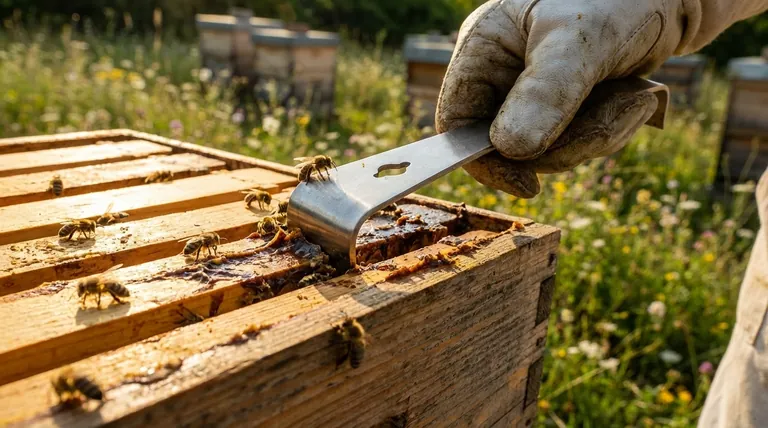
When you slide the beveled edge of a hive tool between two hive bodies, you are not simply breaking a seal. You are communicating.
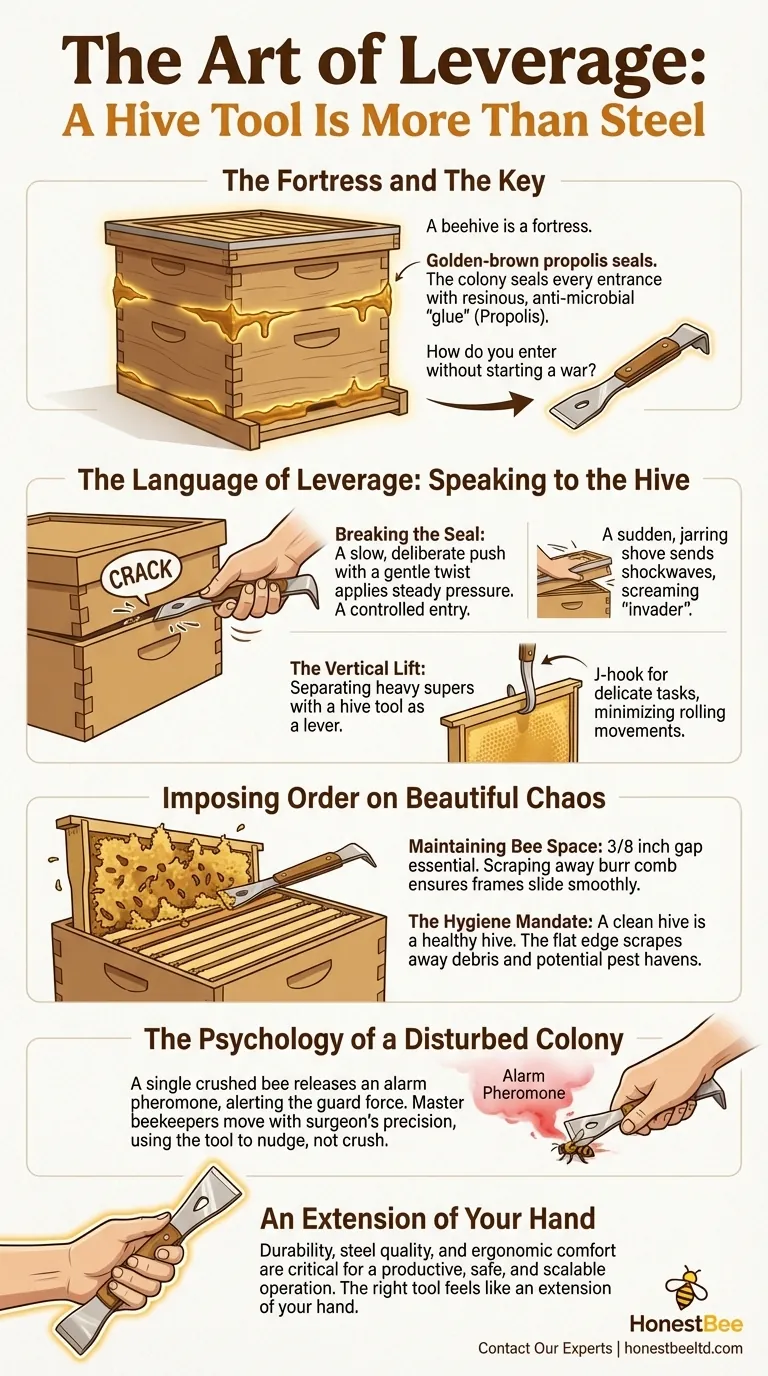
A slow, deliberate push with a gentle twist applies steady pressure. The result is a clean, sharp "crack" as the propolis gives way. This is the sound of a controlled entry. A sudden, jarring shove, however, sends a shockwave through the entire structure—a seismic event that screams "invader" to tens of thousands of bees.
The tool doesn't just provide force; it amplifies your intent. Patience feels different from aggression, and the bees can tell.
The Vertical Lift
Separating heavy supers glued with propolis and wax is a challenge of physics. The hive tool acts as a simple lever, allowing you to apply immense force with minimal effort. This protects your back, but more importantly, it protects the hive from being violently jolted, which can provoke a defensive response or even injure the queen.
The most delicate task is lifting the first frame. It is packed tightly and welded in place. Here, a J-hook style tool becomes invaluable, allowing you to lift the frame straight up, minimizing rolling movements that could crush the bees clinging to its surface.
Imposing Order on Beautiful Chaos
Beyond prying, the hive tool is an instrument of order. Bees are brilliant but messy architects, and they will build burr comb in any space they deem suitable, often ignoring the beekeeper's plans.
Maintaining Bee Space
The hive is designed around the principle of "bee space"—a gap of about 3/8 of an inch that bees will naturally leave open for passage. If a space is too large, they fill it with comb; too small, and they seal it with propolis.
Scraping away unwanted burr comb and excess propolis from frames and boxes isn't just janitorial work. It is the act of maintaining the hive's design integrity. It ensures frames slide smoothly and supers sit flush. For a commercial operation, this tidiness translates directly into speed and efficiency during inspections.
The Hygiene Mandate
A clean hive is a healthy hive. The flat edge of the tool is perfect for scraping away debris from bottom boards and cleaning old frames for reuse. This removes potential havens for pests like wax moths and hive beetles, contributing to the overall health and productivity of the colony.
The Psychology of a Disturbed Colony
Every action a beekeeper takes has a reaction. The hive tool, as the primary point of contact, is at the center of this dynamic.
-
A Gouge in the Wood: Using excessive force doesn't just damage your equipment; it creates a lasting wound. A split in the soft pine of a hive body is an open invitation to pests and moisture, shortening the life of your assets. It’s the physical scar of impatience.
-
The Chain Reaction of a Single Bee: When prying frames apart, it's easy to accidentally crush a bee. A single crushed bee can release an alarm pheromone, a chemical signal that instantly puts the entire guard force on high alert. One small mistake can turn a calm inspection into a defensive frenzy, a ripple effect that can spread through an entire apiary.
The master beekeeper understands this. They move with a surgeon's precision, giving bees a chance to move, using the tool to nudge, not to crush.
An Extension of Your Hand
For the hobbyist, any hive tool will do. For a commercial apiary or a distributor supplying them, the calculation is different. When you use a tool hundreds of times a day, small differences in design become magnified.
Durability, steel quality, and ergonomic comfort are no longer luxuries; they are critical inputs for a productive, safe, and scalable operation. The right tool feels less like an object and more like an extension of your own hand, translating your knowledge and finesse directly into the hive with minimal friction. At HONESTBEE, we supply the professional-grade beekeeping equipment designed for the rigors of commercial use, ensuring every tool meets the demands of efficiency and reliability.
If your operation depends on equipment that works as hard as you do, let's talk. Contact Our Experts
Visual Guide
Related Products
- HONESTBEE Professional Long Handled Hive Tool with Precision Cutting Blade
- Professional Multi-Function Stainless Steel Hive Tool
- HONESTBEE Premium Italian Style Hive Tool with Hardwood Handle
- Ergonomic Plastic Frame Spacer Tool for Rapid Hive Management Beekeeping
- Professional Grade Foldable Beehive Handles
Related Articles
- Force and Finesse: The Hive Tool as the Beekeeper's Critical Interface
- The Essential Guide to Hive Tools in Modern Beekeeping
- The Apiary as a System: Why Your Hive Tool is More Than Just Steel
- How to Choose Hive Tools That Match Your Beekeeping Workflow
- The Beekeeper's Scalpel: How a Simple Hive Tool Governs Apiary Health


















