The Repetitive Task We Tolerate
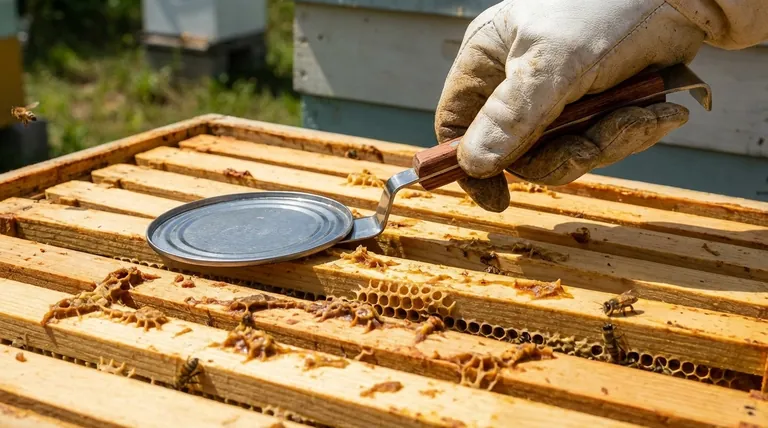
Every commercial beekeeper knows the feeling. You're moving through the yard, a rhythm established, when you hit a snag. A sugar can, sealed tight with propolis, refuses to budge.
Your standard hive tool, a trusted generalist, scrapes and slips. The movement is jarring. You apply more force, the can finally pops loose, and the entire hive jolts.
This tiny moment of friction is more than an annoyance. It’s a break in flow. Multiplied across hundreds or thousands of hives, it becomes a significant drain on time, energy, and even the colony's well-being. It’s a systemic problem masquerading as a minor inconvenience.
When a Generalist Tool Fails
The standard hive tool is the workhorse of the apiary, designed for prying frames and scraping wax. It's a master of many trades.
But its relatively thick, flat blade is not engineered for the specific physics of lifting a feed can. Wedging it under a tight-fitting metal rim requires force at an awkward angle. This is the root of the problem: we are using a perfectly good tool for a job it was never quite designed to do.
The Hidden Costs of "Good Enough"
In a commercial operation, efficiency is measured in seconds. The fumbling, the extra pry, the moment of readjustment—these are not just lost seconds. They are cumulative drags on profitability.
- Increased Labor: A task that takes eight seconds instead of two costs you four times as much in labor over a season.
- Colony Stress: Abrupt, jarring movements agitate bees, making the rest of the inspection more difficult and stressful for the colony.
- Equipment Damage: Applying excessive force can damage inner covers, leading to unnecessary replacement costs.
We accept this friction because the standard tool is good enough. But in a system scaled for production, "good enough" is an enemy of excellence.
The Engineer's Romance: A Simple, Elegant Modification
The solution is not a new, expensive gadget. It’s a deliberate, thoughtful modification to the tool you already own.
By grinding down one corner of the hive tool to create a thinner, sharper hook, you fundamentally change its mechanics. This isn't just sharpening metal; it's an act of tailoring your equipment to your workflow.
This small change transforms the task entirely.
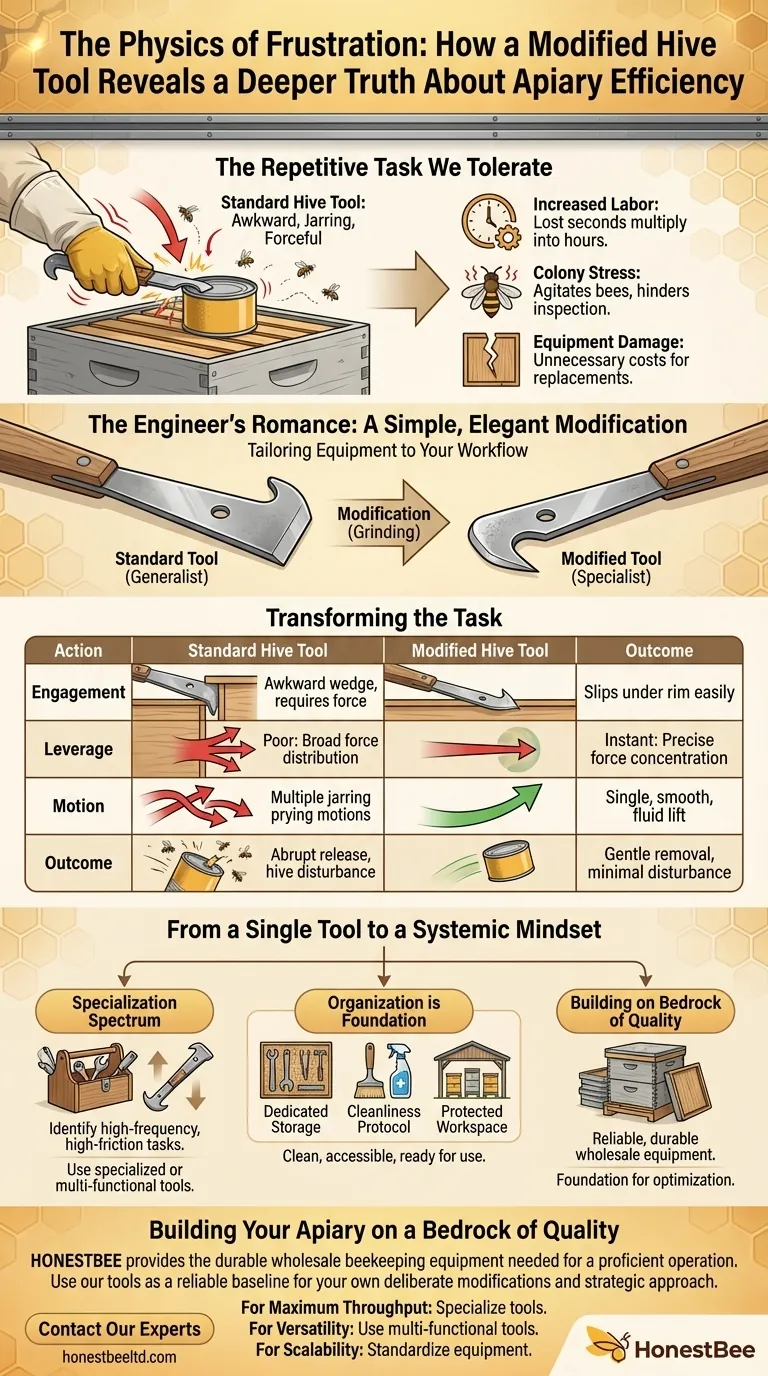
| Action | Standard Hive Tool | Modified Hive Tool |
|---|---|---|
| Engagement | Awkwardly wedge and force the blade | Slip the sharp point under the rim easily |
| Leverage | Poor; force is distributed broadly | Instant; force is concentrated precisely |
| Motion | Multiple jarring prying motions | A single, smooth, fluid lift |
| Outcome | Can pops out abruptly, disturbs hive | Can is removed gently, with minimal disturbance |
The modified tool turns a moment of friction into a seamless, one-motion action. It feels less like work and more like an extension of your intent.
From a Single Tool to a Systemic Mindset
The principle behind modifying a hive tool extends far beyond removing feed cans. It represents a shift in mindset: from passively using the tools you have to actively shaping your equipment to serve a larger operational system.
The Specialization Spectrum
This doesn't mean you need a unique tool for every task. That leads to a cluttered toolbox and decision fatigue. The key is to identify the high-frequency, high-friction tasks in your workflow. These are the bottlenecks where a specialized or multi-functional tool delivers the highest return on investment.
Organization is the Foundation
An efficient tool is only effective if it's clean, accessible, and ready for use. The philosophy of intentionality should extend to your entire workspace.
- Dedicated Storage: A pegboard, magnetic rack, or organized toolbox protects tools and makes them easy to find.
- Cleanliness Protocol: Clean tools are safer, last longer, and prevent the spread of disease.
- Protected Workspace: A dedicated area for your gear prevents loss, weather damage, and pest infestation.
These organizational habits create the stable foundation upon which true workflow efficiency is built.
Building Your Apiary on a Bedrock of Quality
Before you can optimize, you need a reliable starting point. A low-quality tool, even when modified, is prone to bending or breaking, erasing any efficiency gains.
For commercial apiaries and distributors, the focus must be on a foundation of durable, well-designed equipment. This is where HONESTBEE provides critical value. We supply wholesale beekeeping equipment that is built to withstand the rigors of commercial use. Our tools serve as the perfect, reliable baseline for any operation—whether you use them straight out of the box or as a platform for your own deliberate modifications.
Your approach to equipment should be a strategic choice tailored to your goals:
- For Maximum Throughput: Start with our robust standard tools and specialize them for your highest-frequency tasks.
- For Versatility: Equip your crews with high-quality multi-functional tools that reduce the amount of gear carried in the field.
- For Scalability: Standardize your entire operation with our consistent, reliable equipment to simplify training and maintenance.
Ultimately, thoughtful tool selection and management are the hallmarks of a proficient, modern beekeeping operation. Optimizing your workflow begins with the right equipment foundation. To discuss how our tools can support your operational goals, Contact Our Experts.
Visual Guide
Related Products
- HONESTBEE Professional Long Handled Hive Tool with Precision Cutting Blade
- Professional Multi-Function Stainless Steel Hive Tool
- HONESTBEE Premium Italian Style Hive Tool with Hardwood Handle
- Ergonomic Plastic Frame Spacer Tool for Rapid Hive Management Beekeeping
- Professional Grade Foldable Beehive Handles
Related Articles
- Force and Finesse: The Hive Tool as the Beekeeper's Critical Interface
- The Essential Guide to Hive Tools in Modern Beekeeping
- The Apiary as a System: Why Your Hive Tool is More Than Just Steel
- How to Choose Hive Tools That Match Your Beekeeping Workflow
- The Beekeeper's Scalpel: How a Simple Hive Tool Governs Apiary Health


















