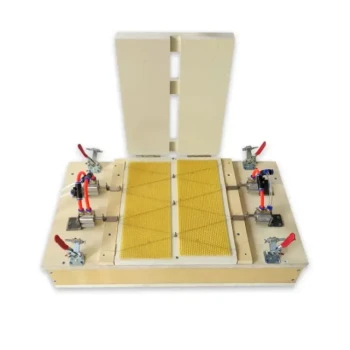
A dual-module microwave resonant system functions as a staged thermal separator, utilizing specific temperature distinct temperature thresholds to decouple the extraction of honey from the recovery of beeswax. By splitting the process into two phases, the system ensures that honey is removed at a lower, safe temperature before high heat is applied to melt the wax.
The core advantage of this system is its ability to resolve the conflict between preserving honey quality and maximizing beeswax yield. It achieves this by creating two distinct thermal environments, preventing the high heat required for wax melting from degrading the heat-sensitive biological components of the honey.
The Mechanics of Staged Separation
Phase One: Enhancing Honey Flowability
The first module operates by adjusting microwave power to heat the raw materials to a precise target of approximately 44°C.
At this temperature, the primary physical change is an increase in the flowability of the honey.
By reducing viscosity without reaching high temperatures, the honey effectively separates through filter holes first, leaving the solid beeswax behind.
Phase Two: Complete Wax Liquefaction
Once the majority of the honey has been removed, the remaining material enters the second module.
Here, the system applies higher-intensity microwave radiation to raise the temperature to approximately 64°C.
The specific function of this stage is to completely melt the beeswax, ensuring efficient extraction and high recovery rates of the wax byproduct.
Why Staged Temperature Control Matters
Preserving Biological Activity
The most critical function of the dual-module design is the protection of the honey's nutritional value.
Honey contains enzymes and biological components that are sensitive to heat.
By extracting the honey at 44°C in the first module, the system preserves biological activity that would be destroyed if the honey were subjected to the 64°C heat required for the wax.
Optimizing Extraction Efficiency
A single-stage process would force a compromise: either the temperature is too low to extract wax, or too high to protect the honey.
The dual-module approach eliminates this trade-off.
It allows for high-quality honey separation simultaneously with efficient beeswax extraction, maximizing the economic value of both raw materials.
Understanding the Operational Requirements
Precision is Critical
The effectiveness of this system relies entirely on maintaining the specific temperature differentials.
If the first module exceeds 44°C, you risk degrading the honey quality immediately.
If the second module fails to reach 64°C, the beeswax will not fully melt, leading to waste and lower yield.
Sequential Dependency
The system functions on a strict sequential logic.
The honey must be separated via the filter holes during the first stage for the second stage to work correctly.
If honey remains in the mixture during the high-intensity heating phase, it will be subjected to the higher 64°C temperature, negating the benefits of the system.
Making the Right Choice for Your Goal
To get the most out of a dual-module microwave resonant system, align your operational monitoring with your specific production goals:
- If your primary focus is Premium Honey Quality: Strictly monitor the first module to ensure the temperature never exceeds the 44°C threshold, guaranteeing enzyme preservation.
- If your primary focus is Beeswax Yield: Ensure the second module consistently maintains 64°C to achieve full liquefaction of the remaining solids.
This system provides the technical capability to process raw honeycomb without sacrificing the quality of one product for the extraction of the other.
Summary Table:
| Process Stage | Target Temperature | Primary Function | Physical Outcome |
|---|---|---|---|
| Module One | ~44°C | Enhance Honey Flowability | Honey separates via filters; enzymes preserved |
| Module Two | ~64°C | Complete Wax Liquefaction | Beeswax melts fully; maximum byproduct recovery |
| Overall Goal | Staged Heating | Dual-Product Optimization | High-quality honey & high-yield beeswax |
Elevate Your Apiary's Production with HONESTBEE
Are you a commercial apiary or distributor looking to maximize the value of your harvest? HONESTBEE provides the industry's most comprehensive range of beekeeping tools, machinery, and essential consumables. From advanced honey-filling machines to specialized hive-making hardware, our solutions—including the latest in thermal separation technology—ensure you never have to choose between honey quality and wax yield.
Unlock higher efficiency and premium product standards today. Contact our expert team now to explore our wholesale offerings and industrial equipment tailored to your growth.
References
- A. V. Shevelev, G M Toboev. Optimization of structural and technological modes of operation of the microwave wax melter. DOI: 10.32634/0869-8155-2022-364-11-88-93
This article is also based on technical information from HonestBee Knowledge Base .
Related Products
- HONESTBEE AC Powered Wire Embedder with Alligator Clips
- Solar Beeswax Melter Easy Solar Wax Melter for Beeswax
- HONESTBEE Adjustable Voltage Wire Embedder with Digital Display
- Heavy-Duty Ergonomic Grip Galvanized Pollen Shovel
- Professional Electric Honey Uncapping Knife with Heated Digital Temperature Control for Beekeeping
People Also Ask
- How can combs be further strengthened? Embed Wires for Durable, High-Yield Hives
- What is an embedder in beekeeping? Essential Tool for Strengthening Wax Foundation & Hive Frames
- Why must strict sanitary and health prevention protocols be implemented for honeybee transport? Maximize Colony Survival
- What are the primary indicators of healthy honeybee colonies? Optimize Your Commercial Apiary for Peak Productivity
- Why must honeybee samples be stored in high-concentration ethanol and low temperatures? Ensure Genetic & Physical Integrity