The Psychology of the Intruder
Pests, particularly ants, operate on a simple, relentless calculus of opportunity. They aren't malicious; they are efficient. For a commercial apiary, this efficiency represents an unseen tax on productivity. Every colony forced to divert energy to fending off invaders is a colony producing less honey, pollinating fewer crops, and weakening over time.
The common approach is to react to infestations. But the winning strategy is to think like the pest: to see your apiary not as a collection of hives, but as a landscape of pathways and incentives. The goal is to make the path impossible and the incentive non-existent.
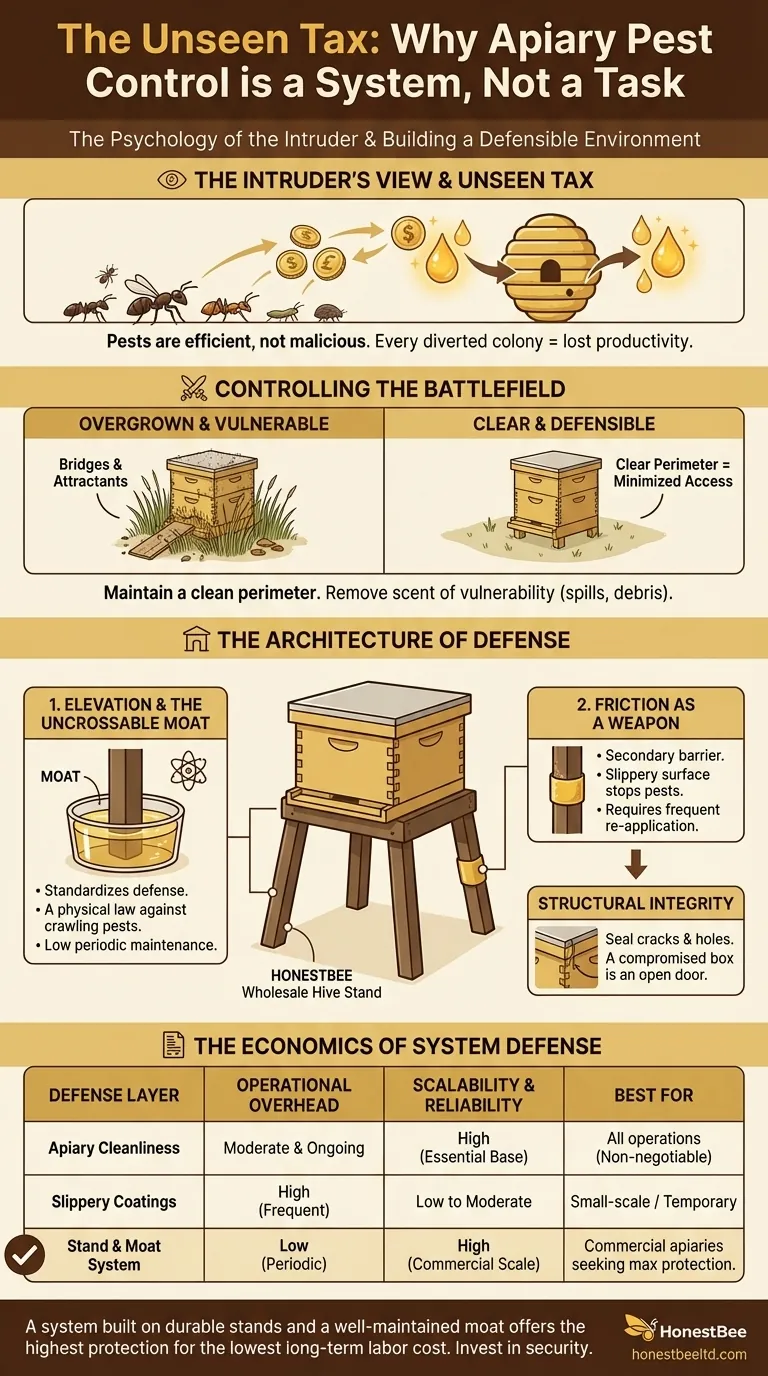
Controlling the Battlefield
The ground itself is the first pathway. Overgrown vegetation is not just untidy; it is a series of bridges that renders your primary defenses useless. A single blade of grass touching a hive stand can become a superhighway for an army of ants.
Maintaining a clean, clear perimeter around each hive is the first principle of apiary defense architecture. It’s not about aesthetics. It’s about creating a defensible space where threats are visible and access points are minimized.
Removing the Scent of Vulnerability
Pests are drawn to signals of opportunity. Spilled sugar syrup, discarded bits of comb, or dead bees are powerful attractants. In a large-scale operation, small spills and debris from one hive can trigger a cascading problem that affects an entire yard.
Keeping the apiary clean is about information control. By removing these attractants, you are removing the "scent of vulnerability" that tells pests this is a profitable place to forage.
The Architecture of Defense
With the environment controlled, the focus shifts to the hive itself. The solution isn't a chemical wall, but an elegant physical one. It’s about creating an impassable fortress through simple engineering.
First Principle: Elevation
A hive on the ground has infinite potential entry points. A hive on a stand has exactly four: its legs. Elevation is the most critical step because it standardizes the defense, channeling all ground-based threats to a few controllable points.
For commercial operations, this demands equipment that can withstand the elements and the weight of a productive colony. HONESTBEE provides robust, wholesale hive stands designed for the rigors of commercial use, forming the essential foundation for any serious defense system.
The Uncrossable Moat: A Law of Physics
The single most effective way to stop crawling insects is to create a barrier they physically cannot cross. By placing each leg of the hive stand into a shallow container of non-toxic oil or soapy water, you create a moat.
This isn't a temporary fix; it's a law of physics applied to pest control. The key operational challenge is maintenance. Debris like leaves or grass can form a bridge across the liquid, so regular inspection is vital to ensure the system's integrity.
Friction as a Weapon: A Secondary Barrier
If a moat system isn't practical, using a thick, sticky substance like Vaseline in a wide band around each leg can create a barrier. Ants and other small pests cannot maintain their grip on the slippery surface.
However, this method is more susceptible to environmental degradation. Dust and debris will eventually compromise the coating, requiring frequent re-inspection and reapplication. It's a useful tactic, but less reliable for a "set and forget" system at commercial scale.
Structural Integrity: The Final Line of Defense
Even with a perfect perimeter, a compromised hive box is an open door. Over time, wooden equipment can develop cracks, gaps, or holes. These small imperfections are ideal entry points and hiding places for smaller pests that get past the primary defenses.
Regularly inspecting hive bodies and sealing any breaches is crucial. A colony's ability to defend itself is compromised if its home is not secure. This underscores the importance of investing in high-quality, durable hive components that resist warping and damage, minimizing vulnerabilities from the start.
The Economics of System Defense
Choosing a defense strategy is an economic decision that balances initial cost against long-term operational overhead. For a commercial apiary, reliability and scalability are paramount.
| Defense Layer | Operational Overhead | Scalability & Reliability | Best For |
|---|---|---|---|
| Apiary Cleanliness | Moderate & Ongoing | High (Essential Base) | All operations; the non-negotiable first step. |
| Slippery Coatings | High (Frequent) | Low to Moderate | Small-scale or temporary solutions. |
| Stand & Moat System | Low (Periodic) | High | Commercial apiaries seeking max protection. |
A system built on durable stands and a well-maintained moat offers the highest level of protection for the lowest long-term labor cost. It's an investment in the underlying security of your entire operation, freeing up resources and allowing your bees to focus on what they do best.
Protecting your investment is an exercise in systems thinking. It’s about building a defensible environment where your colonies can thrive without the constant, draining pressure of invaders. Building this system starts with the right foundation. HONESTBEE specializes in providing commercial apiaries and distributors with the robust, wholesale equipment needed to implement these defenses at scale. Contact Our Experts
Visual Guide
Related Products
- Gourd Shaped Hanging Wasp Trap Professional Wasp Catcher
- Reusable Aluminium Beetle Trap for Small Hive Beetles Silver Bullet
- Black Plastic Beetle Barn Hive Beetle Trap for Beehives
- Durable Plastic Hive Number Set for Beekeeping
- Compact Circular Bee Mite Treatment Dispenser
Related Articles
- The Queen's Prison: How a Pollen Trap Can Create a Single Point of Failure in Your Apiary
- How to Install Pollen Traps Without Stressing Your Hive: A Beekeeper’s Guide
- The Paradox of the Pollen Trap: Engineering for Harvest and Hive Health
- How Pollen Traps Transform Beekeeping: From Hive Health to Additional Income
- The Interface Problem: How Pollen Trap Design Shapes Colony Behavior and Harvest Quality