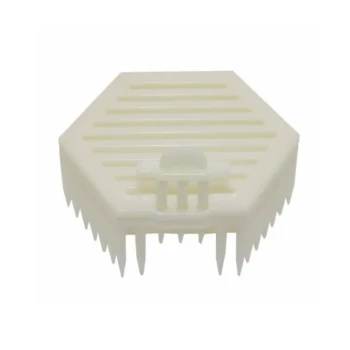
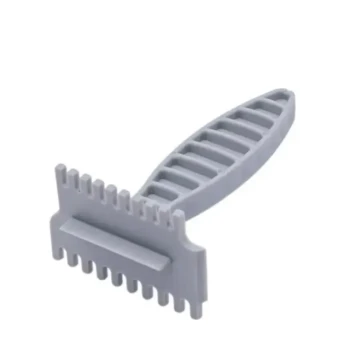
A queen-excluder comb cage is a precision instrument designed to restrict a queen bee to specific experimental combs for the purpose of timed egg-laying. By physically confining the queen to a targeted area, the device ensures that all eggs on the comb are laid within a narrow, defined timeframe. This creates a population of worker bee larvae with synchronized ages, which is a fundamental requirement for controlled biological experiments.
Core Takeaway In scientific research, variable larval age can skew data and invalidate results. The queen-excluder comb cage eliminates this variable by forcing the queen to lay eggs simultaneously on specific substrates, allowing researchers to isolate and measure the exact effects of environmental factors—such as beeswax composition—on honey bee physiology.
The Role of Synchronization in Research
Achieving Uniform Larval Age
The primary utility of the comb cage is standardization. In a natural hive setting, a queen lays eggs continuously across various frames, resulting in a brood pattern with mixed developmental stages.
By confining the queen to a specific comb for a set period, researchers ensure every egg on that comb is approximately the same age. This allows for the study of larvae that develop in unison.
Isolating Experimental Variables
When studying physiological indicators, researchers must control all external variables. If larvae are at different developmental stages, their physiological responses to treatments will vary naturally, obscuring the data.
Using a comb cage allows scientists to attribute observed changes directly to the experimental condition (such as the type of beeswax substrate used) rather than the natural variation in larval age or health.
Distinguishing the "Comb Cage" from Standard Excluders
The Comb Cage vs. The Hive Body Excluder
It is critical to distinguish the comb cage from the standard queen excluder often used in general beekeeping and royal jelly production.
A standard queen excluder separates entire hive bodies (vertically), restricting the queen to a lower box while allowing workers to pass through to an upper box. This is typically used to create queenless environments for royal jelly production or to help beekeepers locate the queen by narrowing her location to a specific box.
Precision vs. Production
While the standard excluder manages the colony's spatial organization for production efficiency (honey or royal jelly), the comb cage manages time.
The comb cage is a micro-management tool specifically for research and breeding precision, whereas the standard excluder is a macro-management tool for hive logistics.
Understanding the Trade-offs
Stress on the Queen
Confinement is an artificial condition. Restricting a queen to a small cage for an extended period can induce stress, potentially affecting her laying rate or the colony's behavior toward her.
Space Limitations
Because the queen is confined to a single comb or section, she may run out of empty cells if left too long. This requires precise timing by the researcher to release the queen or remove the cage before the limited space impacts the experiment.
Making the Right Choice for Your Goal
Whether you need a comb cage or a standard excluder depends entirely on the level of precision your project requires.
- If your primary focus is controlled research: You must use a comb cage to ensure all larvae are the exact same age, allowing for accurate physiological comparison between experimental groups.
- If your primary focus is production (Royal Jelly/Honey): You should use a standard queen excluder to restrict the queen to the brood chamber, allowing workers to maintain production in the upper hive bodies without queen interference.
Precision in equipment selection leads to precision in data; choose the tool that aligns with your specific need for either spatial separation or temporal synchronization.
Summary Table:
| Feature | Queen-Excluder Comb Cage | Standard Queen Excluder |
|---|---|---|
| Primary Goal | Temporal Synchronization (Timed Laying) | Spatial Organization (Honey/RJ Production) |
| Restriction Level | Confined to specific experimental combs | Confined to specific hive bodies |
| Larval Age | Uniform/Synchronized age groups | Mixed developmental stages |
| Best Used For | Scientific research & breeding experiments | Commercial honey & royal jelly production |
| Key Benefit | Eliminates larval age as a variable | Prevents queen from laying in honey supers |
Elevate Your Apiary with HONESTBEE Precision Equipment
Whether you are a commercial apiary manager or a global distributor, HONESTBEE provides the professional-grade tools necessary for both high-yield production and precise biological research. From specialized queen-excluder comb cages and hive-making machinery to honey-filling systems and essential industry consumables, our comprehensive wholesale portfolio is designed to meet the rigorous demands of the modern beekeeping industry.
Ready to streamline your operations or stock the highest quality beekeeping hardware?
Contact us today to discuss your wholesale needs and discover the HONESTBEE advantage in reliability and innovation.
References
- Aneta Strachecka, Mariusz Gagoś. How does adulteration of wax foundation affect phenoloxidase and lysozyme activities as selected parameters of immunity in <i>Apis mellifera</i>?. DOI: 10.2478/jvetres-2024-0040
This article is also based on technical information from HonestBee Knowledge Base .
Related Products
- Professional Bamboo Queen Isolation Cage
- Professional Queen Catcher and Introduction Queen Cage
- Hexagonal Direct Comb Introduction Queen Bee Cage
- Wood and Mesh Push-In Queen Cage
- Premium Wood Framed Metal Wire Queen Bee Excluder
People Also Ask
- Why are specialized queen bee cages used for the banking of mated queen bees? Maximize Commercial Apiary Storage Efficiency
- What is the mechanism of action for using temporary queen bee cages? Master Successful Queen Introduction
- How does the side ventilation design of a queen bee cage impact the safety of the queen during long-distance transport?
- What should you do if the queen is still in the cage and the worker bees have not accepted her? Protect Your Colony from Queen Rejection
- What technical precaution must be taken regarding the mesh or grill side of a queen bee cage? Ensure Queen Survival