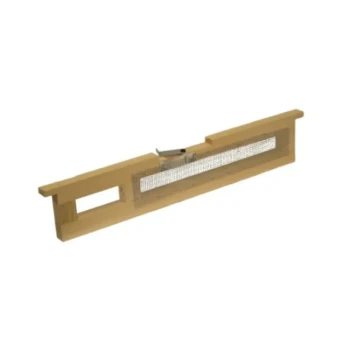
The primary purpose of a wooden frame cage with glass and stainless steel mesh sides is to provide a secure, controlled environment for honeybee containment and observation. This specialized apparatus allows researchers to visually monitor bee status without physical disturbance while ensuring maximum ventilation, which is critical for physiological procedures such as anesthesia.
This tool resolves the tension between containment and accessibility. It allows for the rapid, uniform diffusion of gases like carbon dioxide for anesthesia, while simultaneously offering a clear window into bee behavior without the need to open the enclosure.
The Principles of Design and Function
Non-Intrusive Monitoring
The inclusion of glass panels is a strategic design choice that prioritizes the stability of the subject's environment.
It allows researchers to conduct continuous visual checks on the bees' health and activity levels.
Because the cage does not need to be opened for these checks, the bees remain undisturbed, reducing stress variables that could skew experimental data.
Optimized Ventilation Dynamics
The stainless steel mesh sides are not merely for containment; they are the functional core of the cage's environmental control system.
This mesh ensures high airflow, preventing the buildup of heat or humidity that could occur in a fully enclosed glass or wooden box.
The durability of stainless steel also prevents bees from chewing through the enclosure, ensuring long-term security during experiments.
The Critical Role in Anesthesia
Rapid Gas Diffusion
The most distinct advantage of this cage configuration is its performance during carbon dioxide (CO2) anesthesia.
In many experimental protocols, bees must be temporarily sedated for handling or treatment.
The mesh sides allow the sedative gas to permeate the cage immediately and diffuse uniformly.
Consistency in Treatment
Uniform diffusion is vital for scientific rigor.
It ensures that all bees within the cage receive the same exposure level simultaneously, preventing instances where some bees are overdosed while others remain active.
This standardization is essential for reproducibility when comparing physiological responses across different test groups.
Understanding the Trade-offs
Artificial Constraints
While excellent for short-term containment and specific interventions, this cage is an artificial environment.
It does not replicate the complex social or spatial structure of a natural hive, meaning it is less suitable for long-term colony behavior studies compared to standard Langstroth or nucleus hives.
Thermal Vulnerability
The high ventilation provided by the mesh, while good for gas exchange, makes the cage susceptible to ambient temperature fluctuations.
Unlike a wooden hive which offers insulation, this cage offers little thermal buffering, requiring the laboratory environment to be strictly temperature-controlled.
Making the Right Choice for Your Goal
To determine if this specific apparatus is the right tool for your research, consider your primary experimental variables:
- If your primary focus is physiological intervention: This cage is the superior choice due to the mesh sides that facilitate rapid and uniform CO2 anesthesia.
- If your primary focus is visual monitoring: The glass panels provide the necessary visibility to observe status without introducing the stress of handling.
By selecting equipment that balances visibility with ventilation, you ensure that your data reflects the bees' biological reality rather than their reaction to the containment itself.
Summary Table:
| Feature | Material | Primary Function in Experiments |
|---|---|---|
| Observation Window | Glass Panels | Allows visual monitoring without disturbing the bees' environment. |
| Airflow & Gas Exchange | Stainless Steel Mesh | Facilitates rapid, uniform diffusion of CO2 for consistent anesthesia. |
| Structural Integrity | Wooden Frame | Provides a lightweight, stable, and durable housing structure. |
| Safety & Security | Stainless Steel | Prevents bees from chewing through the enclosure during studies. |
Elevate Your Apiary Operations with HONESTBEE
At HONESTBEE, we understand that precision is the foundation of success for commercial apiaries and distributors. Whether you are conducting refined research or scaling industrial honey production, our comprehensive wholesale portfolio delivers the specialized tools you need.
Why partner with us?
- Advanced Machinery: From high-efficiency honey-filling machines to professional hive-making equipment.
- Premium Essentials: A full spectrum of beekeeping tools, durable hardware, and high-quality industry consumables.
- Diverse Portfolio: Unique honey-themed cultural merchandise to expand your retail reach.
Ready to enhance your efficiency and output? Contact us today to discover how HONESTBEE’s professional-grade equipment and machinery can transform your beekeeping business.
References
- Daniel Stec, Karolina Kuszewska. CO<sub>2</sub> narcosis influences the memory of honey bees. DOI: 10.1080/00218839.2019.1710028
This article is also based on technical information from HonestBee Knowledge Base .
Related Products
- Classic Wooden and Mesh California Queen Cage
- Wood and Mesh Push-In Queen Cage
- Premium Wood and Steel Push In Queen Cage
- Professional Wooden Requeening Frame for Beekeeping
- Assembled Wooden Bee Frames with Beeswax Foundation Ready to Use by HONESTBEE
People Also Ask
- How are queen cages used to protect newly hatched queens? Secure Your Virgin Queens During Development
- Why are queen cages or grid cages used in bee studies? Achieve Precise Biological Data for Research
- Why are professional queen cages necessary for queen replacement? Secure Your Apiary’s Future
- What should be done if bees damage the queen cage? Secure Your Queen with These Emergency Intervention Steps
- What is the correct procedure for installing a queen cage into a new hive? A Pro Guide for Colony Success