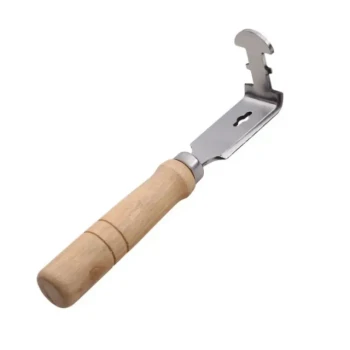
Professional bee colony inspection tools act as the critical interface for conducting rigorous, on-site clinical examinations. By facilitating the identification of specific disease markers—such as the sunken cappings of American Foulbrood (AFB), the larval discoloration of European Foulbrood (EFB), or the trembling associated with Chronic Bee Paralysis Virus (CBPV)—these tools ensure that health observations are both accurate and clinically valid.
Core Takeaway While individual diagnosis is the immediate function, the broader role of professional inspection tools is to establish a unified standard for data collection. They transform subjective observations into comparable, quantitative metrics, enabling precise health tracking and management across large-scale, cross-regional apiaries.
The Foundation of Clinical Accuracy
Identifying Pathogenic Symptoms
The primary role of inspection tools is to enable the detection of subtle physiological changes in the colony. Inspectors rely on these instruments to uncover specific symptoms that untrained eyes might miss.
For example, tools help visualize sunken cappings or larval discoloration, which are definitive signs of AFB and EFB respectively. They also assist in observing behavioral anomalies, such as the bee trembling characteristic of CBPV.
Standardizing Clinical Observations
In large-scale assessments, consistency is more valuable than isolated accuracy. Professional tools serve as foundational hardware that ensures every inspector is looking at the hive through the same lens.
This standardization removes variability caused by inspector experience levels. It ensures that a clinical observation made in one region is statistically comparable to one made in another.
Establishing Quantitative Benchmarks
Spatial Benchmarks for Population Analysis
Beyond disease detection, standardized tools—specifically beehive frames—act as spatial measuring sticks. They allow technicians to quantify colony strength by measuring the percentage of adult bee coverage.
By counting capped and uncapped brood cells against the known surface area of a standard frame, experts can objectively calculate reproductive capacity. This data is vital for assessing the impact of pathogens like Nosema microsporidians on colony growth.
Precision Through Hardware Uniformity
Reliable assessment requires reliable hardware. Professional hive-making machines use CNC technology to manufacture components with extreme physical uniformity.
This hardware standardization is a prerequisite for using advanced monitoring equipment. It ensures that electronic scales and sensor mounts fit perfectly, generating comparable health indices across different research institutions.
Non-Invasive Monitoring and Dynamics
Weight as a Health Indicator
Industrial-grade electronic weighing devices provide a data-driven view of colony dynamics without disturbing the hive. By measuring total mass, apiarists can calculate average bee weight and resource reserves.
This method allows for the prediction of negative pathogen impacts, such as those from Varroa mites. Significant fluctuations in hive weight often signal a decline in vitality before visual symptoms appear.
Environmental Sensing
Multi-functional sensor equipment expands the assessment role to include real-time environmental data. These tools monitor critical metrics like temperature, humidity, and CO2 concentrations.
This technology enables the assessment of physiological status without the stress of opening the hive. It allows for the rapid identification of abnormal colonies, optimizing maintenance routes for commercial efficiency.
Understanding the Trade-offs
Disturbance vs. Detail
There is an inherent trade-off between the depth of data and colony stress. Manual inspection tools provide the most detailed disease diagnosis (e.g., seeing EFB larvae) but require dismantling the hive, which disrupts colony productivity.
Conversely, remote sensors and scales offer non-invasive data but may miss early visual signs of brood disease. Reliance solely on weight data might delay the diagnosis of a pathogen that does not immediately impact colony mass.
Standardization vs. Local Adaptation
While standardized hardware (CNC hives) is essential for cross-regional comparison, it can be rigid. Strict adherence to unified equipment standards may not account for local micro-climates or specific subspecies behaviors that usually require modified hive structures.
Making the Right Choice for Your Assessment Strategy
To select the correct tooling strategy, you must define the primary goal of your health assessment program:
- If your primary focus is specific disease eradication: Prioritize manual inspection tools that allow for the visual identification of clinical symptoms like AFB and EFB.
- If your primary focus is productivity and efficiency: Implement high-precision weighing scales and sensors to track yield and vigor without disrupting the colony.
- If your primary focus is cross-regional research: Ensure all physical hardware (frames and hives) is manufactured via CNC to guaranteed specifications to ensure data comparability.
Success in large-scale apiary management comes from combining the diagnostic precision of manual tools with the scalable, data-driven insights of automated monitoring systems.
Summary Table:
| Tool Category | Primary Role in Assessment | Key Metric / Symptom Detected |
|---|---|---|
| Manual Inspection Tools | Clinical diagnosis & visual verification | AFB/EFB symptoms, larval health, brood patterns |
| CNC-Standardized Frames | Spatial benchmarks & population analysis | Bee coverage %, reproductive capacity, colony strength |
| Electronic Scales | Non-invasive vitality monitoring | Resource reserves, hive weight fluctuations, Varroa impact |
| Environmental Sensors | Real-time physiological tracking | Internal temperature, humidity, and CO2 concentrations |
Elevate Your Commercial Beekeeping with HONESTBEE
Precision health assessments require precision hardware. HONESTBEE empowers commercial apiaries and distributors with high-performance tools designed for the demands of large-scale operations. From CNC-manufactured hives that ensure data consistency across regions to advanced honey-filling and hive-making machinery, we provide the full spectrum of industrial-grade equipment.
Why partner with HONESTBEE?
- Wholesale Excellence: Comprehensive supply of tools, machinery, and essential consumables.
- Standardized Quality: Precision hardware for accurate, cross-regional data collection.
- Expert Support: Specialized solutions tailored to professional beekeeping and distribution.
Ready to optimize your apiary’s health and productivity? Contact HONESTBEE today to discuss our wholesale offerings and equipment solutions!
References
- Marie‐Pierre Chauzat, Magali Ribière-Chabert. Risk indicators affecting honeybee colony survival in Europe: one year of surveillance. DOI: 10.1007/s13592-016-0440-z
This article is also based on technical information from HonestBee Knowledge Base .
Related Products
- Professional Dual-End Stainless Steel Hive Tool for Beekeeping
- Professional Bee Frame Wiring Tool with Integrated Tensioning System by HONESTBEE
- Professional Multi-Function Stainless Steel Hive Tool
- HONESTBEE Professional Mini J-Hook Hive Tool for Beekeeping
- Professional Stainless Steel Pry-Bar Hive Tool
People Also Ask
- What specific challenges do beekeeping hive tools address during hive maintenance? Essential Solutions for Apiaries
- Why are professional hive tools considered indispensable? Master Beekeeping Maintenance with Precision Leverage
- What is the role of professional hive tools in routine apiary maintenance? Expert Tips for Hive Health and Longevity
- What role do professional beehives and beekeeping tools play in honey prosumption? Scale yield & commercial success.
- What are the primary functions of a stainless steel hive tool? Essential Equipment for Professional Beekeeping