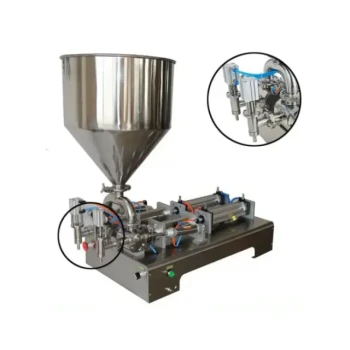
Strict adherence to net mass standards is the cornerstone of ethical industrial food processing. To comply with honey quality and food labeling standards, filling and weighing machinery must calculate the weight of the honey alone, rigorously excluding all packaging components such as glass jars, caps, and labels.
The core objective is trade fairness: the consumer must receive exactly the amount of product declared on the label, necessitating high-precision equipment to strictly distinguish between the consumable product and its container.
The Imperative of Net Mass
Defining True Product Weight
In industrial contexts, net mass refers exclusively to the consumable product.
The weight of the container, seal, and label is known as tare weight. Industrial machinery is calibrated to subtract the tare weight from the gross weight (total weight) to ensure the final calculation reflects only the honey.
Meeting Regulatory Standards
Governments and trade organizations enforce strict labeling laws.
If a label declares 500g of honey, the package must contain 500g of actual honey. Including the weight of the jar in this figure is a violation of trade fairness and can lead to significant legal penalties and product recalls.
Building Consumer Trust
Precision creates reputation.
When customers purchase a product, they are paying for the content, not the packaging. Ensuring the actual amount matches the label declaration is essential for maintaining consumer confidence and brand integrity.
The Role of High-Precision Equipment
Automated Accuracy
Manual weighing is prone to human error and inconsistency.
Industrial-grade filling machines utilize high-precision automated metering. This technology ensures that every single unit processed meets the exact weight requirements, eliminating the variance found in manual operations.
Achieving Product Uniformity
High-end markets demand consistency.
Beyond simple compliance, industrial machines ensure uniformity across finished products. This level of standardization is critical for accessing premium markets, particularly when dealing with high-value goods like organic honey.
Understanding the Operational Trade-offs
The Cost of Precision vs. Product Giveaway
Investing in high-precision machinery requires a higher upfront capital expenditure.
However, using lower-precision equipment often leads to "product giveaway"—overfilling jars to ensure minimum compliance. Over time, giving away even a few grams of honey per jar creates a substantial financial loss that often exceeds the cost of better equipment.
Weighing vs. Contamination Control
While weight accuracy is the primary metric for fairness, it cannot come at the cost of hygiene.
Advanced machinery must balance weighing speed with aseptic packaging technologies. For organic certification, the equipment must ensure purity and prevent secondary contamination during the filling process, proving that weight precision and hygiene must operate in tandem.
Making the Right Choice for Your Production Line
To select the appropriate machinery, you must align your equipment capabilities with your specific business objectives.
- If your primary focus is Regulatory Compliance: Ensure your machinery features automated tare adjustment to guarantee the net mass matches the label declaration without exception.
- If your primary focus is Market Expansion: Prioritize equipment that combines high-precision weighing with aseptic technology to meet the strict entry requirements of the high-end organic market.
Precision in weighing is not merely a legal obligation; it is the fundamental metric of your brand's integrity.
Summary Table:
| Key Metric | Definition | Importance in Honey Filling |
|---|---|---|
| Net Mass | Weight of honey only | Ensures consumer receives the exact amount paid for. |
| Tare Weight | Weight of jar, cap, and seal | Must be excluded to meet global labeling standards. |
| Gross Weight | Total weight (Product + Package) | Used by logistics; irrelevant for food content labeling. |
| Product Giveaway | Excess honey filled per jar | Prevented by high-precision machinery to save costs. |
Elevate Your Honey Production with HONESTBEE Precision
At HONESTBEE, we understand that for commercial apiaries and distributors, every gram counts toward your bottom line and brand reputation. Our high-precision honey-filling and weighing machines are designed to eliminate 'product giveaway' and ensure 100% compliance with international net mass standards.
From automated hive-making equipment to aseptic honey-filling systems and industry consumables, we provide a comprehensive wholesale portfolio tailored to scale your operations. Partner with HONESTBEE to access the specialized machinery and cultural merchandise you need to dominate the premium honey market.
Contact Our Technical Experts Today to optimize your production line for maximum efficiency and integrity.
References
- Suzana Vidaković Knežević, Milica Živkov Baloš. LABEL ANALYSIS OF SERBIAN HONEY: WHAT DOES (NOT) THE LABEL TELL US?. DOI: 10.46784/e-avm.v10i2.70
This article is also based on technical information from HonestBee Knowledge Base .
Related Products
- Precision Durable Efficient HONESTBEE Rotary Honey Filling Machine
- Commercial Rotary Honey Filling Machine for Production
- Automatic Honey Filling and Filtering Machine for Beekeeping Bottle Filling
- Fully Automatic Honey Filling Packaging Machine for Processing Line
- Economy Small Honey Filling Machine Honey Bottle Filler Packaging Machine
People Also Ask
- How do honey filling and processing machines aid native bee product conservation? Boost Value with HONESTBEE Technology
- What are the common types of bottling machines used for honey? Choosing the Right Solution for Your Apiary
- What quality control role does professional honey filling equipment perform? Ensure Consistency and Product Stability
- How do honey filling machines work? Achieve Precision & Speed for Your Apiary
- What is a key feature of the new generation of the honey filling machine? The Advanced Electronic Control Unit