All Questions
What Are The Construction Specifications For Single Wall Clean-In-Place (Cip) Tanks? Industrial Durability Standards
Learn why 11 gauge 304 stainless steel is the standard for single wall CIP tanks to ensure durability and corrosion resistance.
What Are The Construction Specifications And Size Range For Clean-Out-Of-Place (Cop) Wash Tanks? Expert Insights
Learn about COP wash tank specs: 14 gauge 304 stainless steel construction and capacities ranging from 100 to 300 gallons for sanitary cleaning.
What Material Is Typically Used For Sanitary Fittings In Honey Processing Equipment? Choose 304 Stainless Steel
Learn why 304 stainless steel is the industry standard for honey processing, preventing corrosion and ensuring food safety compliance.
What Range Of Custom Equipment Can Be Fabricated For Honey Processing Operations? Optimize Your Apiary Production
Discover custom honey processing equipment: from heavy-duty tanks and reactors to mobile platforms and automated filling systems.
What Custom Equipment Is Available For Initial Honey Processing? Optimize Extraction With Precision Machinery
Discover custom honey extractors, wax spinners, and filtration systems designed for efficient, high-purity honey production.
What Are The Steps Involved In The Honey Processing Procedure? A Comprehensive Guide To Modern Honey Extraction
Learn the 4 key stages of honey processing: extraction, filtration, homogenization, and packaging to ensure product quality and shelf life.
What Is The Importance Of Using Quality Honey Processing Equipment? Secure Purity & Maximize Efficiency
Discover why high-quality honey processing equipment is essential for ensuring product purity, safety compliance, and operational efficiency.
What Are The Essential Factors To Consider When Choosing Honey Processing Equipment? Optimize Your Apiary's Efficiency
Learn how to select the right honey processing equipment by balancing scale, budget, and quality to maximize your production and purity.
What Is The Importance Of Honey Pasteurization? Ensure Biological Stability And Long-Term Shelf Life
Learn why honey pasteurization is essential for eliminating yeast, preventing fermentation, and ensuring commercial shelf stability.
How Do Automatic Honey Processing Machines Enhance Efficiency In Honey Production? Boost Your Apiary's Roi And Yield
Learn how automatic honey processing machines optimize extraction, preserve combs, and streamline filling for commercial-scale honey production.
What Are The Advantages Of Using A Honey Concentrator Machine In Apiculture? Boost Quality & Shelf Life
Learn how honey concentrators reduce moisture, prevent fermentation, and improve texture to meet commercial standards for premium honey production.
What Methods Can Be Employed To Reduce The Moisture Content In Honey? Optimize Quality And Prevent Fermentation
Learn effective honey moisture reduction techniques: from dehumidification and air circulation to industrial vacuum concentration.
What Does Honey Processing Entail? Mastering Extraction And Refining For Premium Quality
Learn the essential stages of honey processing: from uncapping and extraction to filtration and stabilization for commercial success.
How Does Bulk Processing Of Honey Work? Efficiency And Quality At Scale For Commercial Producers
Learn the professional steps of bulk honey processing: thermal conditioning, gravity filtration, and the essential 3-day settling rule.
What Materials Are Approved For Modern Honey Processing Equipment? Choose Stainless Steel For Safety
Learn why 304/316 stainless steel and food-grade plastics are the only approved materials for honey processing to prevent metal contamination.
What Are The Best Practices For Harvesting Honey To Ensure It Has A Low Moisture Content? Achieve Premium Quality Honey
Learn the best practices for harvesting low-moisture honey, from identifying capped frames to timing your harvest to avoid fermentation.
What Can Be Done With The Wax And Honey Residue Left After Extraction? Turn Byproducts Into High-Value Assets
Learn how to process extraction residue into pure beeswax through thermal separation and washing for candles, cosmetics, and hive maintenance.
What Core Functions Do Professional Honey Processing Plants Perform? Enhance Your Global Export Competitiveness
Discover how professional honey processing plants use dehydration, filtration, and automation to meet international export standards.
What Role Does Industrial-Grade Hygienic Honey Processing Equipment Play? Ensuring Quality And Medicinal Integrity
Learn how industrial-grade honey equipment ensures sterility, preserves nutrients like phenolic compounds, and extends shelf life for retail.
What Are The Key Functions Of Constant Temperature Storage For Honey & Royal Jelly? Protect Quality & Market Value
Learn how constant temperature storage prevents HMF formation, crystallization, and bioactivity loss in premium bee products.
Why Are Specialized Extraction Tools And Low-Temperature Centrifuges Required For Processing Royal Jelly? Key Insights
Learn why specialized tools and low-temperature centrifuges are vital to preserve royal jelly bioactivity and 10-HDA stability during processing.
What Are The Advantages Of Flash Pasteurization Equipment? Preserve Honey Quality With 72°C/15S Tech
Discover how flash pasteurization at 72°C for 15s protects honey’s biological value, prevents darkening, and ensures food safety.
Why Is The Use Of Temperature-Controlled Storage Tanks Essential For Honey? Secure Quality And Prevent Fermentation
Learn how temperature-controlled storage tanks preserve honey quality by preventing fermentation and maintaining chemical integrity.
Why Is A High-Precision Benchtop Ph Meter Necessary For Honey? Ensure Accuracy Over Color-Biased Test Strips
Discover why benchtop pH meters are essential for honey analysis, offering precise, color-independent readings for quality control and safety.
Why Is A Centralizing Decanter Essential For The Post-Harvest Processing Of Honey? Improve Purity & Protect Equipment
Learn why centralizing decanters are vital for honey purification, removing wax and air to protect fine filters and ensure high-quality results.
Why Is Industrial Drying Equipment A Core Component For Bee Pollen Stability? Ensure Premium Product Preservation
Learn how industrial drying equipment stabilizes bee pollen by reducing water activity to 0.3, halting spoilage while preserving key nutrients.
How Does An Industrial Box Resistance Furnace Facilitate The Determination Of Ash Content In Stingless Bee Honey?
Learn how box resistance furnaces enable precise ash content analysis in honey through high-temperature mineralization and organic combustion.
What Is The Application Value Of Honey Analysis And Testing Equipment In Organic Honey Production? Secure Your Purity.
Learn how honey testing equipment validates organic integrity, detects contaminants, and builds market trust through data-driven traceability.
What Role Does Professional Processing Equipment Play In Bee By-Products? Transform Raw Output Into High-Value Ingredients
Learn how professional equipment like wax melters and filtration systems refine beeswax and propolis for pharmaceutical and cosmetic use.
What Is The General Process For Infusing Honey With Natural Flavorings For Commercial Purposes? Scaling Your Production
Master the 4-step commercial honey infusion process: integration, melding, filtration, and packaging for premium flavored honey production.
What Maintenance Is Required For Large Batches Of Honey During The Infusion Period? Professional Scale-Up Guide
Master large-batch honey infusion with expert tips on periodic stirring, overcoming separation, and ensuring uniform flavor consistency.
How Does Professional Emulsification Equipment Ensure The Quality Of Honey-Based Cosmetics? Master Premium Skincare.
Learn how high shear force and professional emulsification create stable, high-end honey-based creams with superior skin feel and absorption.
What Key Industrial Infrastructure Is Necessary To Stabilize The Honey Processing And Trade Supply Chain? | Honestbee
Discover how temperature-controlled storage, vacuum dehydration, and automated packaging stabilize the global honey supply chain and boost trade.
What Is The Critical Function Of Standardized Acid-Base Titration Devices? Ensure Honey Compliance & Sensory Quality
Learn how standardized acid-base titration devices verify honey free acidity after organic acid treatments to ensure global market compliance.
What Environmental Conditions Are Required For A Professional Honey Processing Space? Ensure Purity And Quality
Learn the essential environmental requirements for professional honey processing, from humidity control to contamination prevention.
Why Use Specialized Vacuum Honey Suction Machines For Stingless Bee Honey? Protect Your Colony & Purity
Learn why suction-based extraction is essential for stingless bee honey harvesting to preserve hive structures and ensure medical-grade purity.
Why Are Refined Harvesting Tools And Specialized Separation Equipment Necessary For Monofloral And Gi Honey Production?
Learn how specialized equipment preserves the chemical markers and purity required for high-value monofloral and GI honey certification.
What Is The Primary Function Of Professional Solvent Extraction Equipment In Propolis Processing? Boost Your Yields
Learn how professional solvent extraction isolates bioactive compounds and standardizes propolis for commercial markets.
Why Is The Selection Of Specific Rotor Specifications Necessary For Measuring Honey Viscosity? Achieve Precise Accuracy
Learn why correct rotor selection is vital for honey viscosity measurement to ensure accurate torque, minimize edge effects, and optimize data.
How Does An Industrial-Grade Muffle Furnace Operate For Honey Ash Determination? Ensure Precise Mineral Analysis
Learn how muffle furnaces use 600°C oxidation to determine honey ash content, classifying blossom vs. honeydew honey with industrial precision.
Why Is The Establishment Of Integrated Processing Centers Critical For Large-Scale Beekeeping? Scale Your Apiary Business
Learn how integrated processing and supply chain management solve scalability issues, ensure quality, and bridge the gap to global honey markets.
Why Is Industrial-Grade Stainless Steel Processing Equipment Required For Honey Harvesting? Ensure Purity & Compliance
Discover why industrial-grade stainless steel is essential for honey processing to prevent contamination and ensure analytical precision.
How Does Laboratory Sugar Analysis Equipment Assist In Honey Adulteration Identification? Detect Fraud & Ensure Purity
Learn how sugar analysis equipment uses chemical ratios and optical rotation to detect honey adulteration and ensure regulatory compliance.
What Is The Contribution Of Ph Meters And Acidity Titration Equipment To The Quality Control Of Honey? Ensuring Purity
Learn how pH meters and acidity titration equipment ensure honey safety, freshness, and authenticity by detecting fermentation and spoilage early.
What Are The Core Functions Of Standardized Processing Units In Honey Deep Processing? Enhance Purity & Stability
Learn how honey processing units use precise dehydration and filtration to stabilize moisture, remove impurities, and extend shelf life.
What Is The Function Of High-Power Optical Microscopes In Honey Analysis? Ensure Authenticity And Botanical Traceability
Learn how high-power optical microscopes and digital imaging identify pollen grains to verify honey origin and detect adulteration effectively.
Why Is A Laboratory Centrifuge Necessary During The Honey Pollen Concentration Process? Essential For Pollen Analysis
Learn how laboratory centrifuges isolate trace pollen from honey using centrifugal force to enable accurate floral origin analysis.
Why Is A High-Sensitivity Digital Ph Meter Required? Ensure Honey Quality, Safety, And Purity
Learn why high-sensitivity digital pH meters are essential for detecting honey spoilage, adulteration, and ensuring microbial safety.
What Role Does A Uv-Visible Spectrophotometer Play In Determining The Hmf Content Of Honey? Ensure Purity & Freshness
Learn how UV-Visible spectrophotometry quantifies HMF at 284nm and 336nm to detect heat damage, monitor storage, and verify honey authenticity.
How Do Modern Beekeeping Machinery And Automated Honey Processing Equipment Improve The Economic Efficiency? Boost Roi
Discover how automated extraction, hive-making machines, and moisture control systems increase yields by 27% and lower labor costs.
What Is The Function Of Stainless Steel Settling Tanks In Honey Processing? Achieve Natural Purity And Clarity
Learn how stainless steel settling tanks use gravity to clarify honey, remove impurities, and maintain nutritional quality.
How Do Haccp-Certified Honey Processing Facilities Contribute To The Honey Value Chain? Elevate Your Product Standards
Learn how HACCP-certified facilities transform raw honey into high-value exports through standardized safety and industrial-grade processing.
What Is The Function Of Professional Technical Support Services In Industrial Honey Lines? Secure Your Roi And Quality
Discover how professional technical support optimizes industrial honey processing through standardization, asset protection, and quality control.
How Do Modern Honey Harvesting, Filtration, And Filling Machines Ensure Quality? Advanced Tech For Pure Honey Yields
Learn how centrifugal extraction, multi-stage filtration, and sterile filling machines protect honey purity and extend shelf life.
How Does Modern Beekeeping Machinery Improve Honey Quality? Achieve Superior Purity With Honestbee Technology
Discover how centrifugal honey extractors enhance purity, preserve enzymes, and ensure international food safety standards vs manual squeezing.
How Do Temperature-Controlled Storage Facilities Ensure The Quality Of Honey? Protect Potency And Market Value
Learn how temperature control prevents honey fermentation and HMF increases while preserving royal jelly nutrients for maximum market value.
How Does High-Efficiency Honey Machinery Influence Aggressive Bee Colonies? Stabilize Management And Reduce Hive Stress
Discover how automated honey extraction and filling machinery reduces hive disturbance, prevents bee aggression, and ensures long-term colony stability.
How Does The Deep Processing Of Bee Products Contribute To Economic Efficiency? Unlock High-Value Apiculture Growth
Discover how deep processing transforms raw honey and wax into high-margin products, increasing revenue and market competitiveness in apiculture.
How Is The Optimal Intervention Timing Determined For Honey Equipment? Maximize Your Apiary's Efficiency
Learn how to optimize honey extraction timing to improve equipment turnover, ensure moisture quality, and maximize commercial apiary profits.
How Does Professional Honey Collection And Processing Equipment Influence Beekeepers? Maximize Profit & Market Access
Discover how professional honey equipment boosts beekeeper income through standardization, higher purity, and efficient by-product recovery.
What Are The Advantages Of Standardized Honey Processing? Radial Centrifuges & Facilities For Urban Honey Production
Discover the technical benefits of standardized honey facilities and radial centrifuges for yield maximization and food safety compliance.
What Technical Advantages Does A Specialized Honey Colorimeter Offer? Precision Grading With The Pfund Scale
Discover how honey colorimeters eliminate bias, provide precise Pfund scale values, and ensure consistent grading for international trade.
Why Must Honey Processing Equipment Possess Traceability Recording Functions When Preparing Organic Certified Honey?
Learn why traceability is vital for organic honey: ensuring purity, preventing cross-contamination, and meeting certification standards.
How Do Professional Honey Harvesting And Post-Processing Technologies Contribute To The Export Competitiveness?
Learn how advanced processing and harvesting technologies ensure honey quality, meet export standards, and maximize market value for global trade.
What Is The Function Of An Industrial-Grade Grinder For Propolis Ethanol Extract (Pee)? Optimize Resin Pre-Treatment
Learn how industrial-grade grinders maximize extraction efficiency and potency by transforming raw propolis into a high-surface-area powder.
How Do Honey Processing Machines Support Commercial Beekeeping? Scale Your Apiary With Automation And Precision
Learn how honey extractors and filling machines enhance hygiene, ensure precision, and drive profitability for commercial beekeeping operations.
What Technical Indicators Does A Rotational Viscometer Provide? Optimize Your Honey Processing Workflow
Learn how dynamic viscosity data from a rotational viscometer optimizes honey pump selection, filling accuracy, and pipeline pressure design.
How Does Honey Processing Equipment Contribute To The Quality Of Honey? Boost Your Marketability And Retail Value
Learn how professional honey processing equipment improves standardization, shelf life, and visual appeal to command premium market pricing.
Why Is Hygienic Design A Core Requirement For Honey Equipment? Ensure Global Safety Standards & Export Compliance
Learn how hygienic design in honey centrifuges and buckets prevents microbial contamination, ensures infant safety, and boosts honey purity.
Why Is Ultra-Low Temperature Freezing Equipment Required For Preserving Royal Jelly? Protect Your Bioactive Integrity
Learn why -22°C ultra-low freezing is vital for preserving the enzymatic stability and nutritional potency of royal jelly and bee pollen samples.
What Role Does Industrial Honey-Filling And Processing Machinery Play? Elevating Value In The Apiculture Chain
Discover how honey-filling and processing machinery bridge the gap between extraction and retail while maximizing economic value for apiaries.
How Does Food Processing Machinery Ensure Product Quality For Stingless Bee Honey Candies? Boost Consistency & Nutrients
Learn how food processing machinery preserves nutrients and ensures uniform texture when making value-added stingless bee honey products.
How Does Industrial Honey Processing Equipment Impact Marketability? Drive Profits With Superior Purity & Clarity
Learn how industrial-grade honey filtration and processing equipment enhances visual clarity, extends shelf life, and boosts market value.
What Is The Function Of Low-Temperature Freezing In Propolis Extraction? Boost Efficiency & Yield
Learn how industrial-grade freezing equipment transforms sticky raw propolis into a brittle solid to enable efficient pulverization and extraction.
Why Is High-Efficiency Crushing Equipment Necessary For Propolis Extracts? Unlock Maximum Bioactive Potency
Learn why high-efficiency crushing is essential for propolis extraction. Maximize flavonoid yield and ensure solvent penetration for premium extracts.
Why Should Apiaries Be Equipped With Modern Processing Equipment? Unlock High-Value Honey Markets
Learn how modern processing and temperature-controlled storage preserve honey nutrients, ensure purity, and meet export standards.
What Value Do Shared Honey Processing Units Provide? Unlock Commercial Efficiency And Higher Premiums For Producers
Discover how shared honey processing units empower beekeeping cooperatives with industrial equipment, lower costs, and premium product quality.
How Does The Propolis Grinding Process Increase The Extraction Rate? Maximize Yield With Advanced Processing Techniques
Learn how propolis grinding boosts extraction efficiency by expanding surface area and accelerating solvent penetration for higher bioactive yields.
What Are The Advantages Of Using A Vacuum Lyophilizer For Propolis? Preserve Potency & Solubility Effectively
Learn why vacuum lyophilization is superior to thermal evaporation for propolis, ensuring maximum bioactive retention and superior powder texture.
What Is The Primary Purpose Of Using An Industrial Electronic Crusher? Maximize Yield In Propolis & Seed Processing
Learn how industrial electronic crushers maximize extraction efficiency by increasing surface area for superior solvent interaction and yield.
Why Does Honey Weigh More Than Water For The Same Unit Of Volume? Understanding Honey Density & Mass
Discover why honey is 50% denser than water. Learn about specific gravity, chemical composition, and how density affects weight vs. volume.
How Do Industrial Honey Processing Machines Ensure Light Color & Mild Flavor? Master Precision Filtration & Thermal Care
Learn how multi-stage filtration and strict temperature controls in industrial honey machines preserve clarity and delicate flavor profiles.
What Specific Processing Requirements Existed For Honey Used In High-End Food? Expert Standards For Premium Formulations
Learn the strict standards for high-end honey processing, focusing on clarity, viscosity, and solubility for medicinal and gourmet applications.
How Does A High-Precision Ph Meter Assist In Honey Analysis? Unlocking Botanical Origin And Quality Standards
Learn how high-precision pH meters determine honey's botanical origin, verify processing quality, and detect early signs of fermentation.
What Information Does An Electrical Conductivity (Ec) Meter Provide? Unlock Honey Quality And Mineral Analysis
Learn how EC meters analyze minerals, organic acids, and proteins in honey to determine botanical origin and environmental impact.
What Is The Function Of A High-Temperature Muffle Furnace In Honey Ash Detection? Ensure Purity & Quality
Learn how muffle furnaces isolate minerals in honey through precision calcination to determine ash content, origin, and quality grading.
How Does Honey Refining And Processing Equipment Increase The Value Of Bee Products? Maximize Your Apiary Profits
Learn how professional honey refining equipment enhances product clarity, unlocks beeswax revenue, and ensures market-ready standardization.
What Are The Requirements For Temperature-Controlled Storage Equipment For Honey? Maximize Stability & Quality
Learn the essential requirements for honey storage equipment, focusing on precision temperature control and dry ventilation to manage crystallization.
How Do Professional Honey Filtration And Processing Equipment Contribute To The Purity And Market Grading? Boost Quality
Learn how professional filtration equipment ensures honey purity, stabilizes quality, and secures premium market grading for commercial success.
Why Are Automated Honey Processing Machines Essential? Scale Your Production From Artisan To Professional.
Learn how automated honey processing and filling machinery ensures quality, hygiene, and consistency for scaling your beekeeping business.
How Do The Facilities Within A Honey Processing Plant Influence Market Positioning? Unlock Premium Global Value
Discover how advanced honey processing facilities elevate purity, ensure biological stability, and enable high-value international exports.
What Are The Technical Objectives And Methods Of The Honey Pasteurization Process? Master Commercial Honey Stabilization
Learn the technical objectives and industrial methods of honey pasteurization, focusing on microbial control and commercial uniformity.
How Does Professional Honey Processing Machinery Improve Apiary Efficiency? Scale Your Commercial Success
Learn how professional honey processing and filling machinery boosts revenue, ensures quality, and streamlines commercial apiary operations.
What Are The Primary Advantages Of Using A Biological Incubator For Bee Bread Fermentation? Scale Your Production Fast
Discover how biological incubators slash bee bread fermentation from 17 days to 60 hours while ensuring consistent pH and quality.
What Roles Do Vacuum Chambers And Vacuum Pump Systems Play In The Production Of Bee Bread? Essential Spoilage Prevention
Learn how vacuum systems create anaerobic environments to inhibit bacteria, prevent oxidation, and preserve bee bread quality.
How Do Temperature-Controlled Storage Containers Influence Honey Toxicity? Ensure Safety With Controlled Aging
Learn how temperature-controlled storage reduces honey toxicity through the 'time effect' while preserving flavor and quality for large-scale production.
What Are The Specific Functions Of Isothermal Boxes And Polyethylene Containers For Melipona Beecheii Honey Collection?
Discover how isothermal boxes and polyethylene containers preserve the bioactivity and purity of Melipona beecheii honey during transport.
What Is The Function Of A Steam Generator In Beekeeping? Achieve Deep Sterilization For Hives And Equipment
Learn how steam generators use high-pressure, 100°C+ vapor to eliminate heat-resistant pathogens in hard-to-reach beekeeping equipment crevices.
How Do Industrial-Grade Uv Lamps Contribute To The Sanitation Of Beekeeping Facilities? Achieve Residue-Free Hygiene
Discover how industrial UV radiation lamps at 265 nm provide non-chemical disinfection for beekeeping facilities to protect bees and honey purity.
What Technical Challenges Do Industrial-Grade Honey Processing Plants Address In Export? Ensure Global Compliance.
Learn how industrial honey processing plants solve moisture control, impurity removal, and crystallization to meet strict global export standards.
Related Products
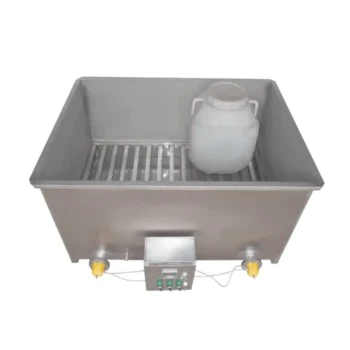
Heavy Duty Stainless Steel Honey Processing Machine Decrystallizing Tank

Electric Double Wall Honey Filtering Machine Purifier Equipment for Honey Processing Plant

Fully Automatic Honey Filling Packaging Machine for Processing Line

Electric Honey Press Machine for Squeezing Honey Comb Press Equipment

Commercial 48-Frame Stainless Steel Honey Extractor